
Lieferung heute & morgen

Qualitätsgarantie

Willkommens-Angebote freischalten: KOSTENLOSE Lieferung | Bis zu 80 % RABATT | Kostenlose 30-Tage-JoyPlus-Testphase
App herunterladen
Finding the right game for the family sounds simple at first. However, the range includes board games, card games, puzzle games and electronic games with very different requirements. Board games for children and families should therefore be chosen based on more than just their theme or brand recognition. Age, number of players, playing time, materials and the space actually required are all important factors.
A game for ages 6 and over is not automatically suitable for every child in this age group. Some children quickly get to grips with tactical rules, while others need a short introduction or help setting everything up. Small parts also present a choking risk for children under 3 years of age. The manufacturer’s age recommendation should therefore be treated as an essential selection criterion.
A game may be marketed for families but only be designed for two players. If you are planning a family games night, check the recommended number of players. Card games or party games for groups of four to twelve people are suitable for larger groups, for example, while strategy games for children are often limited to two to four players.
Terms such as “educationally valuable”, “creative” or “develops logical thinking” do not automatically describe how enjoyable or practical a game is for everyday use. Instead, check what the player actually has to do: match colours and numbers, plan routes, combine clues or solve spatial tasks. This makes it easier to judge whether the game is right for the child and the family.
For children’s games from age 6, clear rules and a manageable playing time are particularly important. Catan Junior, for example, is designed for two to four players aged 6 and over and uses simplified trading rules. Games for ages 8 or 10 and over may include several sets of rules, tactical decisions or longer rounds.
Also check whether adults should help with the initial set-up. This is normal with more comprehensive board games and is not a sign of poor quality.
The number of players affects the whole gaming experience. A cooperative board game in which everyone collects clues together works differently from a competitive game with individual victory points. With cooperative board games, families should check whether children can make active decisions or whether adults end up dictating too much of what happens.
For shorter rounds, card games such as UNO or simple two-player games are suitable. For longer games nights, consider family games involving planning, trading or route building.
A game board with lots of cards and playing pieces needs a dry, level playing surface. Compact boxes or folding game sets are more practical for travelling. The weight and external dimensions indicate whether a game will fit in a rucksack, suitcase or hand luggage.
With electronic games, you should also check the power requirements. Simon Classic, for example, requires 3 AAA batteries; according to the product details, test batteries are included. Battery-free educational and travel games have no ongoing battery costs. Small game pieces should be counted in full after every round and stored safely.
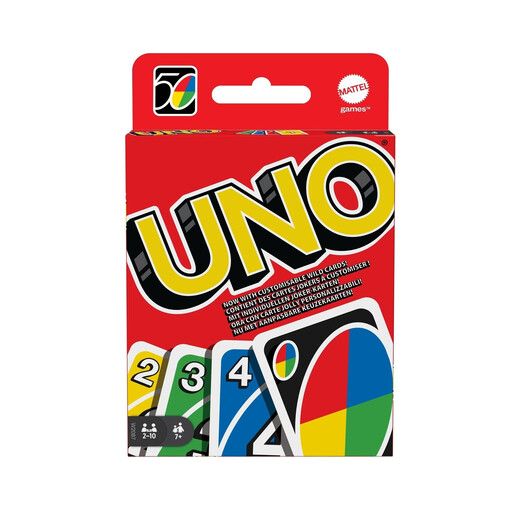
Why this product suits the profile: This card game takes up little space, requires no batteries and is designed for 2 to 10 players aged 7 and over. That makes it ideal for quick rounds at home, when visiting friends or family, or while travelling.
The number of players and recommended age are clearly stated. The compact card format reduces storage problems and there are no battery costs.
112 cards, colour and number matching, plus special cards such as Skip, Reverse and Draw Two.

Why this product suits the profile: The junior edition combines a pirate theme with simplified trading and hideout building. It is designed for 2 to 4 players aged 6 and over, making it ideal for playing together as a family.
The product details specify the recommended age, number of players, materials and dimensions of approximately 29.7 × 30.0 × 7.5 cm. This allows you to assess the space required before buying.
Game materials made from cardboard and plastic, simple rules for getting started, and a game objective involving seven built hideouts.
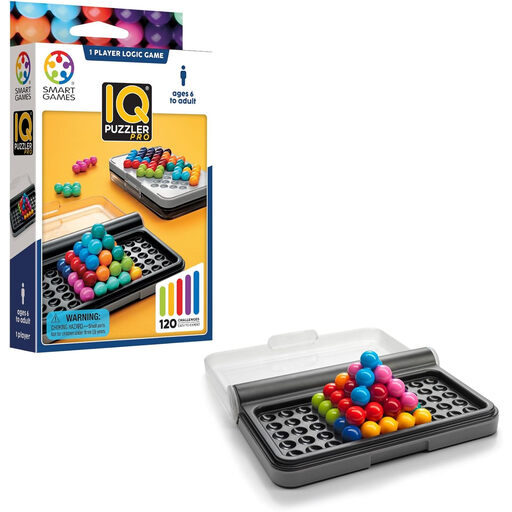
Why this product suits the profile: This solo game offers 120 challenges in two- and three-dimensional formats. Its compact dimensions make it suitable for children aged 6 and over who want to play independently at home or while travelling.
The set is listed as containing 13 pieces, with no batteries or assembly required. According to the description, the challenges increase in difficulty and are set out in the accompanying booklet.
120 challenges, solo play and a small, easy-to-transport format.
We have put together a complete, regularly updated list of products that fully meet these strict selection criteria and the safety regulations applicable in the EU.
For two players aged 6 and over, Connect 4 with a vertical grid and 42 playing discs is a good choice. If you are looking for a travel game for children aged 7 and over, consider Battleship Grab And Go, with its folding playing boards. For older children and adults, Ticket to Ride: Europe from age 8 or MicroMacro: Crime City from age 10 may be suitable. Both games require more table space and more time for learning the rules and playing.
Electronic puzzle games such as Hasbro Simon Classic are designed for one player aged 8 and over, according to the product details. The coloured light and sound signals mean the game does not depend on having other players, but batteries are required.
Games with a few basic rules, a limited playing time and a clear age rating are suitable. Catan Junior, Connect 4 and certain educational games for ages 6 or 7 and over offer different levels of difficulty. Suitability depends on the child’s stage of development and experience.
Lifespan depends mainly on the materials, storage and how the game is handled. Cardboard should be stored in a dry place and not cleaned with liquid. Count the game pieces after every round and keep them in the original box or in resealable bags. With electronic games, batteries should be removed before storing them for a longer period.
In addition to the purchase price, there may be battery costs. Check the type and number of batteries required. Games without electronics, such as UNO, Catan Junior or IQ-Puzzler PRO, do not incur ongoing energy costs during normal use.