
Lieferung heute & morgen

Qualitätsgarantie

Willkommens-Angebote freischalten: KOSTENLOSE Lieferung | Bis zu 80 % RABATT | Kostenlose 30-Tage-JoyPlus-Testphase
App herunterladen
Board games for children and families should provide long-lasting enjoyment, easy-to-understand rules and an experience suited to the players’ ages. In practice, however, a few common buying decisions can lead to disappointment: the game is too complicated, becomes uninteresting after a few rounds or is unsuitable for the planned group size. Checking a few details before buying can help you choose a game that fits your family much more closely.
“From 6 years” does not automatically mean that every child will understand the game without support. The amount of reading, the length of the rules, the playing time and the number of small game pieces are also important. A game involving strategic decisions may be suitable for a six-year-old, but could still require an introduction from an adult.
When choosing children’s board games, you should therefore consider not only the minimum age, but also the players’ stage of development. For younger children, short turns, clear objectives and only a few special rules are usually easier to understand.
A game for two to four people is of limited use to a family of five. Conversely, a game for up to ten players may lose some of its energy when played in a small group. Check whether the stated number of players suits typical situations: a family afternoon, a game night with friends, siblings playing together or travelling.
Descriptions such as “educational”, “strategic” or “for the whole family” are not, on their own, a sufficient basis for a purchase. Look for specific details such as age recommendation, number of players, material, playing time, language version and battery requirements. For games with app connectivity, you should also check whether a smartphone or internet access is required.
For board games from age 6, simple rules and a clear objective are often crucial. A game can still include tactical elements, provided children understand their decisions and adults do not have to control every round.
For children aged eight and over, more complex strategy games for children and families may be suitable. From age ten or twelve, longer texts, multi-stage puzzles and more abstract decisions can play a greater role.
Game pieces should be robustly made and suitable for their intended use. Cardboard, paper, wood and plastic are often combined. Before buying, it is worth checking:
The CE marking is a manufacturer’s declaration that relevant EU requirements have been met. It does not replace checking whether the game is suitable for the child’s age and supervision requirements.
A large game board needs enough clear space. For train journeys, holidays or waiting times, compact travel games or magnetic logic games are often more practical. Any potential ongoing costs should also be considered: some games require batteries, an app or additional accessories. Escape-room games may involve folding, writing on or cutting materials, meaning they can often only be played once.
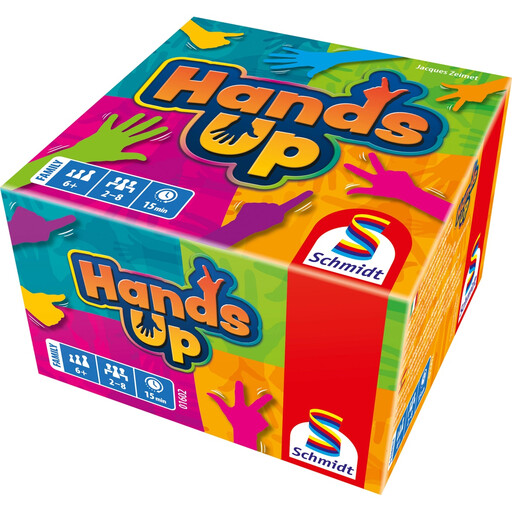
Why this product suits this profile: This compact card game is designed for players aged 6 and over and does not require batteries. It is ideal for quick rounds with family or friends.
The product details specify the age, dimensions of 10 × 10 × 6,8 cm and that no batteries are required. This makes it easier to assess the space and operating requirements before buying.
Sturdy cardboard cards, fast-paced turns and a focus on strategic thinking, memory and social interaction, according to the product description.

Why this product suits this profile: This junior version combines a familiar trading and building game with simplified trading rules. It is designed for 2 to 4 players aged 6 and over.
The simplified rules make it easier to get started than with a more complex adult version. The recommended supervision when setting up also takes the included small parts into account.
A pirate theme, collecting resources, trading and building seven hideouts create several interconnected game decisions.
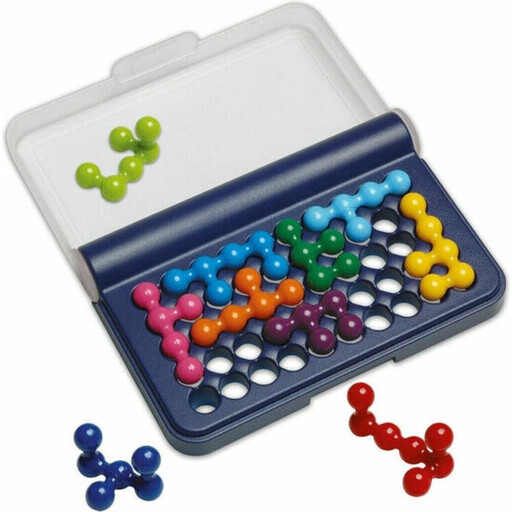
Why this product suits this profile: This solo game for children aged 6 and over is ideal for families looking for a compact educational game for quiet entertainment, travel or waiting times.
The product description specifies compact dimensions of 9,8 × 3,2 × 14,4 cm, one player and no battery operation. This clearly distinguishes it from a group game.
A compact plastic game with a challenge booklet and solutions; according to the product description, it focuses on spatial awareness and logical thinking.
We have put together a complete, regularly updated list of products that fully meet these strict selection criteria and the safety regulations applicable in the EU.
Depending on the occasion, different categories may be worth considering:
Games with clear sequences, concise rules and a manageable playing time are suitable. Catan Junior, Hands Up! and co-operative family games with an age recommendation of 6 and over can be good starting points. The actual suitability depends on the child and their need for support.
Their lifespan depends on the materials, storage and how they are handled. Cards and game boards should be stored somewhere dry and protected from light. A sorting box can help with games containing lots of small parts. One-play escape-room games are an exception, as cards or other materials may be altered during play.
Board games often have no ongoing costs, and many models do not require batteries. However, individual products may require an app, batteries or expansions. So do not compare only the purchase price; also consider the actual scope of use, the number of players and any potential additional costs.