
Lieferung heute & morgen

Qualitätsgarantie

Willkommens-Angebote freischalten: KOSTENLOSE Lieferung | Bis zu 80 % RABATT | Kostenlose 30-Tage-JoyPlus-Testphase
App herunterladen
Board games for children and families should bring different age groups together around the table, offer easy-to-understand rules and avoid disappearing into the cupboard after just one round. When choosing a game, a familiar theme or eye-catching packaging is not enough. The key factors are recommended age, number of players, playing time and game mechanics.
Family games for ages 5 and up, as well as board games for ages 6 or 8 and up, can often lead to disappointing purchases when important details only become apparent after opening the packaging.
‘Ages 6 and up’ is a general recommendation, but it does not automatically mean that every child will understand the rules without help. Games involving text, several exceptions or strategic decisions may have a higher barrier to entry in practice. Parents should therefore check whether younger children will find pictures, short turns and simple sequences of play.
A game for ages 8 and up is not necessarily suitable for every family game night either. Looking at the number of cards, amount of reading and concentration required can help you assess whether it is a good fit.
A game for four or more people is only of limited use in a two-player household. Conversely, a game for 2 to 4 players can lead to waiting around during a larger birthday party.
So make sure you consider the actual group size. Games for 2 to 4 players are practical for smaller families. For children’s birthday parties or larger game nights, family party games with a higher player count may be more suitable.
Educational games for children can involve memory, communication, logical thinking or following rules. That alone, however, says nothing about whether the game is right for your family. The important thing is that the educational element is built into the game mechanics rather than turning the experience into a one-sided practice exercise.
In cooperative games for children, for example, the focus is on solving a task together. This can be ideal for families where competition quickly leads to arguments. If you prefer direct head-to-head play, choose a competitive game with clear, easy-to-follow rules.
Compare the recommended age with the child’s stage of development. Children aged 5 and over will usually benefit from short rules, few components and clearly visible objectives. Board games for ages 6 and up can already include simple decisions and changing game boards. From age 8, games may introduce time pressure, reading cards or multi-stage tasks.
One example is Kosmos EXIT – The Game Kids: Monster Puzzle Fun. According to the product details, it is suitable for children aged 5 and over and for 1 to 4 players. Its puzzle mechanics are designed with younger children in mind. Adult supervision is recommended for children aged 5 to 7.
The number of players should suit how you intend to use the game. For a relaxed family evening, 2 to 4 players are often enough. For parties or larger groups, formats designed for at least four participants are a better choice.
Playing time also matters. A round lasting around 20 to 30 minutes is easier to fit into everyday life than a game with lengthy set-up and playing times. When buying, you should also check whether the game works without batteries and whether an app is optional or essential.
Board games are often made from cardboard, paper and plastic. Check the manufacturer’s information and the safety instructions on the packaging. Many games contain small parts and are therefore unsuitable for children under 3 years of age. Younger children should be supervised during play.
For long-lasting use, it is important to store the game in its original packaging in a dry place. Avoid folding the cards wherever possible; game boards and plastic parts can be cleaned with a dry cloth when needed.
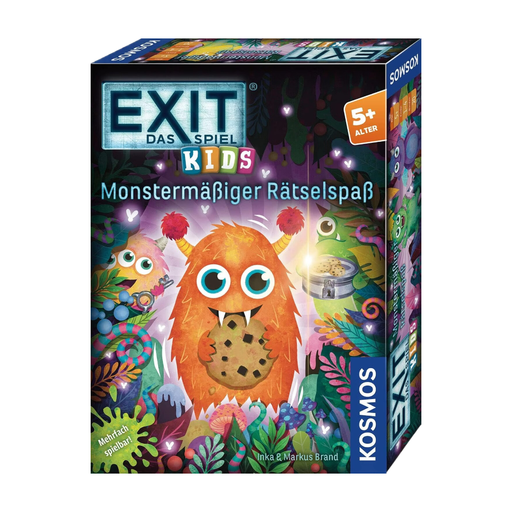
Why this product suits the profile: An introduction to the escape-room world designed for children aged 5 and over, playable with 1 to 4 players. The rules are designed to make getting started easy.
The age and player recommendations clearly define the target group. According to the description, the puzzles are adapted for children, while adults can support younger players.
1 to 4 players, recommended for ages 5 and over, optional app with timer and hints.
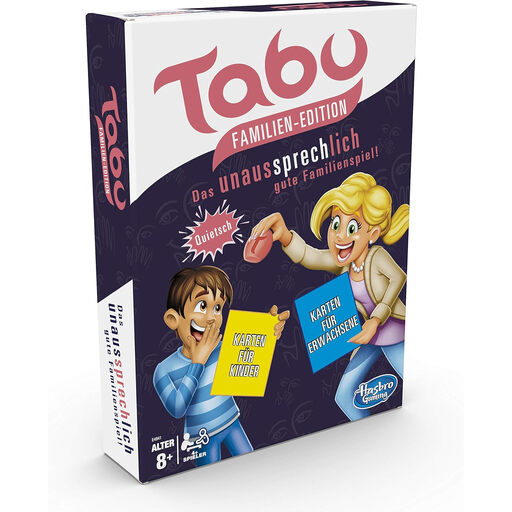
Why this product suits the profile: This edition is aimed at families with children aged 8 and over and larger groups. Separate card sets for children and adults take different vocabulary levels into account.
The target group is defined by more than just a minimum age: 130 cards for children and 130 cards for adults are provided separately. The game is designed for 4 or more players.
260 cards featuring over 1,000 terms, sand timer and team play with time pressure; no batteries required.

Why this product suits the profile: Families with children aged 6 and over get a board game for 2 to 4 players, featuring simplified trading rules and a pirate theme.
The junior edition uses simplified rules and child-friendly tokens. This clearly distinguishes it from the more complex adult version.
2 to 4 players, recommended for ages 6 and over, with trading and building pirate hideouts as the central mechanics.

Why this product suits the profile: This cooperative board game for ages 6 and over is designed for 1 to 4 players. The group works towards a shared goal and uses a rotating game board.
The cooperative mechanics reduce direct competitive pressure. The age and player recommendations show which family situations the game is designed for.
1 to 4 players, ages 6 and over, rotating game board, dice and animal tokens; no batteries required.
For children’s birthday parties, short children’s games that are easy to explain and use a manageable number of components are ideal. KOSMOS 712631 The School of Magical Animals Investigates is designed for 2 to 4 players aged 6 and over and, according to the product details, takes around 20 minutes.
For older children and families who enjoy solving puzzles together, escape-room games for children aged 8 and over are worth considering. The EXIT editions ‘Backstage Boys + Dark Fair’ and ‘Castle Greyrock + Mission Candyland’ each contain two adventures for 2 to 4 players. The puzzles are solved together, while an optional KOSMOS app can provide support with the introduction, timer or hints.
For larger groups aged 12 and over, Top Ten is a good party-game choice. This cooperative card game is designed for 4 to 9 players and has a stated playing time of around 30 minutes. It is therefore better suited to sociable game nights than to a traditional children’s birthday party.
We have put together a complete, regularly updated list of products that fully meet these strict selection criteria and the safety regulations applicable in the EU.
Games with short rules, few exceptions and a manageable playing time are suitable. The minimum age should be considered alongside the child’s reading ability and concentration span. For puzzle games such as EXIT Kids, adult supervision may be helpful.
Games for 2 to 4 players are flexible enough for everyday family life. For larger groups, look for a higher player count. According to the product details, a game such as Taboo Family Edition is designed for 4 or more people and is therefore better suited to groups.
Store the game in a dry place, preferably flat or in accordance with the manufacturer’s instructions. Keep cards, playing pieces and tokens in separate bags or compartments. Before and after playing, check that all small parts are present and follow the safety instructions on the packaging.