
Lieferung heute & morgen

Qualitätsgarantie

Willkommens-Angebote freischalten: KOSTENLOSE Lieferung | Bis zu 80 % RABATT | Kostenlose 30-Tage-JoyPlus-Testphase
App herunterladen
A modern body composition scale promises much more than just displaying your weight. It's designed to provide insights into body fat, muscle mass, and other health metrics, often synced with an app. However, the market is crowded, and many devices don't live up to their advertising claims. Before you make a purchasing decision, it's crucial to understand the common pitfalls to find a model that delivers precise data and functions reliably in the long run.
As your Joybuy Product Recommendation Officer, I'm here to help you separate the wheat from the chaff. In this guide, I'll show you what really matters and how to avoid the three most common mistakes when buying a body fat scale.
Many buyers are disappointed with their new scale after just a short time. The reasons are often the same. Pay attention to these three points to avoid making a bad purchase.
To make an informed decision, you should understand three core technical aspects. These determine the quality and usefulness of your future body fat scale.
Most body composition scales use Bioelectrical Impedance Analysis (BIA). This method sends a very weak, unnoticeable electrical current through the body. Since fat, muscle, and water conduct electricity differently, the scale can calculate the body's composition from the measured resistance.
Look for models with four electrodes on the standing platform to ensure a uniform measurement. Higher-quality scales use an ITO (Indium Tin Oxide) coating instead of visible metal electrodes. This conductive, transparent layer covers the entire surface and allows for a more precise measurement, as foot placement is less critical.
A digital scale with Bluetooth is the standard. The connection to your smartphone should be stable, and data synchronisation should happen automatically in the background as soon as the app is opened. Some premium models also offer a Wi-Fi connection, allowing data to be sent directly to the manufacturer's cloud even without a nearby smartphone.
Important app features include:
A good BMI scale should reliably measure and display the following core values:
Additional values like visceral fat or metabolic age can be interesting, but their accuracy in home devices is often limited.
Based on the criteria above, we have identified a few models that represent a suitable solution for different user groups.
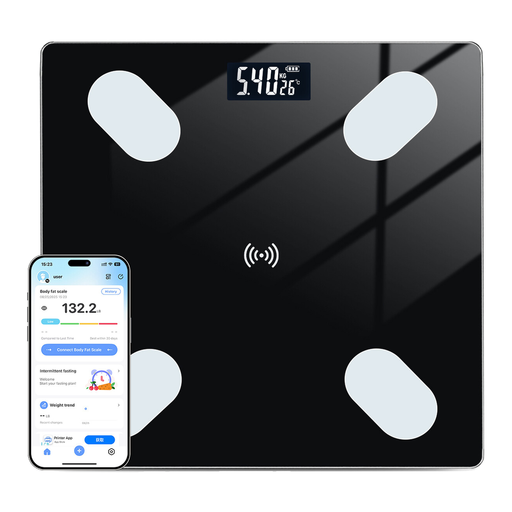
Why This Fits Their Persona: Ideal for users looking for a reliable smart scale with the most important analysis functions without a large budget. It offers all the core features for effective health tracking.
The scale focuses on 13 essential health indicators, avoiding superfluous metrics. Synchronisation with the established OKOK app ensures a stable Bluetooth connection and reliable data collection.
Supports multiple user profiles with automatic recognition, making it family-friendly. Precision sensors deliver consistent measurement results.
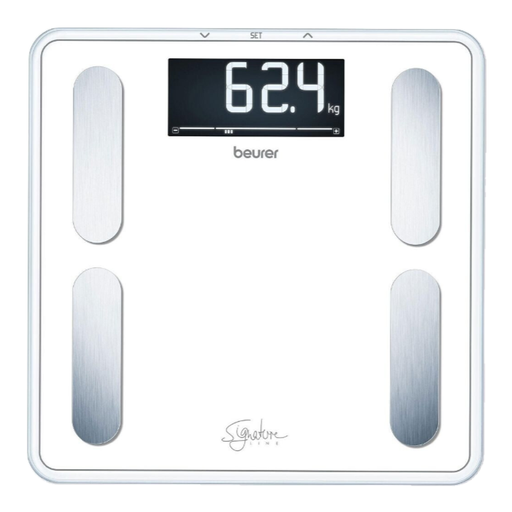
Why This Fits Their Persona: Perfect for families seeking a durable and reliable device from a well-known German brand. Its high weight capacity and multiple user memory slots make it the central health station in the bathroom.
This model forgoes app connectivity, focusing on direct, reliable measurement and display of values on the device itself. This completely bypasses issues with app synchronisation and data privacy concerns.
Offers memory slots for 10 users with automatic recognition. The high maximum weight capacity of 200 kg and the large XL display ensure comfort and durability.

Why This Fits Their Persona: For users who value cutting-edge technology, an attractive design, and comprehensive data analysis. The colour display and ITO glass surface set this model apart from the crowd.
The ITO coating provides improved and more consistent measurement accuracy compared to simple metal electrodes. The stable Bluetooth connection ensures reliable synchronisation of extensive data with the app.
Offers a very wide range of 25 metrics for detailed analysis. The large LED colour display presents data intuitively, and the scale includes a special mode for babies and pets.
We've compiled a complete, up-to-date list of products that fully meet these strict selection criteria and German safety regulations.
Bioelectrical Impedance Analysis (BIA) on home-use scales provides good estimates and is primarily useful for tracking trends. The absolute accuracy cannot compete with clinical methods like a DEXA scan. For consistent and comparable results, it is crucial to always take measurements under the same conditions: at the same time of day (preferably in the morning after using the restroom and before breakfast), on the same surface, and barefoot.
No, not necessarily. Most models are Bluetooth scales that connect to your smartphone. The data is initially stored on the scale or directly in the app on your phone. An internet connection is only needed to synchronise the data with a cloud account or to update the app. Many scales can store multiple measurements offline and will sync them the next time a connection to the app is established.
The right location is crucial for precise measurement results. Always place the scale on a hard, level surface like tiles or parquet flooring. Carpets or uneven floors will lead to inaccurate readings. Make sure to stand still and centred on the scale during the measurement. For the body analysis functions, it is necessary to be barefoot so that the electrodes have skin contact.