
Lieferung heute & morgen

Qualitätsgarantie

Willkommens-Angebote freischalten: KOSTENLOSE Lieferung | Bis zu 80 % RABATT | Kostenlose 30-Tage-JoyPlus-Testphase
App herunterladen
A modern body fat scale with an app can do far more than just display your weight. It provides insights into your body composition and helps you track progress towards your fitness or health goals in detail. But the market is crowded, and not every model delivers on its promises. Many users invest in a smart scale only to find that inaccurate measurements or an unreliable app make the device unusable.
This guide highlights the most common pitfalls and explains which technical features truly matter. This will help you make an informed decision that aligns with your personal goals.
Before choosing a model, it's important to know the typical weaknesses that often only become apparent after the purchase.
body fat scale with an app is only as useful as its software. Many manufacturers neglect app maintenance. The consequences are syncing issues, crashes, or, in the worst-case scenario, the service being discontinued entirely. Another critical point is data privacy. Apps that require registration with extensive personal data without offering a transparent privacy policy pose a potential risk.To avoid these pitfalls, focus on three key technical aspects when making your selection. These determine the accuracy, user-friendliness, and long-term value of your scale.
Bioelectrical Impedance Analysis (BIA) is the technology used by a personal scale with body fat analysis. It works by sending a very weak, imperceptible electrical impulse through the body. Since fat, muscle, and water conduct electricity differently, the scale can calculate the proportions of your body composition from the resistance (impedance).
Two factors are crucial for reliable results:
The connection to your smartphone is typically made via Bluetooth. A stable Bluetooth scale ensures seamless data transfer. When it comes to the companion app, the following points are important:
In addition to standard metrics like weight, body fat, and BMI, some models offer further analysis. A smart scale with heart rate monitoring can, for example, measure your resting heart rate directly during weigh-ins, providing an additional indicator of cardiovascular fitness.
The display also plays a role in daily use. A scale with a colour display can colour-code measurements directly on the scale (e.g., green for a healthy range), allowing for a quick assessment without immediately looking at the app.
Here are some recommendations tailored to different user needs.
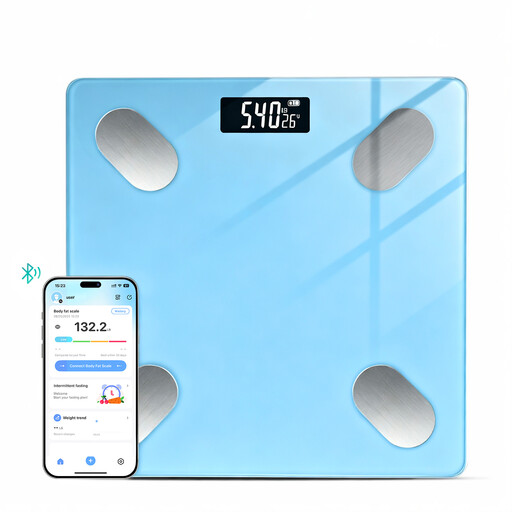
Why This Fits Their Persona: Ideal for families or couples who want to track their health data together. The scale supports multiple user profiles with automatic recognition and reliably syncs the 13 most important body metrics with the OKOK app.
The scale focuses on a stable Bluetooth connection and an established app (OKOK), which minimises the risk of software issues. It avoids being overloaded with dozens of calculated values, focusing instead on core analysis.
The automatic recognition of multiple users makes daily handling straightforward. Four precision sensors provide a reliable measurement base.
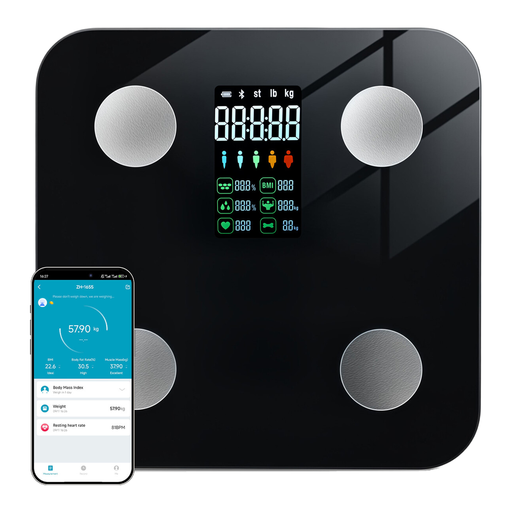
Why This Fits Their Persona: Perfect for users who want detailed insights and immediate feedback. This model not only measures over 15 body metrics but also heart rate, displaying the most important results directly on a bright colour display.
The colour display provides a quick, app-independent evaluation of key data. The heart rate measurement is a concrete hardware feature, not just a calculated estimate, which adds real value.
The combination of integrated heart rate monitoring and a high-contrast colour VA display for instant feedback sets this model apart from standard scales.
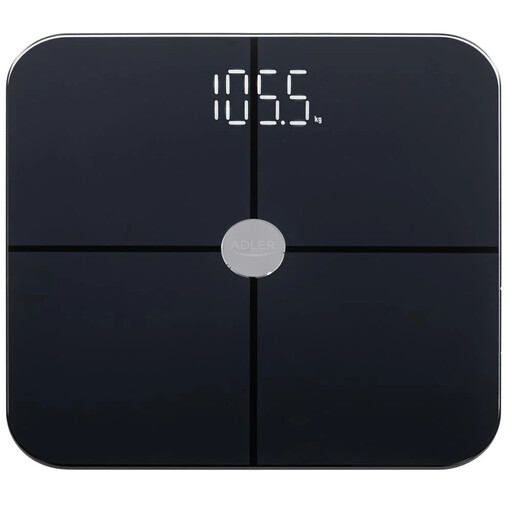
Why This Fits Their Persona: For anyone who values a minimalist design without sacrificing functionality. The scale features a seamless glass surface with an invisible ITO coating and a hidden LED display that only lights up when in use.
This model directly addresses privacy concerns: the companion FitGo app requires no registration and stores data indefinitely. The high-quality ITO coating ensures precise measurement without the visual interruption of metal electrodes.
The elegant, seamless design with an ITO glass surface and the privacy-friendly app that requires no registration are clear advantages for design- and security-conscious users.
We have compiled a complete, up-to-date list of products that fully meet these strict selection criteria and rigorous safety standards.
1. How accurate is body fat measurement at home? BIA measurements from scales for home use provide estimates and are not comparable to a medical analysis (like a DEXA scan). Their strength lies in tracking trends. For consistent results, you should always weigh yourself under the same conditions: at the same time of day, on an empty stomach, and after using the restroom. This allows you to reliably track changes over time.
2. Does the scale need to be connected to the smartphone for every measurement? Not necessarily. Many modern scales can store a certain number of measurements internally. The next time you open the app near the scale, the stored data will sync automatically. However, for a complete record and real-time analysis, an active connection is recommended.
3. Why are accurate measurements not possible on carpet? A scale requires a hard, flat, and stable surface to determine weight correctly. Carpets or uneven tiles cause pressure to be distributed unevenly, which throws off the weight sensors. This not only affects the weight measurement but also the accuracy of the entire body analysis, as weight is a fundamental parameter for the BIA calculation.