
Lieferung heute & morgen

Qualitätsgarantie

Willkommens-Angebote freischalten: KOSTENLOSE Lieferung | Bis zu 80 % RABATT | Kostenlose 30-Tage-JoyPlus-Testphase
App herunterladen
A modern body fat scale promises much more than just displaying your weight. It offers insights into your body composition—from fat percentage and muscle mass to water levels. But the market is crowded, and many devices don't deliver on their marketing promises. Before you make a decision, it's crucial to understand the common pitfalls to find a model that truly aligns with your goals.
As your Joybuy Product Recommendation Officer, I'm here to help you separate the wheat from the chaff. We'll focus on the facts and the key features that define a quality scale.
Many buyers are disappointed with their new device after just a short time. This is often due to inflated expectations created by clever marketing. Pay attention to these three points to avoid a bad buy:
To avoid these traps, you should focus on the technical fundamentals. These three parameters are crucial for a reliable and useful body fat scale.
Modern body fat scales use Bioelectrical Impedance Analysis (BIA). This method sends a very weak, imperceptible electrical current through the body. Since fat, muscle, and water conduct electricity differently, the scale can calculate the proportions of your body composition from the measured resistance (impedance).
The app is the brain of your smart scale. Before buying, check if the corresponding app meets the following criteria:
Focus on the core values that provide real insight into your health and fitness. Less is often more here. The most important metrics include:
Some advanced models also offer heart rate measurement. A bathroom scale with heart rate monitoring can be useful for tracking your resting heart rate first thing in the morning, which can be an indicator of your overall fitness and recovery status.
Based on the criteria above, we have identified several models that represent a considered choice for different user groups.
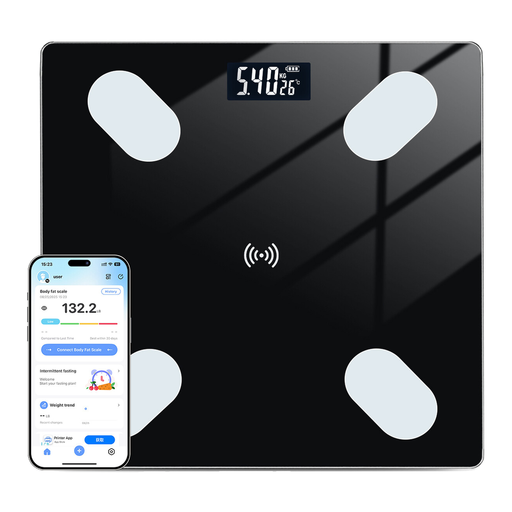
Why This Fits Their Persona: Ideal for users seeking basic yet reliable body analysis with app connectivity without a large budget. It offers all the essential functions for tracking health goals.
The scale focuses on 13 core metrics, avoiding the "feature overload" trap. The OKOK app provides basic tracking functions without hidden subscription costs.
Supports multiple user profiles with automatic recognition. Seamless synchronisation via Bluetooth with the app for easy trend tracking.
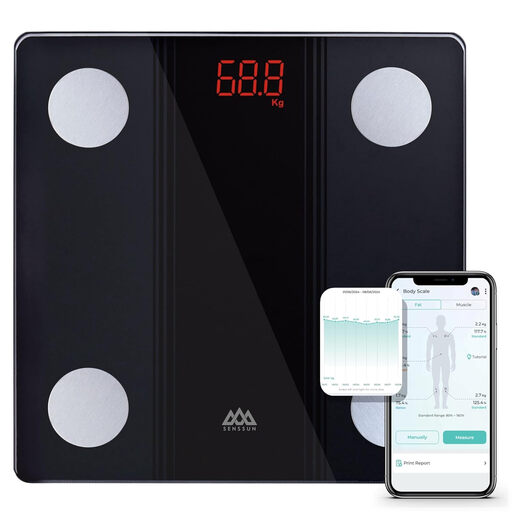
Why This Fits Their Persona: Perfect for households where multiple people want to track their health data separately. Its high user capacity makes it a central health station for the whole family.
Solves the problem of underdeveloped apps with the MovingLife app, which is specifically designed to manage many profiles. Automatic recognition prevents data mix-ups.
Supports up to 15 individual user profiles. The four high-precision electrodes deliver consistent data for all 14 recorded body metrics.

Why This Fits Their Persona: For users who want comprehensive data analysis, including heart rate, and value modern design and advanced technology. The baby/pet mode is a practical extra for young families.
Addresses the trap of inaccurate measurements by using ITO glass. This technology provides a uniform conductive surface, leading to potentially higher measurement consistency.
Comprehensive analysis of 25 body metrics, including heart rate. High weight capacity of 200 kg and a large, colourful LED display for intuitive readability.
We have compiled a complete, up-to-date list of products that fully meet these strict selection criteria and safety regulations.
1. How accurate is a body fat scale for home use? Body fat scales for home use are not intended as medical diagnostic devices. Their strength lies not in absolute accuracy but in their ability to show trends over time. For consistent results, it's important to always weigh yourself under the same conditions: in the morning after using the restroom, before breakfast, and on a hard, flat surface. The relative change in your values is more meaningful than a single measurement.
2. What is the difference between ITO glass and visible metal electrodes? Traditional scales have four visible metal electrodes that you must place your feet on. ITO (Indium Tin Oxide) is a transparent, conductive coating applied to the entire glass surface. This allows for a continuous, minimalist design without visible metal contacts. Functionally, it offers the advantage that the exact foot position is less critical for the measurement.
3. Are there any safety precautions I need to follow? Yes. Individuals with electronic medical implants, such as a pacemaker, should not use the body analysis function, as the BIA measurement uses a weak electrical impulse. For these individuals, only the standard weight function is safe. Pregnant women should also refrain from using the analysis function. Additionally, always place the scale on a dry, solid floor to prevent slipping.