
Lieferung heute & morgen

Qualitätsgarantie

Willkommens-Angebote freischalten: KOSTENLOSE Lieferung | Bis zu 80 % RABATT | Kostenlose 30-Tage-JoyPlus-Testphase
App herunterladen
A modern body fat scale can be a useful tool for tracking health and fitness goals. It provides far more data than just your weight. However, the market is flooded with models whose marketing promises often create more confusion than clarity. Before you make a decision, it's crucial to understand the common pitfalls that can lead to a bad buy.
Many buyers focus on the highest possible number of measured values or are swayed by a futuristic design. Yet, it often turns out that the advertised features are impractical in daily use or the measurements fluctuate wildly. This guide will help you separate the wheat from the chaff and find a scale that is precise, reliable, and tailored to your needs.
To avoid a purchase mistake, you should focus on the technical fundamentals. These three parameters are decisive for the performance and longevity of your body composition scale.
Modern body fat scales use Bioelectrical Impedance Analysis (BIA). This involves sending a very weak, imperceptible electrical impulse through the body. Since fat, muscle, and water conduct electricity differently, the scale can calculate the body's composition from the resistance (impedance). There are two main system differences here:
Also, pay attention to the surface. ITO-coated glass offers a continuous, conductive surface without visible metal electrodes. This not only looks more modern but is also easier to clean and allows for more flexible foot positioning.
The method of data transfer significantly affects user convenience:
The basic features of a scale are also important. A large, brightly lit display (LED or LCD) ensures good readability. Most models use a safety glass platform and have a maximum weight capacity of 180 kg or 200 kg. A BMI scale calculates the Body Mass Index directly and often displays it along with the weight.
Based on the criteria mentioned, we have compiled a selection of models suitable for different user groups and their specific requirements.
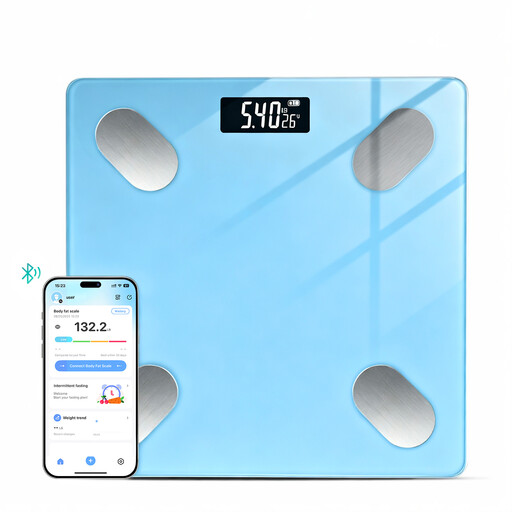
Why it's a good fit: Ideal for those starting their health journey who want to reliably track basic body data without investing in advanced features. It offers the most important metrics for a fundamental understanding of body composition.
This model focuses on 13 essential metrics, avoiding the confusion of an overloaded feature list. The simple Bluetooth connection with the OKOK app is straightforward and functional.
Provides a solid foundation for tracking weight, BMI, and body fat. It supports multiple user profiles, making it suitable for couples or small households.

Why it's a good fit: The combination of solar power and Wi-Fi sync makes this scale extremely low-maintenance and user-friendly for the whole family. Data is synced automatically without anyone needing their smartphone on hand.
Solves the connectivity issue with automatic Wi-Fi synchronisation. The unlimited user capacity with auto-recognition is a genuine benefit for households, not just an empty marketing promise.
Sustainable power supply through solar cells that charge in both sunlight and artificial light. The seamless integration with apps like Apple Health and Google Fit is an added bonus.
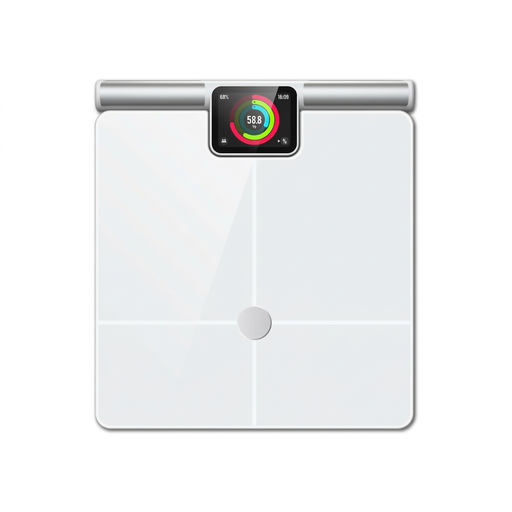
Why it's a good fit: For users who demand maximum data depth and precision. The 8-electrode system enables segmental analysis of arms, legs, and torso, providing detailed insights for targeted training and nutrition plans.
This model doesn't just deliver "more" metrics, but higher-quality data through its advanced 8-electrode technology. The professional health report in the app offers real value instead of just a long list of numbers.
Precise segmental body analysis via 8 electrodes and dual-frequency BIA. The large TFT colour display visualises data directly on the scale, while Wi-Fi and Bluetooth connectivity ensure seamless data synchronisation.
We have compiled a complete, up-to-date list of products that fully meet these strict selection criteria and rigorous safety standards.
For consistent and precise results, you should follow a few basic rules:
Scales with 8 electrodes offer segmental analysis, meaning they measure the resistance in the arms, legs, and torso separately. This can lead to a more accurate overall analysis of body composition, as the distribution of fat and muscle is not uniform throughout the body. For athletes or individuals working very specifically on their body composition, this level of detail can be advantageous. For general use in tracking trends, however, a high-quality 4-electrode system also provides reliable and useful data.
A Wi-Fi feature is a convenience. Its main advantage is that the scale automatically syncs measurement data without your smartphone needing to be nearby or the app being actively open. This is especially practical in households with multiple people, as each user can simply step on the scale and have their data automatically assigned to the correct profile and synchronised. If you always weigh yourself with your smartphone nearby anyway, a Bluetooth-only scale is sufficient.