
Lieferung heute & morgen

Qualitätsgarantie

Willkommens-Angebote freischalten: KOSTENLOSE Lieferung | Bis zu 80 % RABATT | Kostenlose 30-Tage-JoyPlus-Testphase
App herunterladen
A modern body fat scale promises much more than just displaying your weight. It's designed to offer insights into your body fat percentage, muscle mass, and other health metrics. But the market is crowded, and many devices lure you in with marketing promises that often don't hold up in practice. Before you make a decision, it's crucial to understand the common pitfalls to find a model that truly fits your needs and delivers reliable data long-term.
Many buyers are disappointed with their new "smart scale" after just a short time. This is often due to exaggerated marketing claims or poorly designed product features. Pay close attention to these three points:
scale with app connectivity quickly becomes useless.To make an informed purchasing decision, you should focus on the technical fundamentals rather than being swayed by marketing buzzwords.
Modern body fat scales use Bioelectrical Impedance Analysis (BIA). This process sends a very weak, imperceptible electrical current through the body. Because fat, muscle, and water conduct electricity differently, the scale can calculate the body's composition from the measured resistance (impedance).
The method of data transfer significantly impacts user convenience.
A good smart scale with an app should do more than just display data.
Based on these objective criteria, we have identified some models that are particularly well-suited for different user groups.
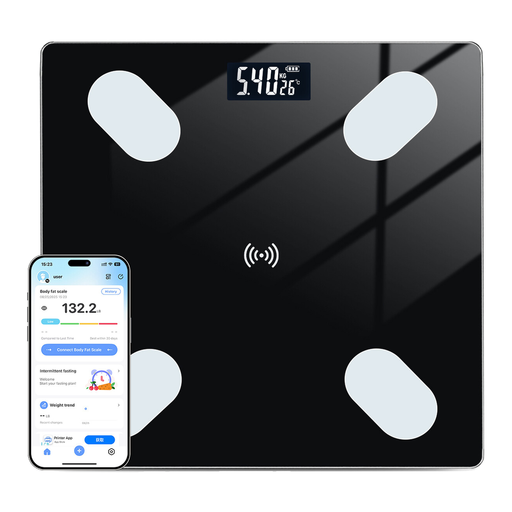
Why This Fits Their Persona: Offers all the fundamental analysis features at an accessible price point. The simple Bluetooth pairing with the OKOK app is ideal for anyone who wants to easily track their progress in weight, BMI, or body fat without breaking the bank.
Focuses on 13 essential metrics without overwhelming users with hard-to-interpret data. The app connectivity is designed for basic, stable synchronisation, avoiding unnecessary complexity.
Support for multiple user profiles and solid measurement accuracy for the basic body data. Being battery-operated makes it independent of power outlets.
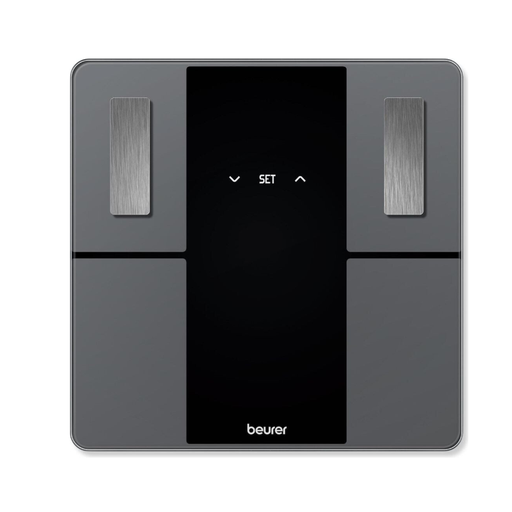
Why This Fits Their Persona: The automatic recognition of up to 8 users makes it ideal for a multi-person household. The established Beurer HealthManager Pro app provides reliable, long-term data storage for each family member without needing manual switching.
Relies on a proven brand-name app instead of a generic application, reducing the risk of connection issues and lack of support. The metrics are focused on essential health indicators.
Reliable automatic user recognition and a clean "Magic LED Display" that is only visible during use, allowing it to blend discreetly into the bathroom decor.
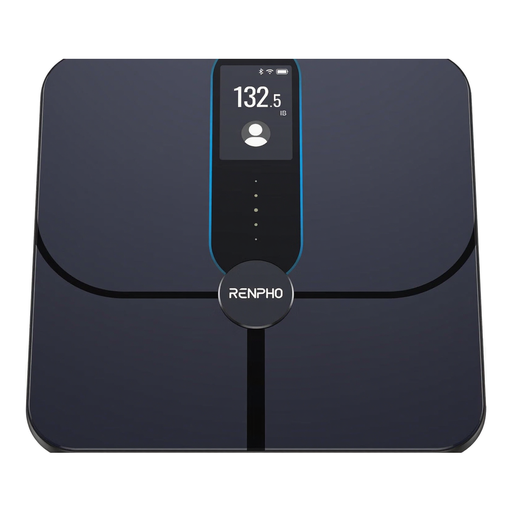
Why This Fits Their Persona: The dual Wi-Fi and Bluetooth connectivity ensures fully automatic synchronisation without needing your smartphone on hand. The RENPHO Health app connects with all major fitness platforms, making it the ideal data hub for athletes.
Solves the problem of unreliable synchronisation with its Wi-Fi option. Data is sent directly to the cloud, eliminating dependence on an active Bluetooth connection and making data collection seamless.
Dual connectivity (Wi-Fi/Bluetooth), a large TFT display that shows key metrics directly, and an eco-friendly, USB-C rechargeable battery.
We've compiled a complete, up-to-date list of products that fully meet these strict selection criteria and rigorous safety standards.
The BIA method used in home scales provides estimates. The absolute accuracy may differ from professional medical devices. However, what's far more important is the consistency of the measurements. To get comparable results, you should always weigh yourself at the same time of day, under similar conditions (e.g., in the morning after using the restroom, before breakfast), and on the same scale. This allows you to reliably track trends and changes over time.
Yes, absolutely. A diagnostic scale must be placed on a hard, flat surface (e.g., tile, hardwood) to measure accurately. On carpets, mats, or uneven floors, the weight can be distributed unevenly, which distorts the sensor readings and leads to highly inaccurate results. Many models come with special "carpet feet," but even these can compromise accuracy. For reliable data, a fixed spot on a hard floor is ideal.
A Bluetooth scale requires an active connection to your smartphone during the weighing process for data to be transferred to the app. This means you need to have your phone handy. A Wi-Fi scale connects independently to your home network and automatically syncs the data in the background with the cloud and your app. This is more convenient, as you don't have to connect with your smartphone every time.