
Lieferung heute & morgen

Qualitätsgarantie

Willkommens-Angebote freischalten: KOSTENLOSE Lieferung | Bis zu 80 % RABATT | Kostenlose 30-Tage-JoyPlus-Testphase
App herunterladen
A body fat scale can display much more than a traditional digital bathroom scale: depending on the model, it may measure body fat percentage, BMI, muscle mass, body water or bone mass, among other metrics. However, choosing the right scale is not about the longest list of features. What matters is whether the technology, operation and everyday use match your requirements.
If you want to buy a smart body fat scale, you should pay particular attention to three common pitfalls:
A body composition scale generally uses bioelectrical impedance analysis, or BIA for short. A weak electrical current is passed through the body, and the device uses the measured electrical resistance to calculate additional body metrics. The results are not a medical diagnosis and should not be interpreted as one.
For home use, the following points are particularly important:
Basic models generally use four electrodes on the platform. The measurement is taken through the feet. Devices with eight electrodes and hand grips can also include the upper body. This may appeal to users who want a more detailed, segmental body analysis.
Regardless of the design, dry, clean feet, a steady posture and a firm surface help to improve comparability. Carpets, damp floors and uneven surfaces can affect the measurement.
A BMI scale often displays weight and body mass index. Smart models add metrics such as body fat, muscle mass, body water, basal metabolic rate or visceral fat. However, displaying more parameters is only useful if the app presents changes clearly and users record their data regularly under similar conditions.
A scale with 12 to 25 body metrics may be sufficient for monitoring your progress day to day. A model with 56 measurements is more suitable for users who want to compare numerous details in a report.
For households with people of different weights, a bathroom scale up to 180 kg is a popular choice. Some models, such as those from Beurer or Soehnle, are rated for up to 200 kg according to the product details. As well as checking the maximum weight capacity, you should also look at the increments: depending on the device, these may be 0.05 kg below 100 kg and 0.1 kg from 100 kg, or a constant 0.1 kg.
The power supply also affects everyday use. Many devices use three or four AAA batteries. According to the product description, the RENPHO Elis Solar 2 features a rechargeable battery with solar assistance. For battery-operated scales, check whether batteries are included in the box.
The following selection categorises products according to typical usage scenarios. The information is based on the respective product descriptions.
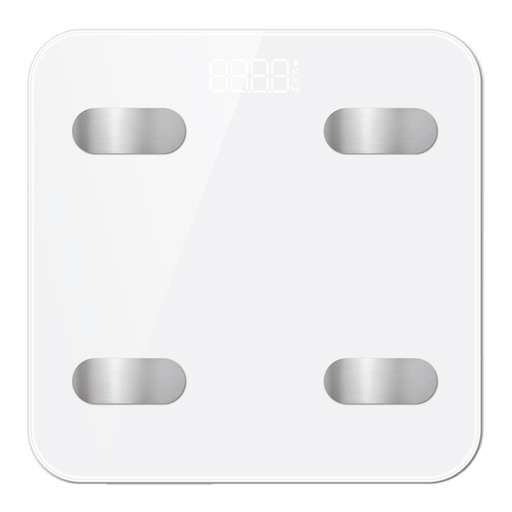
Why this product suits this user profile: This model combines a compact 30×30-cm platform with Bluetooth app connectivity, making it suitable for users who want to track body fat, BMI and other metrics without Wi-Fi.
The product details clearly specify 24 parameters, Bluetooth 4.2 and a weight capacity of 180 kg. This makes it easier to assess the features and connectivity requirements before buying.
Four-polar BIA, LED display, switchable units of measurement and AAA batteries included according to the product description.
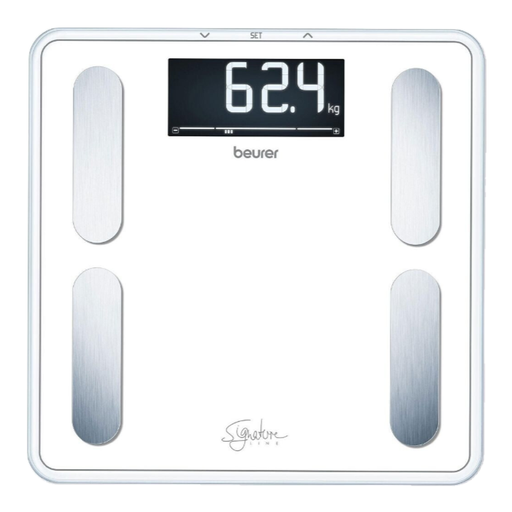
Why this product suits this user profile: This scale is designed for households with several users and features a large, illuminated display along with up to ten user profiles.
The specifications clearly state the maximum weight capacity of 200 kg, the 100-g increments and the supported body metrics. This makes it easier to check whether the scale meets your personal requirements.
BIA measurement, safety glass platform, BMI and body fat display, plus memory for up to ten users.

Why this product suits this user profile: The extendable hand-grip design and eight sensors appeal to users who want to perform a full-body analysis with a Bluetooth app at home or during fitness training.
Rather than simply highlighting the number of measurements, the product clearly specifies its eight sensors, hand grip, Bluetooth connectivity and support for the VitaDock+ app.
More than 20 listed body metrics, Bluetooth, multiple users and a weight capacity of 180 kg.
We have put together a complete, regularly updated list of products that fully meet these strict selection criteria and the safety regulations applicable in the EU.
For regular use of a fitness scale, following a consistent routine is recommended:
People with pacemakers, defibrillators or other implanted electronic devices should not use the BIA function. With many models, basic weight measurement is still possible. Pregnant women, children and teenagers should follow the instructions provided by the relevant manufacturer. These devices are not medical devices and are intended as a guide for use at home.
The scale measures your weight directly and sends BIA data via Bluetooth or Wi-Fi to a compatible app. User profiles, measurement history and additional body metrics can then be saved there. Before buying, check the operating system, app requirements and Wi-Fi frequency.
Lifespan depends on the sensors, glass surface, batteries and frequency of use. Storing the scale in a dry place, stepping onto it carefully and cleaning it with a soft cloth can help maintain its performance in everyday use. If the glass is cracked or the electrodes are damaged, the device should no longer be used.
For battery-operated models, the main running cost is AAA batteries. Consumption is usually low and depends on how often the scale is used, as well as the display and wireless connection. Models with a rechargeable battery need to be charged regularly instead; with solar variants, you should take the amount of available light at the installation location into account.