
Lieferung heute & morgen

Qualitätsgarantie

Willkommens-Angebote freischalten: KOSTENLOSE Lieferung | Bis zu 80 % RABATT | Kostenlose 30-Tage-JoyPlus-Testphase
App herunterladen
A body fat scale should do more than display your weight each day. Depending on the model, it may also record your body fat percentage, BMI, body water, muscle mass and other measurements, and document them via an app. This can be useful for fitness goals, weight management or use by several members of the family.
However, the information provided is often overestimated. A high number of measurements does not automatically mean greater practical value. Before buying, you should therefore focus on the measurement method, ease of use, user profiles and safety requirements.
A smart body fat scale generally uses bioelectrical impedance analysis (BIA). This sends a very weak electrical current through the body. The device calculates estimated values for body fat, body water and muscle mass based on electrical resistance.
These values are intended for monitoring trends at home and do not replace a medical examination. The time of day, fluid intake, skin temperature, foot contact and previous physical activity can all affect the result. Claims such as “measures visceral fat” therefore refer to an algorithmic estimate, not a direct medical measurement.
A Bluetooth body fat scale usually transfers measurement data only when your smartphone is nearby and the associated app is open or activated. Depending on the model, a Wi-Fi body fat scale can synchronise data directly with your user account. This usually requires an app account and a compatible 2.4 GHz Wi-Fi connection.
Before buying, check whether the app works with your Android or iOS device, what data is stored and whether registration is required.
A concealed LED display looks discreet, but it can be harder to read in bright light or from a shallow viewing angle. An XL LCD or TFT colour display offers a different user experience. The platform size and maximum weight capacity are equally important. A platform measuring 28 or 30 cm on each side may be sufficient for everyday use, while larger feet or frequent use may require more space.
A digital body composition scale with four electrodes typically measures electrical resistance through the feet. Models with eight electrodes and hand grips also include the hands and can provide segment-specific calculations. However, more electrodes primarily mean a different measurement arrangement; the results remain estimates and should always be compared under similar conditions.
Depending on the model, the following information may be available:
If you simply want to monitor your weight, you do not necessarily need 24 or 56 measurements. For a structured fitness log, however, a body fat scale for fitness and weight management with app-based progress tracking can be useful.
Pay attention to the maximum weight capacity specified by the manufacturer. The range includes models with a capacity of 180 kg or 200 kg. Depending on the device, increments may be 50 g or 100 g, for example. A finer display does not automatically mean correspondingly greater accuracy in the body analysis.
The scale should be placed on a hard, level and dry floor. Carpets, uneven tiles or soft surfaces can affect the weight display and BIA calculation. A glass platform should be free from cracks and only stepped on with dry feet, as moisture increases the risk of slipping.
For families, a bathroom scale with multiple user profiles is practical. Depending on the product, up to eight or ten people may be supported; automatic recognition is based on stored data such as weight. Check whether measurements can be clearly assigned to the correct profile.
The power supply should also be included in your comparison:
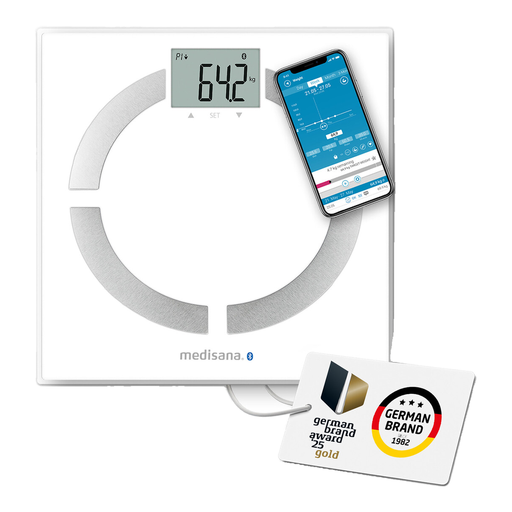
Why this product suits this profile: This model combines weight, BMI, body fat, body water, muscle mass and bone mass with Bluetooth and the VitaDock+ app. Up to eight users can use the scale in one household.
The advertised functions are supported by specific details about the measurements, app and number of users. The weight capacity is specified as 180 kg.
Bluetooth data transfer, automatic recognition of up to eight users and a large LCD display.
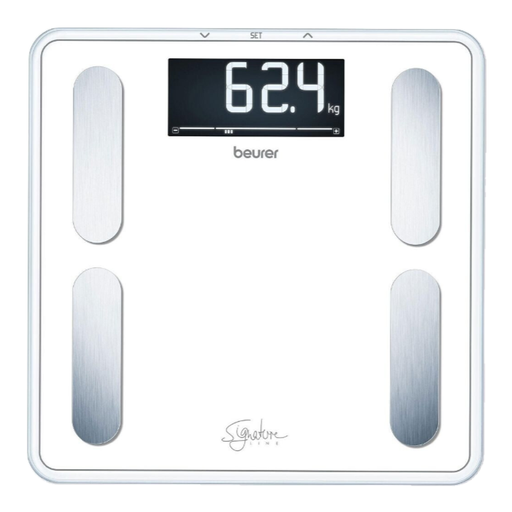
Why this product suits this profile: The scale features a 31 × 31 cm safety glass platform, an illuminated XL LCD, a maximum weight capacity of 200 kg and memory spaces for up to ten users.
Key details such as the measurement functions, number of users, display type and weight limit are clearly specified, rather than relying on vague claims about “smart” technology.
Ten user profiles, 100 g increments for weight readings, and measurements of body fat, body water, muscle percentage, bone mass and BMI.

Why this product suits this profile: The 8-electrode design with retractable hand grip is aimed at users looking for a more comprehensive body analysis scale for regular training and long-term progress tracking.
The design makes it clear how the device differs from foot-only measurement. Correct hand and foot contact is required during use.
More than 20 specified body metrics, Bluetooth connectivity with VitaDock+ and VitaDock Online, and a weight capacity of up to 180 kg.

Why this product suits this profile: Wi-Fi and Bluetooth transfer data to the RENPHO Health app. Automatic user recognition is designed for households with several people.
The power supply, app connection and 13 measurements are described in specific terms. Check app compatibility and synchronisation before use.
Solar-assisted power supply, Wi-Fi and Bluetooth connectivity, and synchronisation with multiple health platforms according to the product description.
We have put together a complete, regularly updated list of products that fully meet these strict selection criteria and the safety regulations applicable in the EU.
For tracking progress, comparing readings from day to day is more important than focusing on a single displayed value. Keep the scale permanently in the same fixed position. Try to weigh yourself at a similar time of day, ideally under comparable conditions. Your feet should be clean and dry; with BIA models, full contact with the electrodes is required.
Body composition readings should be treated as a guide. Significant fluctuations can be caused by fluid balance, meals or exercise. If you have a pacemaker, defibrillator or other implanted electronic or metal devices, the body analysis function must not be used in accordance with the relevant safety instructions. Pregnant women, children and young people should follow the instructions for BIA use in the operating manual. These devices are not intended for diagnosis or therapy.
When BIA is activated, a body fat scale sends a very weak current through the body via electrodes. Body fat, body water and other values are calculated from the measured resistance. The result is a guide for personal use, not a medical diagnosis.
Service life depends on build quality, batteries, the surface it stands on and care. Storing the scale in a dry place, using it on a level floor and cleaning it with a soft, slightly damp cloth can help maintain its suitability for everyday use. Damaged glass surfaces should no longer be used. For longer-term storage, removing the batteries is recommended depending on the model.
Bluetooth models generally use AAA batteries and only transfer data when connected to a compatible smartphone. Wi-Fi models can synchronise readings automatically and require an active network connection to do so. Rechargeable or solar-assisted models reduce the need for regular battery replacement, but should be charged or given sufficient exposure to light in accordance with the manufacturer’s instructions.