Sellers who regularly photograph covers
For clear, consistent images of lots of books, it’s worth planning the framing, perspective and a dedicated shooting spot. Nikon Germany highlights framing as an important factor in flat-lay photography.


You don’t automatically need to buy a new camera just to photograph a few book covers. First, try your existing smartphone with a stable setup and even light from a window. If you photograph lots of covers regularly and want to adjust the framing and settings, an interchangeable-lens camera with a suitable lens could be an option. Image stabilisation and manufacturer specifications alone don’t prove that a camera will reproduce glossy covers better.
For clear, consistent images of lots of books, it’s worth planning the framing, perspective and a dedicated shooting spot. Nikon Germany highlights framing as an important factor in flat-lay photography.
If you want cover colours to look consistent as daylight changes, controllable lighting and white balance are important things to check. Canon Germany points out that natural light varies depending on conditions.
For a few covers, try your existing device with a stable setup before buying a new camera. What matters is whether the details and colours in the finished image meet your needs.
First, check whether your existing device is good enough with a stable setup. If it isn’t, compare suitable lenses, image controls and kit contents against your shooting space.
A good fit if: you only photograph covers occasionally and your device produces clear details and usable colours in a test.
The trade-off: you can avoid buying a camera for now, but you’ll need to check the perspective, reflections and colours in the finished image yourself.
A good fit if: you regularly photograph lots of covers in different sizes and want to adjust the framing and settings.
The trade-off: a zoom lens gives you more flexibility with framing, but you’ll also need to consider the cost, accessories and a suitable setup.
The percentages below refer to consumers choosing a camera for photographing book covers by window light. Each figure shows the priority that matters most to them.
| Priority | What to check before buying | Who cares most about this? |
|---|---|---|
| Straight, sharp and repeatable shots | Space for a tripod or overhead setup; framing and focus with the specific lens. | If I want to photograph lots of books consistently, I need a straight, sharp frame that I can reproduce. This is a priority for around 36% of consumers. |
| Colours and reflections | Adjustable white balance or RAW capture; test the light and camera position with your own cover. | For covers where colour matters, I want to see how daylight and reflections affect the image before I photograph a whole series. Around 29% of consumers prioritise controllable colour reproduction. |
| Changing light from a window | Manual exposure; stabilisation of the specific camera-and-lens system and space for a fixed setup. | If the light fades or changes while I’m taking photos, what matters to me is whether I can adjust the exposure. Around 21% of consumers prioritise this. |
| Keeping extra effort to a minimum | Results with your existing device; check what lens and power accessories are included with a camera kit. | For a few covers, I want to avoid buying and setting up as much new equipment as possible. Keeping extra effort to a minimum is the main priority for around 14% of consumers. |
A higher resolution won’t automatically keep the book straight in the frame or make your shots consistent.
Test the perspective and framing in your intended shooting spot before comparing cameras and lenses.
Depending on the kit, you may need to add a lens or charging accessories.
The EOS R50 with RF-S 18–45mm is a documented APS-C kit with a standard zoom lens.
The Z50II kit with NIKKOR Z DX 16–50mm is another interchangeable-lens option with a standard zoom.
The Alpha 6400 is listed as an APS-C camera with an E-mount and a 16–50-mm-II power zoom kit.
The X-S20 may be relevant if you want to choose an X-mount lens specifically and plan to edit RAW files.
The Lumix G100D with a 12–32-mm lens is a documented Micro Four Thirds kit option.
This selection includes a Sony interchangeable-lens camera with a zoom lens, as well as compact Osmo Pocket cameras. For each model, check that its design, lens or framing, and mounting options suit your fixed setup above the book. The product specifications alone don’t prove that it’s especially suitable for photographing book covers.
 No image available
Check at your shooting spot whether the fixed wide-angle framing suits your book sizes and planned setup.
The product description lists a 20-mm f/2.0 lens and a 1-inch sensor.
 No image available
The zoom kit is an option if you want to adjust the framing for different covers. Check whether you can position the camera securely in your shooting space.
The product description lists 24.2 MP, JPEG and RAW file formats, and a tilting display.
 No image available
If you’re considering this compact camera, check in advance whether you can position it in a fixed setup above the book.
The product description lists a 1-inch CMOS sensor, a rotating 2-inch screen and 2× lossless zoom.
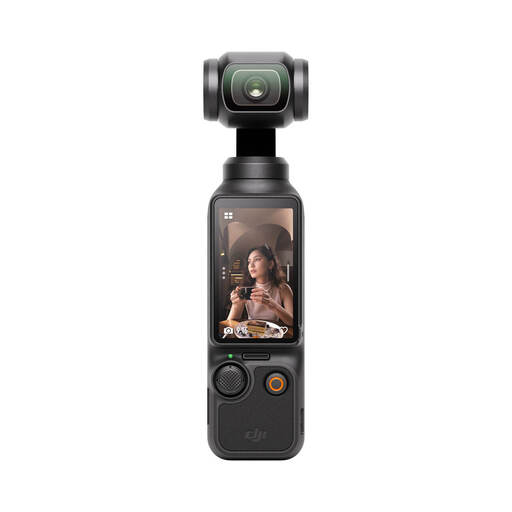 No image available
Check that its compact design suits your shooting space and lets you capture the subject from above as intended.
The product description lists a 1-inch CMOS sensor and a rotating 2-inch touchscreen.
Lay the cover flat, check the framing from above and keep the camera position as consistent as possible between shots. A tripod can help you maintain the same composition. Before you start, check that your planned setup really does position the camera above the book.
Check the lighting and white balance when daylight changes. A model that can shoot RAW gives you more scope to adjust colours later, but it doesn’t replace checking the actual cover.
Check whether the specific offer includes a lens and charger. Canon lists both with the R50 kit mentioned here; Nikon explicitly states that the Z50II kit mentioned here doesn’t include a charger.
You shouldn’t assume that permission is automatically granted. Copyright law covers reproductions; exceptions such as quotation are tied to their purpose, and incidental inclusion only applies when the work isn’t the main subject of the image. Whether a particular publication is allowed depends on factors including the cover, the rights involved and how the image will be used. If you’re unsure, clarify these points before publishing.