What should you consider when choosing?
First decide whether you want to record everyone through one shared microphone, or use individual microphones and plan for enough inputs to record them all at the same time.
One microphone for each speaker
A good fit if: everyone speaks from a fixed seat and the fan needs to stay on.
Bear in mind: You’ll need suitable mounts for several microphones and a recording setup with enough inputs. Having a USB or XLR connection alone doesn’t guarantee separate tracks.
Several XLR microphones with a recorder or interface
A good fit if: your group records together regularly and you want separate inputs for editing later. Elgato explains that the number of microphones needs to match the number of available interface inputs.
Bear in mind: A recorder or interface, XLR cables and suitable mounts are all part of the setup. Separate tracks don’t remove the need to position microphones carefully.
One shared omnidirectional microphone
A good fit if: an easy setup is a priority and a test recording shows that everyone at the table can be heard clearly. CHERRY describes the UM 6.0 ADVANCED’s omnidirectional mode as suitable for several people in the same room.
Bear in mind: The recording picks up sound from every direction, including the fan and other room noise. Individual voices won’t be captured on separate microphone tracks.
One directional microphone for one person
A good fit if: you’re recording just the host or an introduction to start with, and don’t need this microphone to capture the other participants at the same time.
Bear in mind: The microphone won’t automatically capture the rest of the group. Shure describes the switchable noise reduction on the MV7+ and original MV6 as designed for steady sounds such as fans, not as a guarantee of a noise-free group recording.
| What you need |
What to check when buying |
Who is it important to? |
| Record everyone clearly |
Check the number of speakers and inputs you can use at the same time, the polar pattern, the seating arrangement and a test recording with people taking turns to speak. |
If I want to understand contributions from every seat without constantly asking people to repeat themselves, I’ll compare a shared microphone with individual inputs. Around 34% of consumers put clear speech from everyone in the conversation first. |
| Account for fan noise |
Test the microphone’s pickup direction, the speaking distance you can achieve and the fan’s position; listen back to a test recording with the fan running. |
If the fan needs to stay on while recording, I want to know whether everyone will still be clear with my seating arrangement. Around 33% of consumers first look for ways to pick up as little fan noise as possible. |
| Record easily on a computer |
Check the connection to your recording device, how many microphones you need to use at once, which cables are included and whether the software is compatible. |
If I want to get started directly on my PC, I want to check how everything connects without losing sight of how many microphones I need. Around 20% of consumers prioritise a straightforward recording setup. |
| Monitor the sound and plan for accessories |
Check the specific model’s headphone connection and monitoring function, as well as the mounts and cables needed for each speaker. |
If I want to hear whether the sound is right while setting things up, I’ll check the monitoring function and the parts I need in advance. Around 13% of consumers focus on monitoring and having all the right equipment. |
Joybuy microphones for a book discussion
The Joybuy products below are mainly suited to close-up recording at individual speaking positions, as well as kits and systems for several speakers. Before buying, check that the connections and accessories will work with your entire recording setup.
 No image available
FIFINE AM8 USB/XLR dynamic microphone
An option for close-up recording at one speaking position if you want to choose between USB and XLR connections.
The product title lists a mute button, headphone connection and desktop stand. According to the product information, a separate cable is needed for the XLR connection.
View at Joybuy
 No image available
FIFINE K688CT USB/XLR podcast microphone kit
This kit is worth considering if you want to record one speaker close-up and a boom arm will fit your desk setup.
The product title lists a dynamic USB/XLR microphone, boom arm, mute button, headphone connection and gain control. According to the product information, a separate cable is needed for the XLR connection.
View at Joybuy
 No image available
Dynamic USB/XLR microphone set with desktop stand
This set may suit one speaker if a desktop stand works for your setup.
The product title lists USB and XLR connections, RGB lighting, gain control, echo and mute functions, and a desktop stand.
View at Joybuy
 No image available
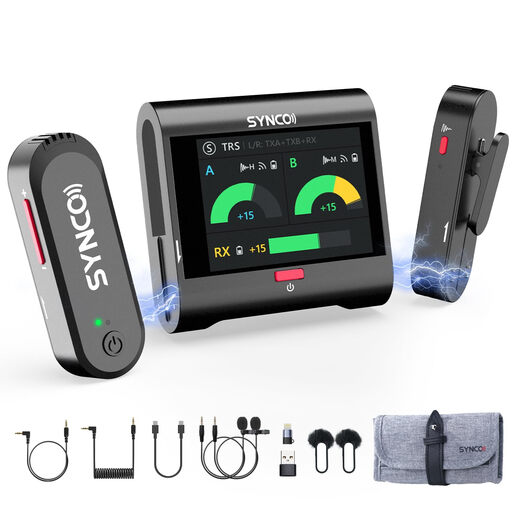
SYNCO G3PRO wireless lavalier microphone system with two lavalier microphones
A wireless system with two lavalier microphones is one way to record several speakers; check that it has a connection suitable for your recording device.
The product title lists a 2.4 GHz connection and two lavalier microphones.
View at Joybuy
 No image available
Yinkaer G10-P17-P17 podcast kit with two microphones and audio mixer
This kit is designed for a two-microphone setup; check in advance that your intended recording device is compatible with the mixer setup.
The product title lists two 3.5 mm condenser microphones, an audio mixer and stands. Computers and mobile phones are listed as compatible devices.
View at Joybuy
Frequently asked questions
Can software noise reduction help with fan noise?
Shure describes a switchable feature on the MV7+ and original MV6 for reducing steady sounds such as fans. According to Shure, it doesn’t reliably remove other voices. Test the feature with everyone taking part, and don’t rely on it instead of positioning the microphones appropriately.
How should I position a microphone for close-up voice recording?
Point the microphone towards the person speaking and listen back to a test recording from the seat they’ll be using. For the PodMic USB, RØDE recommends a distance of around 5–10 cm; don’t apply this recommendation to other models without checking first.
What do I need to connect several XLR microphones to a computer?
To connect several XLR microphones to a computer, you’ll need a suitable recorder or interface with enough inputs to use at the same time, as well as the right cables. Elgato explains that the number of microphones needs to match the number of available interface inputs. Also check the mounts and accessories needed for each speaker.
Can I record a book discussion without the others knowing?
Recording another person’s private words without their permission is an offence under section 201 of the German Criminal Code (StGB). The Federal Office of Justice and the Federal Ministry of Justice publish the text of the law. Make sure everyone involved knows about the recording before you start.
Can I read extracts from a book in an episode I publish?
Not every book discussion gives you permission to read passages of any length. Under section 51 of the German Copyright Act (UrhG), the length of a quotation is limited by its specific purpose; section 63 sets out the requirements for acknowledging the source. The Federal Office of Justice and the Federal Ministry of Justice publish the texts of the laws. Check the specific passage and how you plan to use it rather than assuming that owning the book gives you blanket permission to publish it.


