
Lieferung heute & morgen

Qualitätsgarantie

Willkommens-Angebote freischalten: KOSTENLOSE Lieferung | Bis zu 80 % RABATT | Kostenlose 30-Tage-JoyPlus-Testphase
App herunterladen
A bookcase needs to hold your books securely, make use of unused wall space, and blend in with your décor. In small flats, home offices or bedrooms, it’s not just about looks. What really matters are the dimensions, weight capacity, material, and whether the shelf suits how you plan to use it.
A shelf can look compact in product photos but still be too deep or too wide for the spot you have in mind. Before you buy, measure the available area and also check that doors, windows, radiators or desk chairs won’t be obstructed.
With a freestanding bookcase, you also need to consider the room height and the gap to the ceiling. A tall model may only be possible to stand upright if you have enough clearance.
“Wood effect” doesn’t automatically mean solid wood. A wooden bookcase can be made from solid wood, MDF, particle board or coated wood-based materials. These materials differ in weight, surface finish, care requirements and load capacity.
So pay close attention to the specific material listed:
The number of shelves doesn’t tell you how many books can actually go on them. Paperbacks, ring binders and decorative items all distribute their weight differently. Heavy items should go on the lower shelves wherever possible.
Check whether a maximum load per shelf is stated, and whether a wall fixing or anti-tip kit is included. This is especially important for tall, open shelves and in homes with children – the furniture should stand on a level floor and be secured against tipping over.
Measure the width, height and depth of the spot where you plan to place it. A bookcase with multiple shelves offers vertical storage but needs enough height. For a workspace, a desk shelf with a shallow depth may be more suitable than a freestanding bookcase.
For unused corners, a corner shelf or a space-saving L-shaped unit makes sense. Pay attention to the actual footprint, not just the width of one side.
Fixed shelves work well if your books, folders or boxes are all a similar height. Adjustable shelves give you more flexibility. An open shelf is easy to access and works well for plants, picture frames and décor. At the same time, the contents are on display and more prone to dust than in closed compartments.
Check whether assembly is required and how many people it’s designed for. Screw connections should be checked after assembly and tightened if needed. For tall shelves, a sturdy base, adjustable feet or an anti-tip device are practical features.
An industrial shelf often combines a metal frame with wood-based or laminate shelves. A vintage shelf, on the other hand, usually relies on an aged colour finish or decorative side panels. Both terms primarily describe the style, not automatically the quality or load capacity.
The selection below matches specific models to your space and purpose. The product specifications provided are the key reference.
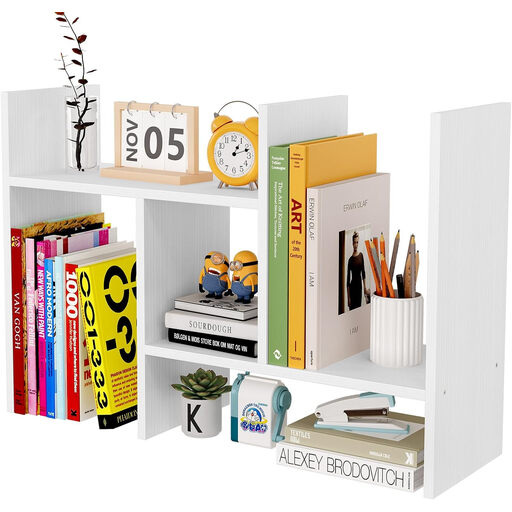
Why this product fits the profile: This compact desk shelf can be adjusted in width from 41 to 73 cm, creating extra storage space in your home office, study or bedroom.
The adjustable width reduces the risk of the shelf not fitting on your existing desk. The product description clearly states it is made from melamine board, not solid wood.
Two adjustable shelves, 19 cm depth, and includes screws and a screwdriver.
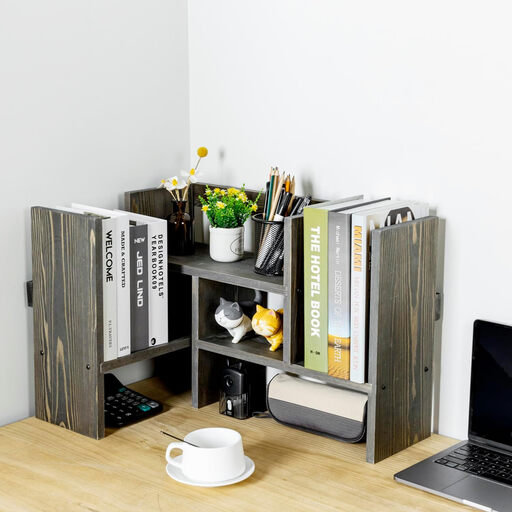
Why this product fits the profile: This solid wood desktop shelf combines three tiers with a rustic grey finish, and is suitable for books, folders, plants or tech accessories.
The material and dimensions are clearly stated: solid wood, 15.7 inches wide, 6.7 inches deep and 15.4 inches high. This makes it easier to judge whether it will suit your desk.
Three tiers, height-adjustable shelves, freestanding use with assembly instructions.
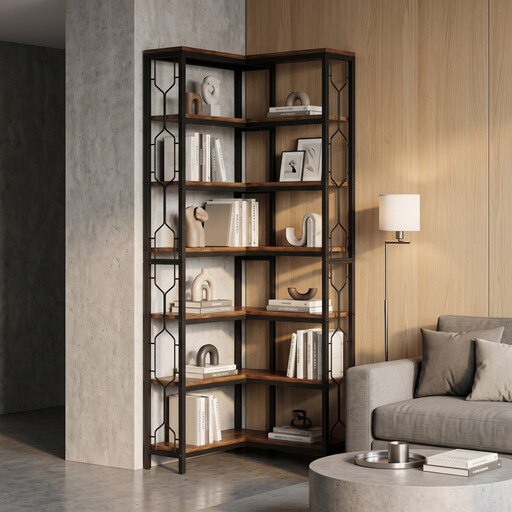
Why this product fits the profile: The L-shaped design makes use of corners in your living room, kitchen or home office. Seven tiers offer space for books, plants and décor.
The dimensions of 60 × 60 × 200 cm make the space requirement clear. Adjustable feet and an included wall anti-tip kit address uneven floors and stability.
Powder-coated metal frame, seven tiers and, according to the product information, up to 45 kg load capacity per shelf.
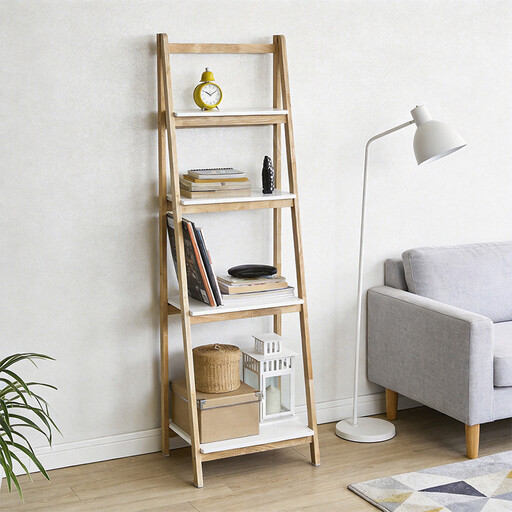
Why this product fits the profile: This foldable ladder shelf is ideal for rented flats, guest rooms or spaces that are occasionally repurposed.
The product details explicitly mention the folding function. This means the furniture can be stored away compactly when not in use, rather than taking up floor space permanently.
Four shelves, rubberwood frame, dimensions of approximately 42 × 140 × 34 cm and up to 15 kg per shelf according to the product information.
We’ve put together a full, regularly updated list of products that fully meet these strict selection criteria and the safety regulations in force in the EU.
For paperbacks, around 20 to 25 cm depth is usually enough. Larger hardbacks, ring binders or decorative baskets need more space. Measure the largest item you plan to store and add a little extra room. For a desk, a shallower depth is often better so you can still use the work surface.
The shelf should stand on a level floor. Heavy items go on the bottom, while light décor can be placed on the upper shelves. For tall furniture, it’s advisable to use the supplied anti-tip device following the assembly instructions. A shelf should never be used as a climbing aid, nor should it be moved while loaded.
Remove dust with a soft, dry cloth. Moisture should not be left standing on the surface. Aggressive cleaning products are usually not necessary for coated shelves. Also check the screws, connectors and stability from time to time, especially if the shelf is used frequently or moved around.