
Lieferung heute & morgen

Qualitätsgarantie

Willkommens-Angebote freischalten: KOSTENLOSE Lieferung | Bis zu 80 % RABATT | Kostenlose 30-Tage-JoyPlus-Testphase
App herunterladen
A bookcase should hold your books securely, make sensible use of the available space and complement your interior. In practice, however, poor purchases are not caused by price and appearance alone. Unclear dimensions, overestimated load capacities and complicated assembly often make a bookcase impractical later on.
This buying guide from the Joybuy Product Recommendation Officer explains the most important criteria and shows which freestanding bookcase, wooden bookcase or wall-mounted shelf could suit different living situations.
A tall bookcase can look spacious in product photos. What really matters, however, are the usable internal dimensions of each shelf. Paperbacks need less depth than large coffee-table books, ring binders or storage boxes. So be sure to check:
A bookcase with multiple shelves makes good use of the room’s height, but it must be positioned securely to prevent tipping. In smaller homes, a space-saving shelf with a vertical design may be more practical than a wide model.
Marketing images often show books, plants and decorations all together. However, the permitted load must be considered per shelf, not just for the furniture as a whole. Particularly heavy ring binders or large books should be placed in the lower sections.
Look for a clear specification such as ‘up to 15 kg per shelf’ or ‘up to 45 kg per shelf’. If no such specification is provided, the actual load should be calculated conservatively. Weight should be distributed evenly to prevent the shelves and frame from warping unnecessarily.
An open bookcase is accessible from several sides, but this also means it can become unbalanced more easily if the load is unevenly distributed. For tall furniture, an included anti-tip kit is important. The appropriate wall fixings depend on the type of wall: concrete, brick, plasterboard and lightweight partition walls require different wall plugs and screws.
Even a seemingly simple shelf can involve several assembly steps. Before buying, check whether assembly is intended to be carried out by two people and whether there is enough room to put it together.
A wooden bookcase made from solid wood can offer a natural surface and distinctive grain. MDF or chipboard models, on the other hand, provide consistent surfaces and a choice of finishes. The material designation alone does not indicate how stable a unit will be. The following factors are also important:
An industrial-style shelf often combines a metal frame with wooden or MDF shelves. This design works well in living rooms, studies or hallways. In damp areas such as kitchens or bathrooms, pay attention to the care instructions and the suitability of the surface finish.
A tall bookcase can provide plenty of storage while taking up little floor space. However, models around 170 to 200 cm high should always be checked for stability and secured to the wall in accordance with the manufacturer’s instructions. A corner shelf makes use of otherwise unused corners, but requires two unobstructed walls and sufficient clearance from other furniture.
Open compartments are ideal in the living room for combining books, pictures and plants. In a home office, larger compartment heights are more important for ring binders and documents. A shelf for books with narrow compartments can be used in a bedroom or hallway where space is limited.
Always follow the lower limit when different load capacities are specified for individual shelves and the bookcase as a whole. Heavy items should be placed at the bottom. Children should not climb onto the shelves or hang from the furniture. For a living-room shelf or a unit in a child’s bedroom, an anti-tip fitting is especially important if the furniture is freely accessible.
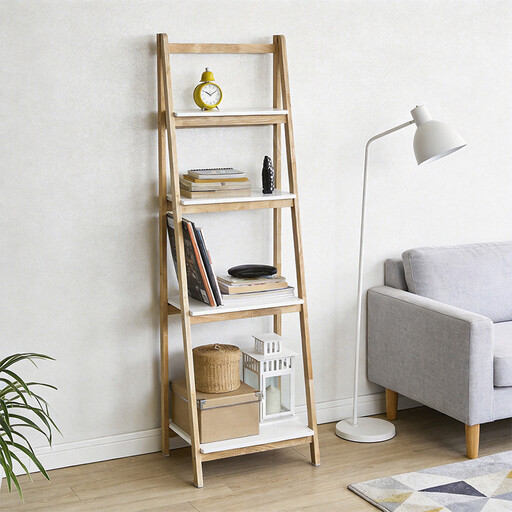
Why this product suits this profile: This folding freestanding bookcase with four shelves is ideal for smaller rooms, students or changing requirements. Measuring approximately 42 × 140 × 34 cm, it can be stored away compactly when not in use.
The product details specify a load capacity of up to 15 kg per shelf. This makes it easier to plan how much to store than when only an unclear overall capacity is given.
Rubberwood frame, white-painted MDF shelves, four tiers, plus assembly hardware and instructions included.
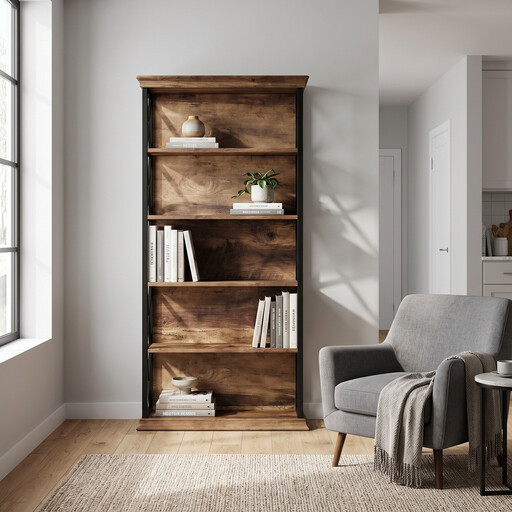
Why this product suits this profile: This 180 cm-high open bookcase is designed for anyone who needs vertical storage in the living room, study or home office and wants to combine metal with a wood-effect finish.
The specifications state a maximum load of 34 kg per shelf, as well as an anti-tip kit. The wall fixing should be used in accordance with the instructions.
Approximately 80 × 30 × 180 cm, E0 MDF shelves, metal frame and five shelves according to the product specification.
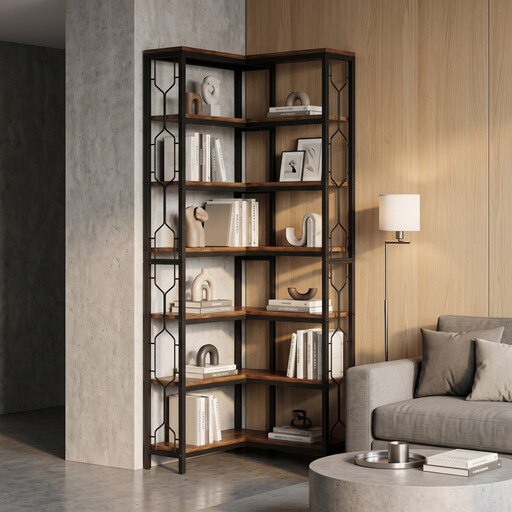
Why this product suits this profile: This L-shaped corner shelf makes use of corners in the living room, kitchen or home office. Seven tiers provide space for books, plants, decorations and household items.
Adjustable feet and an anti-tip kit help with positioning. The manufacturer’s specification of up to 45 kg per shelf does not replace even weight distribution or wall fixing.
Approximately 60 × 60 × 200 cm, E0 chipboard, powder-coated metal frame and seven shelves.
We have put together a complete, regularly updated list of products that fully meet these strict selection criteria and the safety regulations applicable in the EU.
Place the bookcase on a level, load-bearing surface. Anti-tip protection should be installed on tall or narrow models. Distribute heavy books and ring binders across the lower shelves. Decorations and lighter items can be placed in the higher compartments.
For care, a soft, dry or slightly damp cloth is usually sufficient. Avoid standing water, harsh cleaning products and prolonged exposure to direct sunlight if the manufacturer advises against it. Occasionally check the screws, wall plugs and connecting elements on wall-mounted shelves and tall freestanding bookcases.
For ordinary paperbacks, a usable depth of around 20 to 25 cm is often sufficient. Large hardbacks, ring binders and coffee-table books need more space. What matters is not just the overall depth, but the actual depth of the shelf.
For tall, narrow or asymmetrically loaded bookcases, fixing the unit in accordance with the manufacturer’s instructions is advisable. Use wall plugs and screws suitable for the type of wall, and never exceed the stated load capacity.
A freestanding bookcase generally offers more storage for ring binders and books. A wall-mounted shelf saves floor space and is suitable for smaller items or decorations. When storing heavy files, the load-bearing capacity of the wall fixings should be checked particularly carefully.