
Lieferung heute & morgen

Qualitätsgarantie

Willkommens-Angebote freischalten: KOSTENLOSE Lieferung | Bis zu 80 % RABATT | Kostenlose 30-Tage-JoyPlus-Testphase
App herunterladen
A bookcase should safely hold books, display decorations and make sensible use of the available space. In living rooms, bedrooms, home offices, studies and kitchens, it is therefore not just the colour and style that matter. Dimensions, load capacity, material and a suitable construction are all important.
However, several common marketing claims can lead to poor purchasing decisions:
Checking these points before ordering will help you choose a decorative bookcase that is better suited to your room and intended use.
Measure not only the width of the wall, but also the depth and the height up to skirting boards, radiators or sloping ceilings. A space-saving bookcase makes use of vertical space, but must not restrict passageways or windows.
A model around 180 cm high offers plenty of storage space while taking up little floor space. Also check whether the shelf height is suitable for your belongings:
A freestanding bookcase with open compartments can be used flexibly. For households with children or pets, protection against tipping is particularly important.
When choosing an MDF or chipboard bookcase, pay attention to the material thickness, edge finishing and connecting elements. MDF is made from compressed wood fibres and provides an even surface. Chipboard, as specified for the first model, is made from bonded wood chips and is often finished with a decorative surface.
A bookcase with a metal frame can have an industrial character thanks to its frame construction. However, what matters is how the shelves are attached to the frame. A black metal frame and a vintage wood effect initially describe the design, not necessarily the actual load capacity.
Pay attention to:
A 5-tier bookcase or 6-tier bookcase can offer considerably more storage space than a traditional piece of furniture with just a few wide shelves. However, the number of compartments alone says little about its practical capacity.
For example, a bookcase with eight open compartments is suitable for a mixture of books, plants and smaller decorative objects. Unevenly sized compartments can create visual interest, but require more careful planning. For a library or study, evenly sized compartments are often more practical.
The following models differ in dimensions, material, shelf layout and stated load capacities. This allows you to adapt your choice to your room and intended purpose.
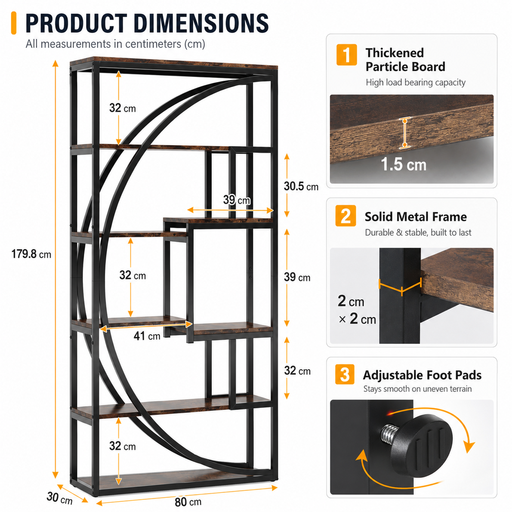
Why this product suits this profile: Measuring 80 × 179.8 × 30 cm, this bookcase makes good use of vertical space and offers five tiers with eight open compartments. The combination of vintage brown and a black metal frame suits industrial and contemporary interior styles.
The product description gives specific dimensions, the number of compartments, and details of the chipboard and metal frame. This makes it easier to plan around the actual available floor space.
Five tiers, eight open compartments, a vertical design and mounting accessories with instructions.
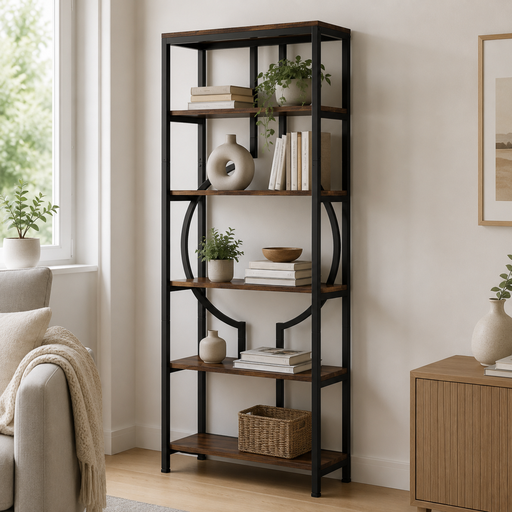
Why this product suits this profile: This industrial bookcase is 180 cm high, 70 cm wide and 30 cm deep. Six open tiers and the stated maximum total load of 100 kg provide a clear basis for planning your storage space.
The product information states a specific maximum load. It is still important to distribute the weight evenly and not exceed the stated limit.
Six shelves, a powder-coated metal frame and a scratch- and stain-resistant laminate surface according to the product description.
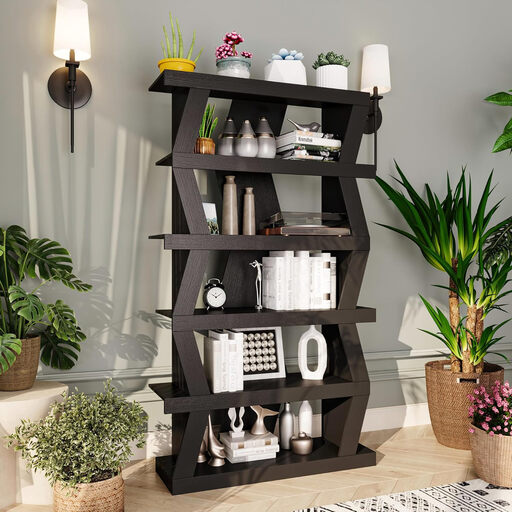
Why this product suits this profile: Measuring 90 × 30 × 162 cm according to the specifications and with five shelves, this MDF bookcase is suitable for living rooms, bedrooms, studies, libraries or kitchens. The uneven compartment layout supports mixed use with books and decorations.
A load of up to 10 kg is specified for each compartment. This makes it easier to organise your belongings, but does not replace even weight distribution or positioning on a level surface.
MDF construction, five shelves, a modern black finish and a stated compartment load of up to 10 kg.
We have put together a complete, regularly updated list of products that fully meet these strict selection criteria and the safety regulations applicable in the EU.
Read the instructions and sort the components before assembly. Tall bookcases should stand on an even, stable surface. Heavy books should preferably go on the lower shelves, with lighter items at the top.
Further practical tips:
This depends on the room height, available floor space and the amount of storage you need. A bookcase 180 cm high makes efficient use of wall space, but requires sufficient clearance from the ceiling and secure positioning. Before buying, measure the actual height, including skirting boards and any unevenness.
MDF and metal have different properties. MDF provides an even, enclosed surface, while a metal frame defines the look of the construction and, depending on its design, may provide additional frame connections. For your purchasing decision, specific details about load capacity, material thickness, connection points and anti-tip protection are more important than the material name alone.
Load capacity varies by model. The 6-Tier Bookshelf has a stated maximum total load of 100 kg, while the Caldion model is specified to hold up to 10 kg per compartment. These values apply only when the relevant usage instructions are followed. The weight should be distributed evenly and the maximum stated load must not be exceeded.