
Lieferung heute & morgen

Qualitätsgarantie

Willkommens-Angebote freischalten: KOSTENLOSE Lieferung | Bis zu 80 % RABATT | Kostenlose 30-Tage-JoyPlus-Testphase
App herunterladen
A bookcase should safely hold your books, make good use of the available space and complement your interior style. In practice, however, unsuitable purchases are often caused not by the design, but by unclear dimensions, overestimated load capacity or an unsuitable construction. Checking a few technical details before buying can significantly narrow down the options for your living room, bedroom, hallway, kitchen or home office.
A freestanding bookcase may look compact in product photos, yet take up too much room next to a door, beneath a window or beside a desk. Therefore, check the bookcase’s width, height and depth, as well as the space needed for skirting boards, sockets and access to windows.
A narrow bookcase is ideal for tight alcoves. A low model can be placed beneath a window or at the foot of a bed. In smaller homes, a room divider bookcase can add structure, but it requires sufficient floor space and should be secured to prevent it from tipping over.
A specification such as ‘maximum load’ does not automatically apply to every individual shelf. What matters is whether the figure refers to one shelf, the entire bookcase or an evenly distributed load. Heavy files and large coffee-table books should ideally be placed at the bottom. Concentrated loads from individual heavy items can put more strain on the shelves than evenly distributed books.
A bookcase with open compartments provides quick access and is suitable for books, plants or decorations. At the same time, its contents remain visible and are more exposed to dust. A bookcase with doors or partially enclosed compartments offers more privacy for documents, household items and smaller accessories. Before buying, be clear about whether displaying your belongings or keeping them protected is your priority.
Measure the available space at several points. In addition to the external dimensions, the internal dimensions of the compartments are important: files need more height than paperbacks, while vinyl records, storage boxes and large art books require greater compartment width and depth.
A staircase bookcase uses its stepped shape as a design feature. A folding bookcase, on the other hand, can be practical if it needs to be stored away or moved occasionally.
A wooden bookcase or a solid-wood bookcase has a different look and feel from a model made of MDF or coated wood-based board. For coated surfaces, care instructions and scratch resistance are important considerations. A bamboo bookcase can combine a natural appearance with a comparatively low weight. Nevertheless, the specific load limit of the model in question should always be observed.
For kitchens or bathrooms, an easy-to-clean surface and the intended area of use are key. Unless the manufacturer specifically states otherwise, moisture resistance should not be interpreted as general material durability.
A tall or heavily loaded bookcase can tip over. Look for a broad base, non-slip elements and an anti-tip device supplied with the product. In households with children, a bookcase must not be used as a climbing frame. Wall mounting should be carried out according to the type of wall, using suitable fixings.
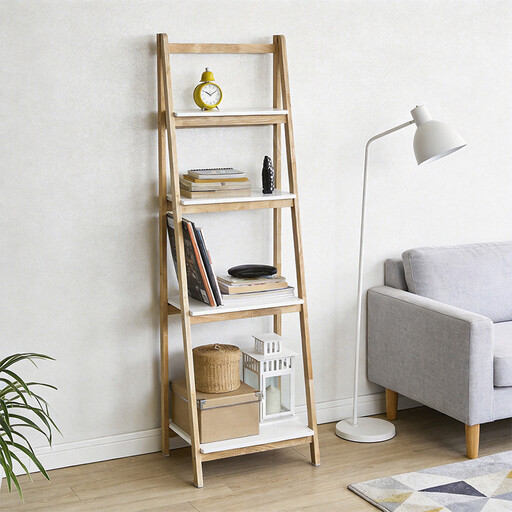
Why this product suits this profile: With four tiers, this folding freestanding bookcase is suitable for rooms where the bookcase may occasionally need to be moved or stored away to save space. According to the product information, its dimensions are approximately 42 × 140 × 34 cm.
The folding design reduces the space required for storage. The stated load capacity of up to 15 kg per shelf should be distributed evenly and must not be exceeded.
Four tiers, a Rubberwood frame, white-lacquered MDF shelves and foldable storage.
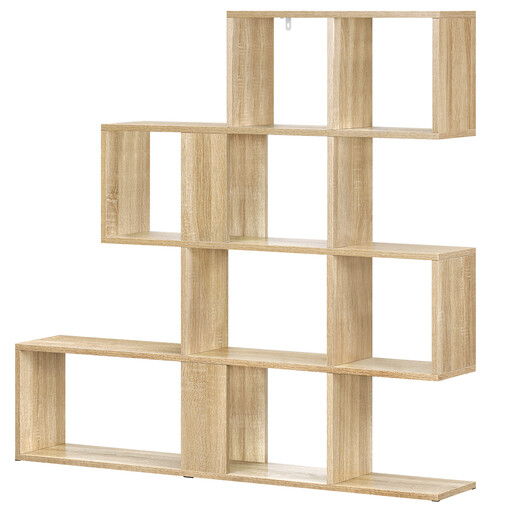
Why this product suits this profile: This bookcase is suitable for users who want to organise books, plants, boxes and decorations across several open compartments. Measuring approximately 115 × 109.5 × 19.5 cm, it can be used as a room divider bookcase or storage unit.
The product details specify 11 open compartments and a maximum total load of 70 kg. Because it features anti-tip protection, the bookcase must be permanently secured to the wall.
Four tiers, 11 open compartments, coated wood-based board and non-slip feet.
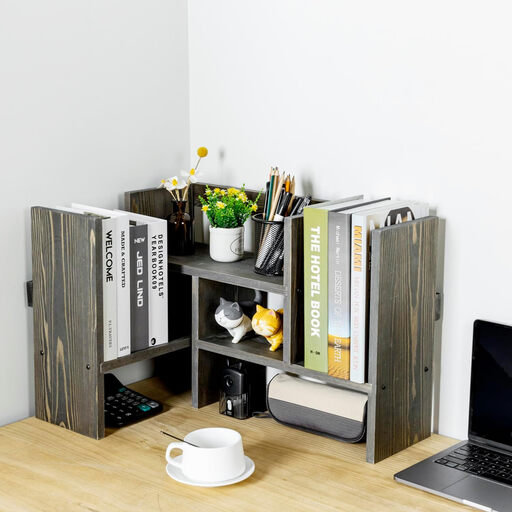
Why this product suits this profile: This desk shelf is designed for home offices, studios or compact workspaces. According to the product description, the three tiers can be adjusted to accommodate different books, files and office accessories.
The adjustable layout means that a small shelf is not limited to just one book size. It is described as a freestanding solution that does not require wall mounting.
Solid wood, three tiers, adjustable shelf heights and a depth of approximately 17 cm.
We have put together a complete, regularly updated list of products that fully meet these strict selection criteria and the safety regulations applicable in the EU.
Start by defining the intended use: A living room bookcase can be open and decorative, while an office bookcase often needs more space for files. For a bedroom or hallway, depth and available room for movement are particularly important. If you want the furniture to remain flexible, a folding bookcase may be a sensible choice. For discreet storage, a model with doors or baskets is recommended.
Also pay attention to the assembly instructions, the fittings supplied and the care information. Natural materials may feature variations in colour and texture. With a bamboo bookcase, the stated total load should be observed and the weight distributed evenly. Heavy items should always be placed on the lower shelves.
A depth of around 20 cm is sufficient for many paperbacks, while larger hardbacks and files require more. The dimensions of your existing books are the key factor. Greater depth is not automatically more practical, as it takes up floor space and can create unused room when the shelves are lightly loaded.
Place the bookcase on a level surface and use the anti-tip protection specified by the manufacturer. Secure it in a way that is suitable for the type of wall. Children should not climb on bookcases or hang from them. The specific safety instructions for the model in question take priority.
A narrow bookcase, a low bamboo bookcase or a desk shelf can make targeted use of the available space. Measure the available width, depth and height beforehand. With a room divider bookcase, you should also check that walkways remain clear and that wall mounting is possible.