
Lieferung heute & morgen

Qualitätsgarantie

Willkommens-Angebote freischalten: KOSTENLOSE Lieferung | Bis zu 80 % RABATT | Kostenlose 30-Tage-JoyPlus-Testphase
App herunterladen
A new bookshelf should bring order to your space while also serving as a visual highlight. But the selection is vast, and not every model lives up to what the product photos promise. As your Joybuy Product Recommendation Officer, I'll help you identify the crucial features and make a choice you won't regret years down the line.
Many buyers focus on design and overlook functional weaknesses that only become apparent in daily use. Before you decide on a model, you should be aware of three common pitfalls:
To avoid these pitfalls, you should base your decision on three objective criteria. These will help you realistically assess the functionality and quality of a bookshelf.
The material determines not only the look but also the stability and longevity.
A crucial value is the maximum load capacity per shelf. Manufacturers often specify this value in kilograms. A typical value for basic shelves is 5–10 kg, while more robust models can support 15 kg, 30 kg, or more per shelf.
Think carefully about where and for what you need the shelf. The design is crucial for optimal use of space.
A stable footing is essential. Look for the following features:
Here are some models tailored to specific needs and living situations that meet the quality criteria mentioned above.
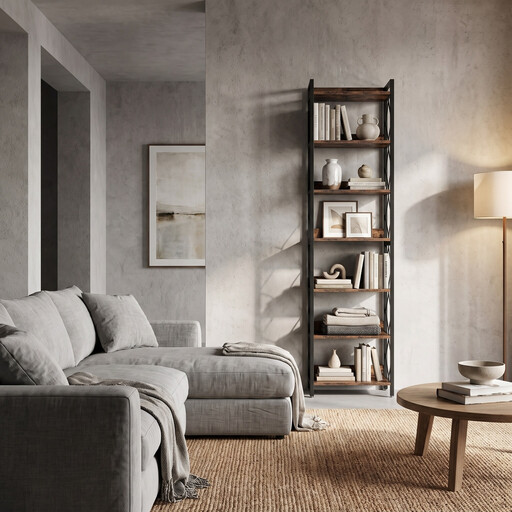
Why This Fits Their Persona: Ideal for anyone living in smaller apartments or rooms who wants to utilize every inch. This tall and narrow corner shelf transforms an often-unused corner into maximum vertical storage space.
It solves the problem of impractical design by being specifically conceived for corners. Its 200 cm height utilizes vertical space instead of width, thus avoiding the trap of bulky furniture in small rooms.
A combination of a metal frame and particleboard provides good stability. According to the manufacturer, an anti-tip kit is included to ensure the safety of the tall shelf.
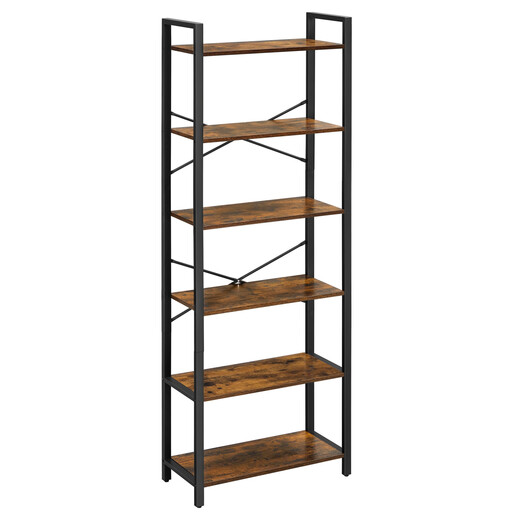
Why This Fits Their Persona: For those who appreciate the urban, robust look of industrial style and are looking for a piece of furniture that cuts a fine figure in both the home office and the living room. It combines functionality with a clear design statement.
This model counters the stability trap with X-bracing on the back and a steel frame. These design features provide significantly more stability than simple shelves without reinforcement.
Adjustable feet to compensate for uneven floors. The combination of steel and particleboard allows for a high total load capacity of 60 kg, according to the manufacturer.
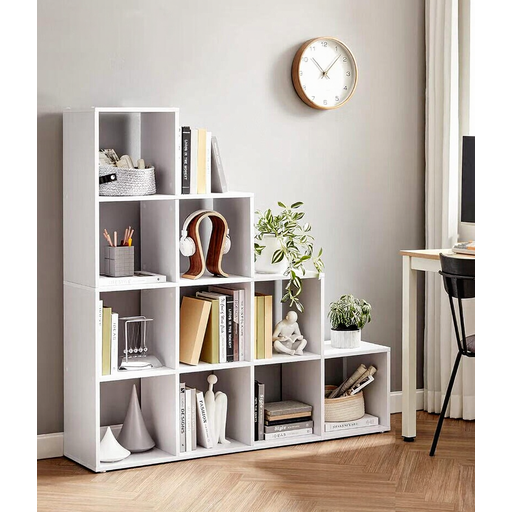
Why This Fits Their Persona: Perfect for people who love open-plan living and seek furniture that serves multiple functions. This stepped shelf can stand against a wall or act as a stylish room divider to separate different living areas.
It bypasses the trap of rigid, single-function shelves. Since it is accessible and attractive from both sides, it is suitable as a room divider, which is not the case with most standard shelves that have a plain back panel.
The 10 cube compartments offer versatile storage space. According to the manufacturer, each compartment holds up to 15 kg, and the melamine surface is scratch-resistant and easy to clean.
We have compiled a complete, up-to-date list of products that fully meet these strict selection criteria and German safety regulations.
The load capacity varies greatly depending on the material and construction. Simple shelves made of thin particleboard often only support 5–10 kg. Models with thicker shelves (15 mm or more) or those with a metal frame can support 15 kg or more per shelf. Always check the manufacturer's specifications for maximum load capacity to avoid sagging or breaking.
Yes, wall mounting is recommended for any shelf that is taller than it is deep, especially for heights over one meter. An included anti-tip kit should always be installed. This increases stability and is an important safety measure to prevent the shelf from tipping over, especially in households with children or pets.
A "wood-effect" shelf usually consists of a core board (typically particleboard or MDF) onto which a printed foil or veneer with a wood grain is applied. A real wood shelf or solid wood shelf is made entirely of wood. Real wood is generally more durable, heavier, and can be repaired if damaged, whereas wood-effect surfaces are easier to clean but cannot be repaired if deeply scratched.