
Lieferung heute & morgen

Qualitätsgarantie

Willkommens-Angebote freischalten: KOSTENLOSE Lieferung | Bis zu 80 % RABATT | Kostenlose 30-Tage-JoyPlus-Testphase
App herunterladen
A new bookshelf should create order, provide storage, and look great while doing it. But the search for the right model can quickly become overwhelming. Too often, it's only after assembly that a supposed bargain reveals flaws that complicate daily life. As your Joybuy Product Recommendation Officer, I'm here to help you identify common pitfalls and make an informed decision.
Many buyers experience disappointment after their purchase. Certain problems arise time and again, but they can be avoided with a careful check before you buy.
To prevent these issues, you should carefully examine three core aspects before buying. These factors define the durability and functionality of your new shelf.
The choice of material is crucial for durability. Common materials include:
The maximum load capacity per shelf is a key metric that should be listed in the product data. A bookshelf requires a higher load capacity than a purely decorative shelf. Look for the following stability features:
A shelf must fit your space and your needs. Measure not only the footprint but also the items you plan to store.
Based on these objective criteria, we have identified several models that offer an ideal solution for specific requirement profiles.
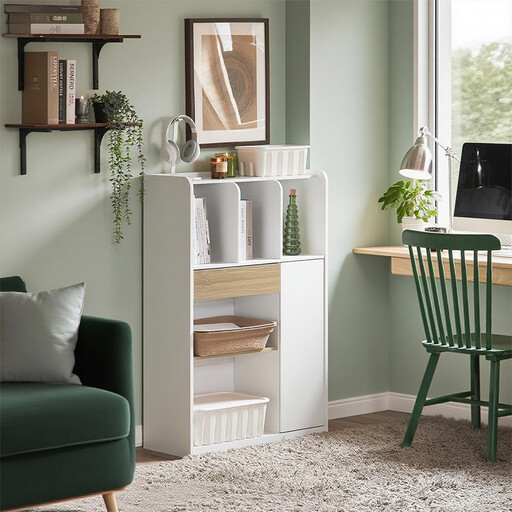
Why It's a Great Fit: Ideal for the home office or small apartments where every inch counts. The combination of open compartments for books and binders and a closed drawer for private documents creates order within a compact footprint.
The clear dimensions (72x110x30cm) and defined drawer size prevent the problem of incorrect measurements. The MDF (E1) material ensures solid core stability.
Combines open and closed storage. The shallow 30 cm depth makes it a perfect solution for niches or areas behind a desk.
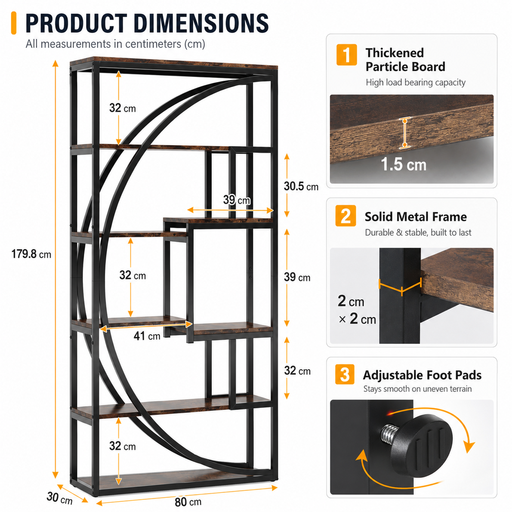
Why It's a Great Fit: For anyone looking for a functional piece of furniture with character. The combination of a wood-look finish and a black metal frame makes a clear statement and fits perfectly into modern living or office spaces.
The continuous metal frame and the geometric arrangement of the compartments provide high inherent stability, counteracting the problem of wobbly constructions.
With 8 asymmetrically arranged compartments on 5 levels, it offers plenty of space for books and decor. The design itself becomes a focal point in the room.
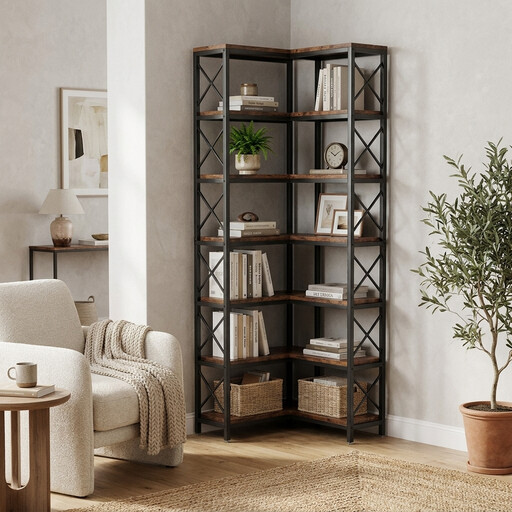
Why It's a Great Fit: This corner shelf is specifically designed to transform an often-unused corner into valuable storage space. With its 200 cm height, it maximises vertical storage without taking up much floor space.
The design, featuring X-bracing and adjustable feet, directly addresses the stability problem. The high load capacity of up to 20 kg per shelf is clearly specified.
Turns a "dead" corner into a functional and visually appealing area. The 7 tiers offer exceptional space for books, plants, or decorative objects.
We have compiled a complete, up-to-date list of products that fully meet these strict selection criteria and safety standards.
1. How much weight can a freestanding shelf hold? Load capacity varies greatly depending on the model and material. A simple decorative shelf often holds only 5-10 kg per tier, whereas a sturdy bookshelf or office shelf with a metal frame and thick boards can support 20 kg or more per level. Always check the "maximum load capacity" in the product details to avoid overloading.
2. How do you securely attach a tall shelf to the wall? Wall mounting is essential for tall and narrow shelves. Most manufacturers include a so-called anti-tip kit. This is usually a bracket or strap that is screwed to the top of the shelf and to the wall. This is an important safety precaution, especially in households with children or pets.
3. What is the most durable material for a bookshelf? For maximum durability, solid wood is an obvious choice, but it is often heavier and more expensive. A very good alternative is a shelf made of wood and metal. The metal frame provides a durable, stable structure, while shelves made of high-quality MDF or veneered particleboard offer a resilient and easy-to-clean surface. This combination is an excellent compromise between durability, aesthetics, and price.