
Lieferung heute & morgen

Qualitätsgarantie

Willkommens-Angebote freischalten: KOSTENLOSE Lieferung | Bis zu 80 % RABATT | Kostenlose 30-Tage-JoyPlus-Testphase
App herunterladen
A bookshelf should safely hold books, folders, plants and decorations while fitting neatly into the available space. In practice, however, some common purchasing decisions can lead to unnecessary costs: the shelf is too deep for the hallway, the shelves are not high enough for lever arch files, or the construction looks stable but still needs to be secured to the wall.
A substantial appearance does not automatically mean a high load capacity. The key factors are the stated maximum load per shelf, the product’s own weight, its construction and whether it can be secured against tipping. Tall, freestanding shelving should be secured to the wall using the supplied anti-tip protection, particularly in households with children or pets.
Width and height alone are not enough when choosing a shelf. The shelf depth determines whether a freestanding unit leaves enough room in the hallway, beside the desk or in a narrow alcove. Before buying, you should also check whether skirting boards, radiators, doors or sockets could obstruct installation.
A shelf with several levels is not automatically equally suitable for books, file folders and decorations. The distance between shelves, usable depth and load capacity are all important. With a ladder shelf or an open staircase design, the available storage space also varies at each level.
Measure the available space, including a small amount of clearance for assembly and cleaning. Books often require less depth than file folders or storage boxes. A narrow bookshelf can be a practical choice for a hallway or bedroom, while a wider model offers more display space for plants and decorations in the living room.
A corner shelf makes use of discreet areas of a room. Check the dimensions along both walls, as well as the height up to the windowsill or ceiling. A room divider shelf, on the other hand, should be sufficiently wide and stable, as it is visible from several sides and may be exposed to greater sideways pressure.
A wooden bookshelf may be made from solid wood, MDF, chipboard or a coated wood-based material. These terms describe different material constructions and should not be treated as interchangeable. Solid wood has a continuous wood structure, whereas MDF and chipboard are made from wood fibres or wood chips and are usually coated.
Pay attention to:
An E0 marking may be a manufacturer’s indication of the emissions class of a wood-based material. It does not replace checking the complete product information and the instructions for use.
The maximum load must be clearly stated for each shelf or for the shelving unit as a whole. Heavy books and folders should preferably be placed in the lower compartments. With tall or narrow models, wall mounting is an important part of safe use. The shelf should stand on a level surface; adjustable feet can help with minor unevenness in the floor.
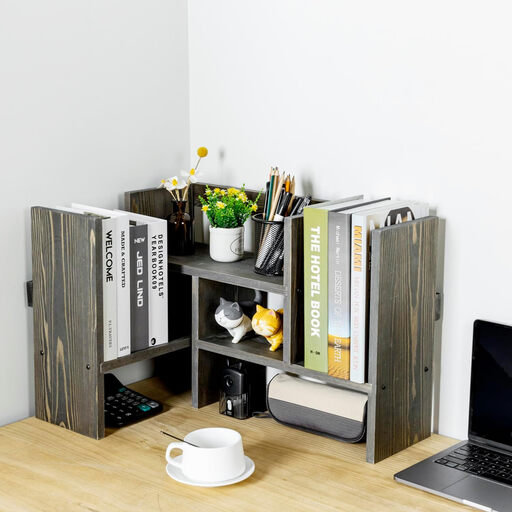
Why this product suits this profile: This compact desktop shelf is designed for home offices, studios or smaller living spaces. Three levels and adjustable heights are suitable for books, documents, plants and tech accessories.
Measuring 15,7 × 15,4 × 6,7 inches, its dimensions clearly limit how it can be used and prevent it being mistaken for a large freestanding shelf. The adjustable levels make it easier to accommodate different items.
Solid wood according to the product description, three storage levels and freestanding use; assembly instructions included.
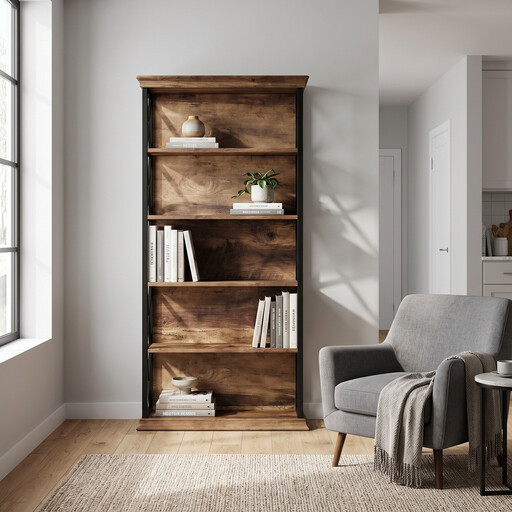
Why this product suits this profile: This 180 cm-high model combines wood-based material with a metal frame and is well suited to living rooms, offices or studies with an industrial interior.
The product information states a capacity of 34 kg per shelf and includes an anti-tip kit. This makes it easier to assess the load limits and safety measure before buying.
Dimensions of 80 × 30 × 180 cm, metal frame, five stated levels and guidance on distributing weight evenly.
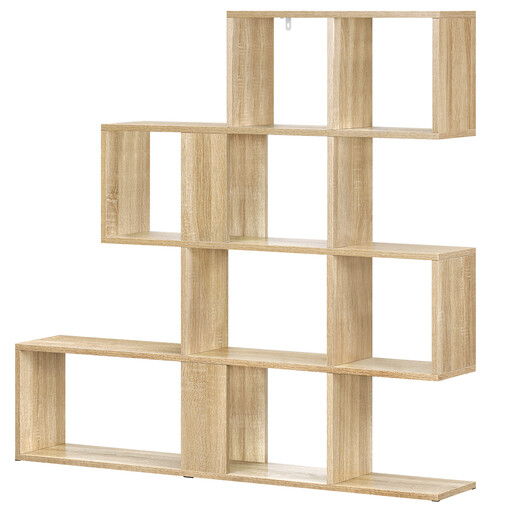
Why this product suits this profile: The combination of four levels and eleven open compartments is suitable for living rooms, bedrooms, kitchens or offices. As a room divider shelf, it helps structure larger spaces without a closed front.
With dimensions of 115 × 109,5 × 19,5 cm, its depth remains manageable. The product information states a maximum load of 70 kg and specifically highlights the need for permanent wall mounting.
Coated wood-based material, non-slip feet, 11 open compartments and anti-tip protection for wall mounting.
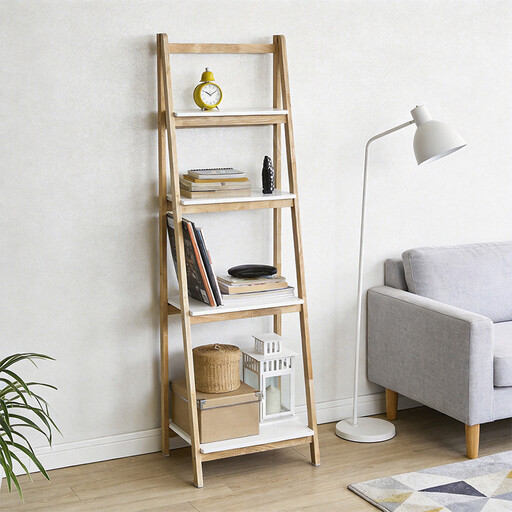
Why this product suits this profile: This foldable bookshelf is suitable for homes where space requirements change, guest rooms, kitchens or use as a plant stand.
The folding function makes the space required when not in use clear. The stated capacity of up to 15 kg per level helps you plan what to store on it.
Four levels, a Rubberwood frame, white-lacquered MDF shelves and dimensions of approximately 42 × 140 × 34 cm.
We have put together a complete, regularly updated list of products that fully meet these strict selection criteria and the safety regulations applicable in the EU.
Before assembly, check all parts against the product description. First place the empty shelf in the intended position and check whether it wobbles or obstructs doors and walkways. Heavy books should then be placed at the bottom, with lighter decorative items arranged above.
With an industrial bookshelf featuring a metal frame, check the screw connections after assembly. Coated surfaces can generally be cleaned with a soft, slightly damp cloth. Prolonged exposure to moisture, direct wetness and strong sunlight can damage wood-based materials, veneers and lacquers.
For many paperbacks and standard-sized books, a usable depth of around 20 to 30 cm is sufficient. Large illustrated books, folders or storage boxes may require more space. Measure your largest items and allow a little extra clearance.
For tall, narrow or heavily loaded models, wall mounting is advisable for safety reasons and is specified in many product instructions. Use the supplied anti-tip kit and choose wall plugs suitable for the type of wall.
Its service life depends on the material, assembly, load, humidity and care. Even weight distribution, observing the stated maximum load and regularly checking the connections can help maintain its functionality. General lifespan estimates are not reliable without specific information about how the product will be used.