
Lieferung heute & morgen

Qualitätsgarantie

Willkommens-Angebote freischalten: KOSTENLOSE Lieferung | Bis zu 80 % RABATT | Kostenlose 30-Tage-JoyPlus-Testphase
App herunterladen
A bookshelf should hold books securely, make sensible use of the available space and complement the surrounding interior. In practice, many models look larger, sturdier or more versatile in product images than they actually are in a room. Focusing solely on colour and price often means overlooking important details.
A narrow bookshelf saves floor space, but it does not automatically provide enough room for larger books, folders or decorative objects. Especially with a freestanding shelf for a hallway or bedroom, check the overall depth, including the base and any wall-fixing hardware. In tight niches, just a few centimetres can make a significant difference.
Height also deserves careful consideration: a 180- or 200-cm-high shelf requires a suitable wall area and should be secured against tipping. The room height alone is not a sufficient selection criterion.
A maximum load per shelf does not mean that the entire bookshelf can be loaded with any amount of weight. The weight should also be distributed evenly. Heavy books belong on the lower shelves, while decorations and lighter items can be placed higher up.
Specifications such as “up to 34 kg per shelf” or “up to 45 kg per level” are manufacturer claims and should not be exceeded. Actual stability also depends on the assembly, a level floor and the wall fixing.
An open shelf has a light, airy appearance and works well as a decorative bookcase for books, plants and picture frames. In kitchens, hallways or utility areas, however, open surfaces collect dust more quickly. A bookshelf with doors protects part of its contents and keeps personal items less visible.
For a room-divider shelf, also check whether both sides are visually appealing and whether the model can be securely attached to the floor or wall.
Compare the width, height and depth with the intended installation space. A narrow bookshelf around 25 to 30 cm deep is suitable for paperbacks and decorative items, while large coffee-table books or folders require greater internal dimensions. Measure not only the wall, but also doors, skirting boards and the route to the installation area.
The number of levels alone says little about the usable space. A shelf with 7 levels offers plenty of vertical storage, but may have shorter compartments. Therefore, check the clear height of each compartment.
For engineered wood, details such as MDF, particleboard or a coated finish are relevant. A melamine coating can make cleaning easier and protect the surface from everyday scratches. However, it is no substitute for careful use or protection against prolonged moisture.
A wooden shelf with a metal frame combines a warm look with a contrasting structure. With bamboo or rattan, the natural design is often the main attraction. For bathrooms or kitchens, follow the care and moisture-resistance recommendations stated for the specific product.
A freestanding shelf does not mean that no fixing is required. Tall or heavily loaded furniture can tip over if children climb on it, items are distributed unevenly or the floor is uneven. An included anti-tip kit should be attached to a suitable wall in accordance with the assembly instructions.
Look for adjustable feet, a sturdy rear or side structure and clear assembly instructions. If you live in rented accommodation, clarify in advance which type of wall fixing is permitted.
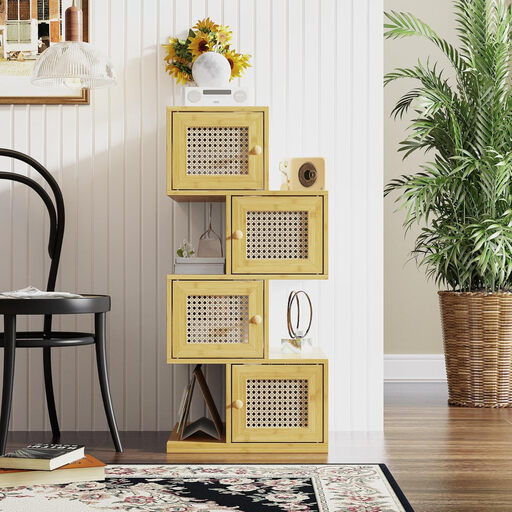
Why it suits this profile: Measuring 85 × 40 × 25.4 cm, this compact piece is ideal for small living rooms, hallways or beside the bed.
The dimensions are clearly stated. Four compartments, along with open and closed storage areas, make it easier to organise books and smaller items.
Bamboo frame, rattan doors and a surface described by the product listing as easy to maintain; suitable as a compact storage shelf.
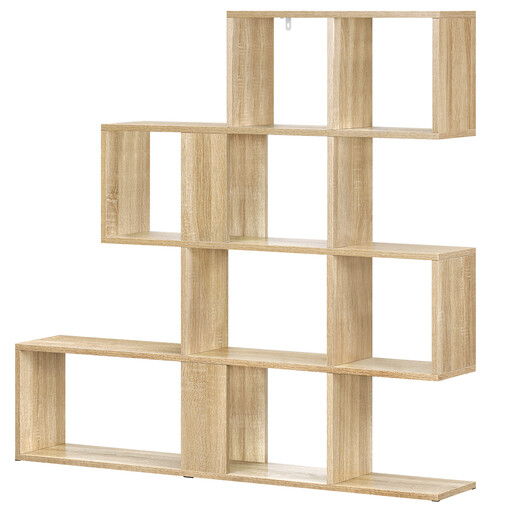
Why it suits this profile: Measuring 115 × 109.5 × 19.5 cm, its open, tiered design works well in living rooms, home offices or as a room divider.
The 11-compartment layout creates visible order rather than offering a single tall, difficult-to-use surface. Wall mounting is provided for.
Coated engineered wood, 11 open compartments and a maximum total load of 70 kg according to the product information.
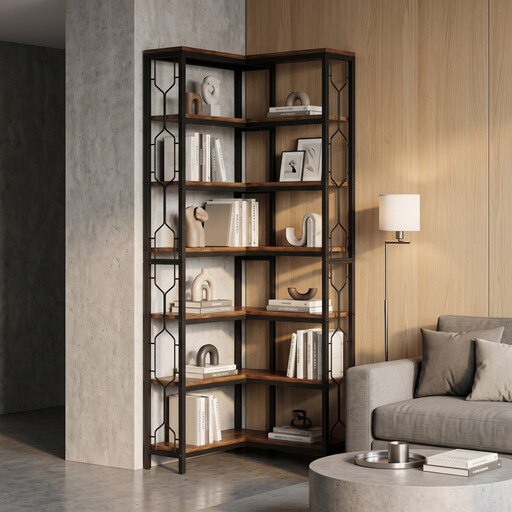
Why it suits this profile: The L-shaped design, measuring 60 × 60 × 200 cm, makes efficient use of a corner in the living room, kitchen or home office.
Adjustable feet and an included anti-tip kit accommodate uneven floors and the tall structure. The load must still be distributed evenly.
Powder-coated metal frame, seven levels and a capacity of up to 45 kg per level according to the supplier.
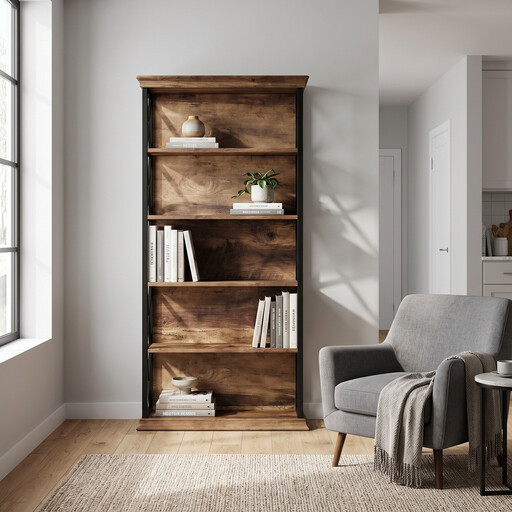
Why it suits this profile: Measuring 80 × 30 × 180 cm, this model provides vertical storage for living rooms, studies or kitchens.
The product specifies a load limit of 34 kg per shelf and includes an anti-tip kit. The product title refers to six levels, while the description mentions five shelves; this detail should be verified before purchase.
E0 MDF according to the product information, a metal frame, X-shaped side elements and an easy-care surface.
We have put together a current selection of products that meet these selection criteria and important safety requirements for use in Germany.
Place the shelf on a level, load-bearing surface and attach the specified anti-tip protection to the wall. Heavy books should be stored in the lower compartments. Children should not climb onto the shelves or hang from the sides or storage surfaces.
Its service life depends on the material, load, room climate and assembly. Evenly distributed weight, dry cleaning and protection against prolonged moisture can help preserve the surface. The key is not to exceed the stated load limit.
A bookshelf normally has no ongoing energy costs because it is not an electrical appliance. Potential additional costs may arise from assembly, wall fixing or extra storage boxes. When choosing a model, compare the included accessories, assembly effort and space requirements above all.