Which speakers are right for different listeners?

Dedicated stereo listeners

If you mainly want to assess the sound of guitar strings, vocals and stereo imaging from a fixed listening position, you can position both speakers to suit. Genelec recommends similar reflection conditions on the left and right for precise stereo imaging.

Listeners with limited space

If you need to fit a stereo pair into an open-plan living area, the space available and the possible positions to the left and right of your listening spot are important factors to consider. DALI says the KUPID comes with a wall bracket.

Listeners without an amplifier

If you want to connect your existing devices directly and don’t want to use a separate amplifier, active models with the right inputs are worth considering. The key is to check that the connections on the specific model match your music source.

What should you look for when choosing?

Passive bookshelf speakers

A good fit if: you already have a suitable amplifier or want to build a system from separate components.

Bear in mind: the amplifier, source connection and, where needed, speaker cables are all part of the system. Speaker placement still matters.

Active bookshelf speakers

A good fit if: you don’t want a separate amplifier and want to connect your source directly through a suitable input.

Bear in mind: check the power supply and the connection between the speakers; some models may need a cable for this.

Network-connected active stereo pair

A good fit if: you want to play music from network sources and use the features designed for them.

Bear in mind: with the KEF LSX II LT, the second speaker connects to the first by cable. Also check that your specific source is supported.

Buying priority What to check before buying Who is this important to?
Guitar and vocal reproduction Listen to familiar recordings and plan for both speakers to be positioned as symmetrically as possible. If I want to assess the sound of guitar strings and vocals from a fixed listening position, I focus on the stereo pair’s reproduction. Around 33 % of consumers put this priority first.
Positioning in the living area Check the available space, dimensions and cable routing. If placing the speakers near a wall, consider the position of the bass reflex port too. If furniture and walkways leave little room in an open-plan layout, I need to be able to position a stereo pair practically. Around 27 % of consumers prioritise speaker placement.
Connections and system set-up Match your source to the inputs; with passive speakers, check amplifier compatibility. If I want to connect my existing devices without needing unplanned extra components, the whole signal path matters. Around 20 % of consumers prioritise suitable connections and a straightforward system set-up.
Being considerate of neighbours Check your tenancy agreement and local rules, and assess the volume from your actual listening position. If I listen to music in a flat, I want to choose a volume that’s considerate of the people around me. Around 20 % of consumers make this their main priority.

Common buying misconceptions

  • Judging sound quality by the wattage

    The power rating given by the manufacturer for the Edifier R1280DB doesn’t tell you about sound quality or stereo imaging from your own listening position.

    Don’t compare power ratings in isolation. Consider speaker placement and your music source too, and listen to familiar recordings if you can.

  • Budgeting only for the speakers when buying passive models

    Passive speakers need a suitable amplifier and don’t have the direct inputs found on an active model such as the ELAC Debut ConneX DCB41.

    Before choosing, make a note of the signal path from the recording to both speakers and check which components you already have.

    A suitable amplifier and, where needed, cables or a source device may take up extra space and require additional set-up.

  • Assuming “wireless” means the speakers connect to each other without a cable

    According to the manufacturer, the second speaker on the KEF LSX II LT connects to the first by cable.

    For the specific model, check separately how music is transmitted, how the speakers are powered and how they connect to each other.

    Allow space for the cable run between the speakers.

Brands and suitable product ranges

ELAC

The Debut 3.0 DB63 is a passive bookshelf speaker option; the Debut ConneX DCB41 is an active alternative with direct inputs.

  • ELAC specifies a nominal impedance of 6 Ω and a front port for the DB63. For the DCB41, the manufacturer lists HDMI ARC, analogue and optical inputs, USB and Bluetooth, among other features.
  • The DB63 needs a suitable amplifier. The manufacturer’s specifications don’t prove that it sounds better with acoustic guitar recordings in a particular room.

DALI

The KUPID is a passive option if compact dimensions or wall mounting are important considerations in your plans.

  • DALI says a wall bracket is included.
  • The amplifier, mounting location and speaker placement all need to suit your planned system. The manufacturer’s sound claims aren’t independent proof of performance in an open-plan flat.

Edifier

The R1280DB is an active option for sources you want to connect via Bluetooth, optical or analogue inputs.

  • Edifier specifies a total output of 42 W RMS, with bass and treble controls.
  • The rated power isn’t a comparative test of sound fidelity or the volume you can achieve in a particular room layout.

Wharfedale

The Diamond 12.1 is a passive bookshelf speaker option for a system with a separate amplifier.

  • Wharfedale specifies a 130 mm mid/bass driver and a 25 mm tweeter.
  • These design specifications aren’t an independent measurement of how the speakers will sound in your living room.

KEF

The LSX II LT is a network-connected active stereo pair for listeners whose sources are compatible with its streaming and digital inputs.

  • KEF lists HDMI ARC, USB-C and an optical input.
  • The second speaker connects to the first by cable; the product specifications don’t prove that it’s particularly suitable for a specific guitar recording.

Joybuy products for different systems

This selection includes active bookshelf speakers with direct source connections, as well as passive pairs for systems with a separate amplifier.

Pair of Lemega active 40 W bookshelf speakers

Lemega Active 40W Bookshelf Speakers, Pair

An active pair for connecting your sources directly, without using a separate amplifier.

Features listed in the product name: Bluetooth, HDMI ARC, optical, USB, AUX and RCA inputs, LED display, bass and treble controls, and remote control. According to the product description, the speakers connect to each other using speaker cable.

View on Joybuy
HiVi-Swans OS-10 active Bluetooth bookshelf speakers

HiVi-Swans OS-10 Active Bookshelf Speakers

An active option if Bluetooth is suitable for your music source.

Features listed in the product name: Bluetooth 5.0, 4-inch woofer, 62 W RMS and touch controls.

View on Joybuy
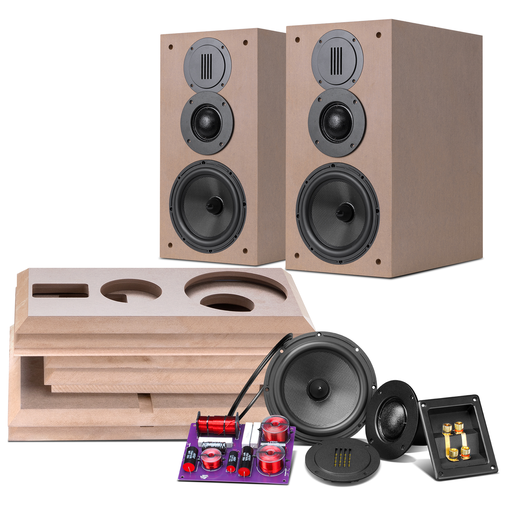
Pair of HiVi-Swans DIY3.1 passive bookshelf speakers

HiVi-Swans DIY3.1 Passive Bookshelf Speakers, Pair

A passive pair for a system with a separate, suitable amplifier.

Feature listed in the product name: 6.5-inch drivers.

Allow for the rear bass reflex port when positioning the speakers.

View on Joybuy
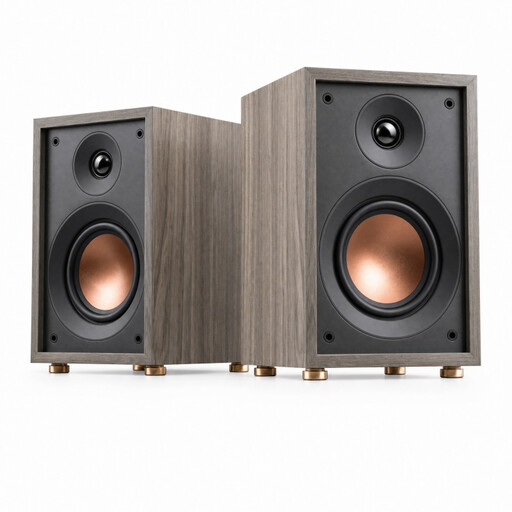
HiVi-Swans Oasis passive bookshelf speaker

HiVi-Swans Oasis Passive Bookshelf Speaker

A passive option if you already have a suitable amplifier and plan to add the pair to your separate stereo system.

Features listed in the product name: 4-inch woofer, 20 mm dome tweeter, 60 Hz–20 kHz, 4 Ω and 10–50 W. A suitable amplifier is required.

View on Joybuy

HiVi D3.1MKII passive bookshelf speakers

HiVi D3.1MKII Passive Bookshelf Speakers

A passive pair for a system with a suitable amplifier. Make room for the rear bass reflex port too.

Features listed in the product name: 6.5-inch mid/bass driver, 28 mm dome tweeter, 8 Ω and 10–120 W.

View on Joybuy

Frequently asked questions

Do I need an amplifier for passive bookshelf speakers?

Yes, passive bookshelf speakers need a suitable amplifier. Check the electrical specifications of the specific pair and make sure they’re compatible with your amplifier. For example, ELAC specifies a nominal impedance of 6 Ω and a recommended amplifier power of 20–140 W for the DB63.

How should I position a stereo pair for a fixed listening spot?

Start by positioning the speakers as symmetrically as possible on the left and right, and angle them towards your listening spot. Genelec describes this arrangement as a guide for studio monitors, but it doesn’t guarantee the same result in every flat.

How can I be considerate of my neighbours when listening to music?

Check the tenancy agreement and local rules that apply to your home, and assess the volume from your actual listening spot. The German Environment Agency notes that rules on noise from neighbours may be set out in state law, local regulations or tenancy agreements.

What are my rights if an online purchase is faulty?

Your statutory rights relating to faulty goods are against the seller and are separate from any voluntary guarantee. For a consumer contract made at a distance, you generally have the right to cancel. The statutory cancellation period is 14 days and, for a standard delivery of goods, usually starts when you receive them. Legal exceptions and requirements for information about cancellation rights apply. These rules are separate from your rights relating to faulty goods.