Which option is right for you?

Listeners with limited space

If there’s only limited room for two speakers in your small living room, compare the cabinet dimensions with your room and the possible positions. KEF lists the Q1 Meta’s dimensions as 302 × 180 × 277 mm per speaker, including the binding post.

Listeners without a separate amplifier

If you want to play music directly from devices you already own, an active pair is worth considering. The key is whether the inputs available on the speakers will work with your smartphone, computer or television.

Listeners with an existing hi-fi system

If you already have an amplifier, passive bookshelf speakers could be a good option. Before deciding, check that your amplifier is compatible with the requirements of the specific speaker model.

What should you look for when buying?

Active bookshelf speakers

A good fit if: you want to listen without a separate amplifier and the inputs are compatible with your existing source device.

Consider: Connections vary by model. You’ll also need to plan for power and the connection between the speakers.

Passive bookshelf speakers

A good fit if: you have a suitable amplifier or want to choose your amplifier and speakers separately.

Consider: Your system will also need an amplifier and speaker cables. KEF lists the Q1 Meta’s nominal impedance as 4 Ω and its minimum impedance as 3.2 Ω.

What matters when buying What to check Who it matters most to
Positioning in a tight space KEF lists the Q1 Meta’s dimensions as 302 × 180 × 277 mm per speaker (H × W × D, including the binding post). Check these against both available spaces and consider your listening position. If I need to fit two speakers in without being able to move my listening position freely, I pay particular attention to their dimensions and placement. Around 29% of consumers say positioning is their top buying consideration.
Connections and amplification Check that the inputs on the specific active model are compatible with your source devices. For the passive Q1 Meta, KEF lists a nominal impedance of 4 Ω, a minimum of 3.2 Ω and an amplifier power range of 10–150 W. Check that your amplifier is suitable. If I want to connect my existing devices directly or continue using an amplifier I already own, I check the signal path for the specific model. Around 29% of consumers put connections and amplification first.
Vocals and instruments KEF gives the Q1 Meta a frequency response of 51 Hz–20 kHz at ±3 dB. Compare familiar recordings from your own listening position; the frequency specification alone doesn’t prove any particular advantage for country music. If I regularly listen to country music, I want to judge for myself how the vocals and instruments come together from my listening position. Around 24% of consumers prioritise how their music sounds.
A complete stereo system Check whether the offer includes a pair and which components and cables you already own. Passive speakers require a suitable amplifier. If I’m putting together a complete system with two speakers, I also take into account whether I’ll need to buy an amplifier. Around 18% of consumers focus on the total cost of a usable system.

Common buying misconceptions

  • Expecting passive speakers to work like a complete active system

    Without suitable amplification, a passive pair can’t be used as a complete stereo system.

    Check the signal path from your source device to both speakers, and review the amplifier requirements for the specific model.

  • Assuming Bluetooth means all the connections you need are covered

    Active models vary in their USB, digital and HDMI eARC connections. Bluetooth alone doesn’t tell you whether a particular television or other source device will be compatible.

    Make a note of the outputs on your devices and check them against the specifications for the speaker model you’re considering.

  • Assuming compact dimensions guarantee a suitable position

    Fitting two cabinets into a room doesn’t necessarily mean you’ll be able to find a suitable listening position. In its guide to OBERON speakers, DALI notes that positioning can affect playback.

    Measure both spaces and try different positions once the speakers are set up. Don’t assume that recommendations for one model will apply to other speakers.

Brands to help guide your choice

ELAC

The passive Debut 3.0 DB53 is worth considering if you have a suitable amplifier or want to choose one separately.

  • ELAC lists a 25-mm aluminium tweeter and an aramid-fibre woofer for the DB53.
  • As a passive speaker, the DB53 doesn’t solve the amplification question on its own. Its design specifications don’t prove any particular sound advantage for country music.

KEF

The passive Q1 Meta has specific dimensions and amplifier requirements that you can compare with your room and existing equipment.

  • KEF lists dimensions of 302 × 180 × 277 mm per speaker, including the binding post, and an amplifier range of 10–150 W.
  • The nominal impedance is 4 Ω, with a minimum of 3.2 Ω. Check compatibility with your amplifier; manufacturer sound claims aren’t an independent listening comparison.

Nubert

The active nuBoxx A-125 pro and nuPro SP-200 pairs are worth considering for different connection needs.

  • Nubert lists USB-C and Bluetooth among the connections on the nuBoxx A-125 pro, while the nuPro SP-200 also offers HDMI eARC.
  • Don’t assume one model has the same connections as another. Check that the input on the model you choose is compatible with your source device.

Edifier

The active S880DB MKII pair is worth considering if you need several digital and analogue connections.

  • Edifier lists Bluetooth 5.3, USB-C, optical and coaxial inputs, plus two RCA inputs.
  • To use LDAC as specified by the manufacturer, you’ll need a compatible Android device. Codec support doesn’t guarantee a particular sound in your living room.

Joybuy products for small living rooms

Active and passive bookshelf speakers for connecting to your existing source devices or hi-fi system.
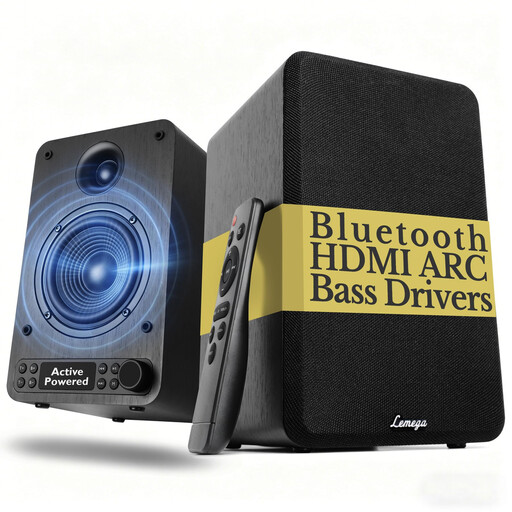
Lemega active bookshelf speakers, 40 W, pair

Lemega active bookshelf speakers, 40 W, pair

This active pair is an option if you want to listen without a separate amplifier.

40 W; Bluetooth; HDMI ARC, optical input, USB, AUX and RCA; bass and treble controls.

View at Joybuy

HiVi D3.1MKII passive bookshelf speakers

HiVi D3.1MKII passive bookshelf speakers

This passive pair is worth considering if you already have a suitable amplifier or want to put your hi-fi system together component by component.

2-way system; 6.5-inch mid-bass driver; 28-mm soft-dome tweeter; rear bass reflex; 8 Ω; 10–120 W. A suitable amplifier is required.

View at Joybuy

Frequently asked questions

Do I need a separate amplifier for bookshelf speakers?

Passive bookshelf speakers need a suitable amplifier; active pairs have amplification built in. Even with active speakers, check that their inputs are compatible with your music source. If you’re choosing passive speakers, make sure your amplifier meets the requirements of the specific model.

How should I position speakers in a small living room?

Measure the space available for both speakers, then try different positions from where you normally listen. DALI’s guide to OBERON speakers recommends trying different positions and keeping objects clear of the space between the speakers and your listening position. This advice won’t necessarily apply to every other model.

What should I do if a product develops a fault after purchase in Germany?

Your statutory rights against the seller are separate from any voluntary manufacturer’s guarantee. If a product is faulty, you can initially request that the seller put things right by repairing or replacing it.

What should I know about disposing of old speakers?

In Germany, electrical and electronic waste must not be put in household rubbish. The Federal Environment Agency lists local collection points and suitable options for returning items to retailers.