Playlists without an extra amplifier
You want to connect a stereo pair in your small living room and play your soul playlist directly from a compatible source. Pay particular attention to suitable inputs and straightforward controls.


Without a separate amplifier, an active stereo pair is generally a good fit, provided its inputs match your smartphone or another music source; Edifier lists Bluetooth and several wired inputs for the R1280DBs. If you have a suitable amplifier, passive pairs are also an option. Choose based on the space available, amplifier specifications and bass at your listening position, rather than wattage or frequency figures alone.
You want to connect a stereo pair in your small living room and play your soul playlist directly from a compatible source. Pay particular attention to suitable inputs and straightforward controls.
Your shelf or TV unit limits the available width, depth or distance from the wall. Check the dimensions of both cabinets and make sure the recommended placement works in your actual space.
You already own an amplifier and want to choose a passive stereo pair. Check the connection and amplifier specifications for the specific model against your system.
Start with the signal path and the space available. Bass at your listening position and your existing system will help narrow down the options further.
| Consideration | What to check before buying | Who it matters most to |
|---|---|---|
| Playlist source and controls | Check the source, the input you need and, for an active system, the mains connection. | If I want to play my soul playlist directly from a suitable source, an easy connection and simple controls matter. Around 31% of consumers put connections and straightforward playback first. |
| Space and placement | Check the dimensions of each speaker, the space available and the placement guidance for the specific model. | If shelf space is limited, I measure the available area and distance from the wall before deciding. Around 25% of consumers prioritise dimensions and placement. |
| Bass at your listening position | Listen to familiar tracks from your intended listening position and try different placements. | If the basslines in my soul playlist matter to me, I want to assess them from my usual seat. Around 25% of consumers prioritise bass at their listening position. |
| Existing system | Check whether the model is active or passive, its amplifier specifications and any additional accessories you need. | If I already have an amplifier, I want to check that its specifications suit the passive pair and see what else I need. Around 19% of consumers put amplifier compatibility and a complete set-up first. |
Passive speakers such as the ELAC Debut 3.0 DB53 or KEF Q1 Meta cannot be used as a complete playback system on their own in the same way as an active system.
Before choosing, make a note of the equipment you already own and your signal path. If you don’t have a suitable amplifier, compare active stereo systems with the right inputs.
The active R1280DBs is an option if you’re looking for a compact stereo system with Bluetooth and several wired inputs.
The passive Debut 3.0 DB53 is worth considering for a set-up with an amplifier. It’s a different model from the particularly compact Elegant BS 312.2.
The Q1 Meta and R3 Meta are passive bookshelf speakers, while the LSX II LT is an active networked stereo system.
The ULTIMA 20 Mk4 is a passive speaker pair for a system with an amplifier or receiver.
The passive GLE 30 S2 is an option for a larger shelf or TV unit if you already have an amplifier.
The products below include active stereo speakers for playback without a separate amplifier, as well as passive pairs that need a suitable amplifier.
 No image available
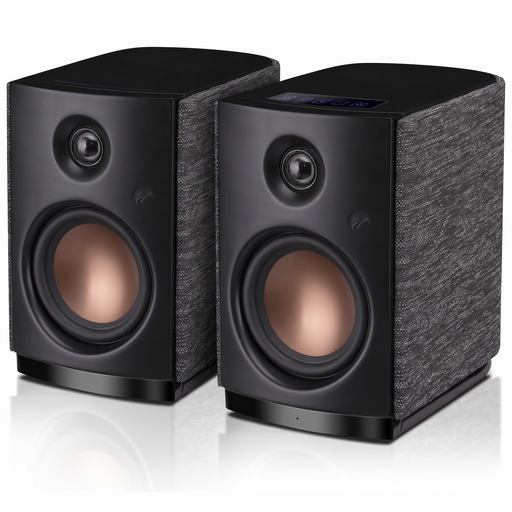
This active pair is an option if you want to play music from a compatible source without a separate amplifier.
Bluetooth, HDMI ARC, optical, USB, AUX and RCA inputs are listed. Check that the connections you need match your source.
 No image available
Before choosing, check the signal path for the specific version against your source, rather than assuming it supports Bluetooth or needs a separate amplifier.
Specifications list a 4-inch woofer, a 20 mm dome tweeter and 4 Ω. Check the connections and amplifier requirements for the version you choose.
 No image available
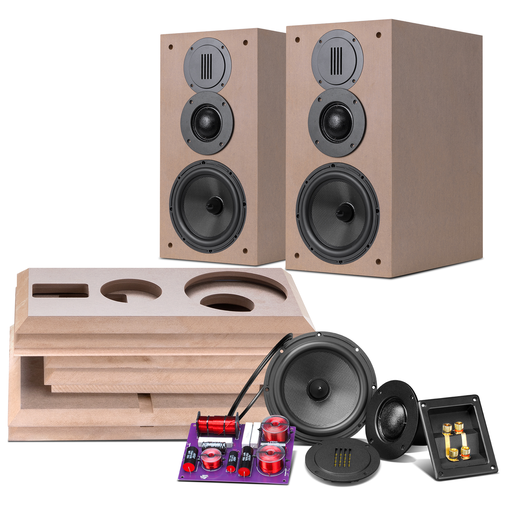
This passive pair is worth considering if you have a suitable amplifier.
Specifications list a 6.5-inch driver, 8 Ω and a rear-facing bass reflex port. For placement close to a wall, KEF recommends taking the distance from the rear wall into account.
 No image available
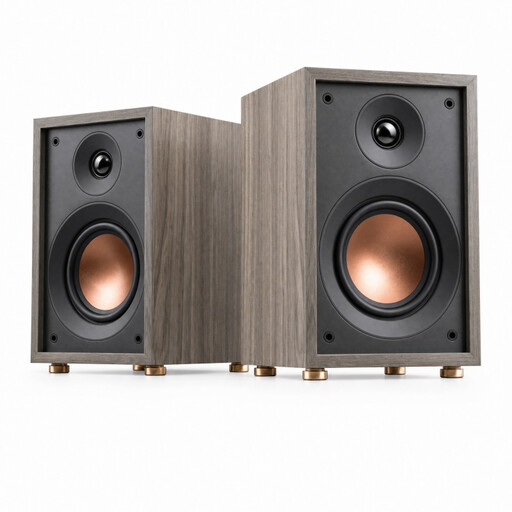
This passive speaker is designed for a set-up with a suitable amplifier.
Specifications list a 4-inch woofer, a 20 mm dome tweeter, a frequency range of 60 Hz–20 kHz and 4 Ω. Check the amplifier requirements and what’s included for the specific version.
 No image available
This passive stereo pair is an option if you have a suitable amplifier.
Specifications list a 6.5-inch mid-bass driver, a 28 mm dome tweeter, a rear-facing bass reflex port and 8 Ω. The recommended amplifier power is 10–120 W. If placing the speakers close to a wall, pay attention to the distance from it.
No. Passive models such as the ELAC Debut 3.0 DB53 or KEF Q1 Meta need a suitable amplifier. You’ll also need a suitable way to feed your smartphone’s signal into the system, so check the connections on your devices.
Start by placing both speakers as symmetrically as possible, and follow the placement guidance for the specific model. Then adjust the distance from the rear wall and listen from your usual seat. KEF describes its guidance as recommendations, not universal, mandatory measurements.
Check whether the specific offer includes one speaker or a pair, and whether you need an amplifier, cables or stands. Canton lists the GLE 30 S2 as a single speaker; KEF lists the Q1 Meta as a pair.
For market surveillance, Germany’s Federal Network Agency says to check that the CE marking is present and correct, that the product is identifiable and that the manufacturer’s details are accurate. This is not a sound-quality assessment and does not automatically verify an individual offer.
No. The German Environment Agency advises that discarded electrical and electronic equipment must be disposed of separately from household waste. Options include recycling centres and suitable retail take-back points; individual retailers’ take-back obligations depend on the relevant legal requirements.