What should you look for when buying?
Start with a suitable listening position and two speakers that can be placed sensibly. Then choose between a passive system and an active pair based on the amplification and sources you already have.
| What matters |
What to check before buying |
Who it matters most to |
| Stereo imaging |
Whether both speakers can be positioned at a similar height and in comparable surroundings relative to your listening position. |
If I listen to chamber music from a fixed position, I want both speakers placed so I can follow the position of the instruments. Around 31% of consumers put stereo imaging at their listening position first. |
| Space and room acoustics |
The dimensions, including space for connections, and possible positions for both speakers. |
With furniture, walkways or unequal distances from the walls, I need to find practical positions for both speakers. Around 25% of consumers give particular importance to placement in an open-plan layout. |
| Amplification and connections |
Amplifier requirements for passive models, and the inputs actually available on active systems. |
If I don’t have an amplifier, I want to be able to connect my sources directly; if I already have one, I want to check it meets the requirements. Around 19% of consumers prioritise compatible amplification and connections. |
| Considerate listening |
Whether the system lets you adjust the volume appropriately; check local rules and your tenancy agreement or house rules. |
At home, I want to listen at my usual volume without disturbing the neighbours unnecessarily. Around 13% of consumers name considerate listening as a priority. |
| Total cost |
Compare two speakers and any extras you actually need on the same quantity basis. |
When working out the cost of a system, I want to include two speakers and any necessary extras, rather than confusing a single-speaker price with a pair price. Around 12% of consumers put total cost first. |
Joybuy product options for passive and active bookshelf speakers
The following Joybuy options include active and passive bookshelf speakers for a compact stereo set-up. When choosing passive models, remember to factor external amplification into your system plan.
 No image available
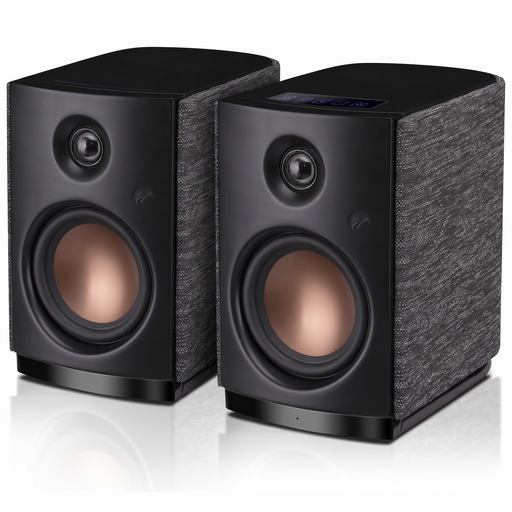
HiVi-Swans OS-10 active HiFi stereo bookshelf speakers
This active stereo system could be a good option if you want to listen without a separate amplifier and use Bluetooth or AUX. The product title lists Bluetooth 5.0, a 4-inch woofer and 62 W RMS.
View at Joybuy
 No image available
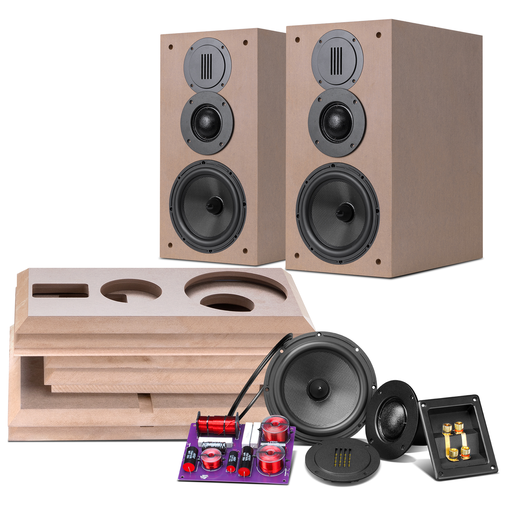
HiVi-Swans DIY3.1 passive bookshelf speaker pair
This passive pair is suitable if you already have appropriate external amplification or plan to buy it separately. The model is listed with a 6.5-inch driver, a 26-mm soft-dome tweeter and 8 Ohm impedance.
View at Joybuy
 No image available
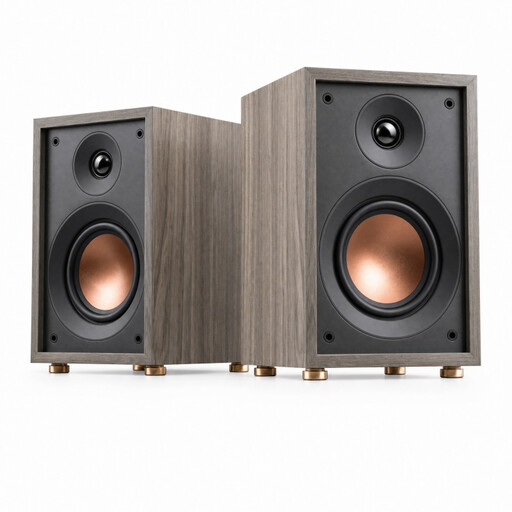
HiVi-Swans Oasis passive 2-way bookshelf speaker
If you’re planning a passive set-up, check that you have suitable external amplification and that the quantity on offer is right for your stereo system. The product title lists a 4-inch woofer, a 20-mm tweeter, 60 Hz–20 kHz, 4 Ω and an amplifier rating of 10–50 W.
View at Joybuy
 No image available
HiVi D3.1MKII passive HiFi bookshelf speakers
This passive model could be an option if you’re planning to use external amplification and can check the specifications against your amplifier. The product title lists a 6.5-inch mid-bass driver, a 28-mm soft-dome tweeter, 8 Ohm impedance and an amplifier rating of 10–120 W.
View at Joybuy
Frequently asked questions about bookshelf speakers in open-plan living spaces
Do passive bookshelf speakers need to be connected to an amplifier?
Yes. Passive speakers need external amplification. KEF explicitly lists the Q1 Meta as a passive speaker that requires an amplifier, so check that your existing amplifier meets its requirements.
How should I position a stereo pair for a fixed listening position?
Angle both speakers towards your listening position, and aim for a similar height and comparable conditions on the left and right. Genelec’s guide explains these principles for studio monitors; use it as a guide, not as a definitive rule for every Hi-Fi model.
Can room adaptation fix poor speaker placement?
You shouldn’t rely on it alone. Genelec points out that calibration may not fully resolve room problems. First check the possible speaker positions, then look at the adjustment features on the specific model.
What costs should I include when comparing systems?
First, check whether the listed price is for one speaker or a pair. Canton lists the GLE 30 S2 per speaker, while KEF sells the Q1 Meta as a pair. Only factor in additional components such as an amplifier, cables or stands if you actually need them.
Are the legally mandated quiet hours for playing music at home the same throughout Germany?
The information available doesn’t establish a single set of quiet hours for the whole of Germany. On its topic page dated 24 October 2017, the Federal Ministry for the Environment stated that there were no nationwide statutory rules for neighbour noise caused by people’s behaviour. Check the guidance that applies where you live, along with your house rules.


