For chamber music in a small living room, your pair of speakers should fit in both intended positions and work with your music source. With a suitable amplifier, passive speakers are an option; if you don’t have a separate amplifier, an active pair with the right inputs may be more convenient. The best way to decide whether the tonal balance and stereo imaging work for you is to listen to familiar recordings.
Which type of speaker is right for you?
Chamber music listeners with a hi-fi system
If you want to use a passive stereo pair with your existing amplifier, check that the amplifier is suitable and consider where both speakers will go. KEF specifies an amplifier requirement of 10–150 W for the passive Q1 Meta.
Listeners short on space
If you need to place two speakers in a limited area or in two suitable positions, check the cabinet dimensions and allow space for the cables. Edifier gives the dimensions of the R1280DBs as 146 × 234 × 196 mm per cabinet.
Listeners without a separate amplifier
If you’re considering an active pair, make sure its inputs match your existing music sources. Edifier lists Bluetooth, line-in, optical and coaxial inputs for the R1280DBs.
What should you look for when buying?
| What matters |
What to check before buying |
Who should pay particular attention |
| Sound for chamber music |
If possible, listen to both speakers with familiar recordings at a similar volume. |
If I care about a balanced sound and convincing stereo imaging for strings and piano from my listening position, I want to compare the speakers for myself. Around 36% of consumers put sound quality first. |
| Space and positioning |
Measure both spaces and check the cabinet dimensions and positioning guidance for the specific model. |
If my living room has limited space, both speakers and their cables need to fit in the intended positions. Around 29% of consumers prioritise available space. |
| Amplifier and music source |
For passive speakers, check they’re compatible with your amplifier; for active speakers, compare their inputs with your source’s outputs. |
If I want to keep using my existing system, the speaker setup needs to work with my amplifier and source. Around 21% of consumers put system compatibility first. |
| Complete stereo system |
Check the number of speakers and what’s included, and allow for an amplifier, cables and any other components you need. |
If I’m putting together a complete, ready-to-use stereo system, I need to consider any extra equipment, not just the speakers themselves. Around 14% of consumers prioritise the total cost of the system. |
Avoid common buying mistakes
-
Assuming one speaker is a complete stereo pair
Genelec specifies one monitor per pack for the Genelec 8020D. You can’t assume that the pack size for one model applies to other speakers.
Check the number of speakers and what’s included in the specific listing. You may need to buy a second speaker for a stereo system.
-
Planning to use passive speakers without an amplifier
Passive models such as the KEF Q1 Meta need a suitable separate amplifier. A passive pair on its own isn’t a ready-to-play system.
Compare the specifications of the specific speakers with your amplifier, or include an amplifier in your system plans.
-
Assuming active speakers have every connection you need
The connections Edifier lists for the R1280DBs are Bluetooth, line-in, optical and coaxial. This doesn’t automatically mean it has Wi-Fi, HDMI or a phono input.
Make a note of the connections your sources need and check the specifications for the exact model variant.
Key brands to consider
KEF
The passive Q1 Meta is a compact option for a stereo system you put together from separate components.
- KEF specifies an amplifier requirement of 10–150 W for the Q1 Meta.
- You’ll still need a suitable amplifier, and the manufacturer’s descriptions of its sound can’t replace listening in your own space.
ELAC
The passive Debut 3.0 DB53 is another bookshelf speaker option for a system with a separate amplifier.
- ELAC describes the DB53 as having an aluminium tweeter and an aramid-fibre woofer.
- The manufacturer’s description isn’t an independent comparison. Also check positioning requirements and amplifier compatibility.
Edifier
The active R1280DBs offers a range of connections for listeners who don’t want to use a separate amplifier.
- Edifier lists Bluetooth, line-in, optical and coaxial inputs, as well as a subwoofer output.
- These connections don’t mean it has Wi-Fi or HDMI, and the manufacturer’s description of its sound isn’t an independent listening assessment.
Wharfedale
The Diamond 12.1 is a passive compact speaker for a two-channel system.
- Wharfedale specifies a 130-mm mid/bass driver and a 25-mm tweeter for the Diamond 12.1.
- The Diamond 12.1 and the updated 12.1i are different model names. Check the exact variant and its positioning requirements.
Q Acoustics
The 3020c is a passive model in the 3000c range.
- Q Acoustics distinguishes the 3020c from the smaller 3010c and the larger 3030c.
- Check the dimensions of the specific variant and make sure you have enough space for it. The manufacturer’s descriptions of its soundstage aren’t a substitute for listening in your own space.
Joybuy products for active and passive setups
The products below include active and passive bookshelf speakers. What matters is having the right connections, a suitable amplifier and enough room for both speakers.
 No image available
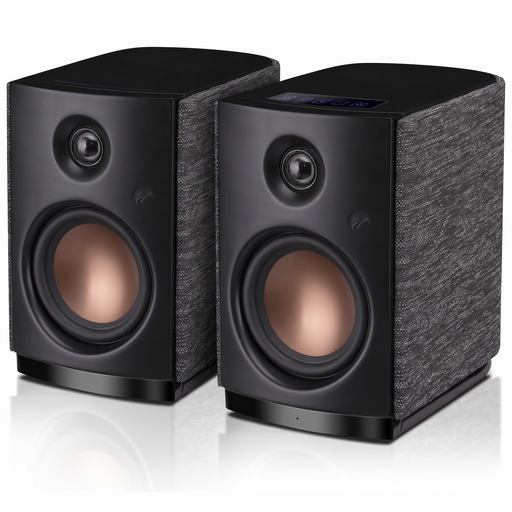
HiVi-Swans OS-10
For a compact setup without a separate amplifier. Check whether Bluetooth or AUX works with your music source.
Described as an active speaker with a 4-inch woofer, 62 W RMS, Bluetooth 5.0 and AUX.
View at Joybuy
 No image available
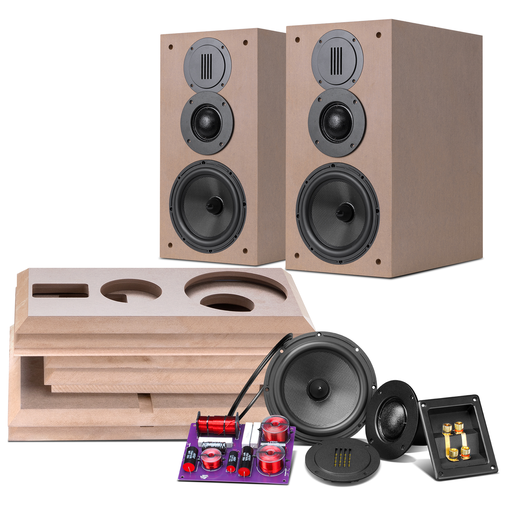
HiVi-Swans DIY3.1
For a stereo system built from separate passive components. A suitable external amplifier is required.
The product title specifies a pair with 6.5-inch mid/bass drivers; the description lists 26-mm tweeters and a bass-reflex cabinet.
View at Joybuy
 No image available
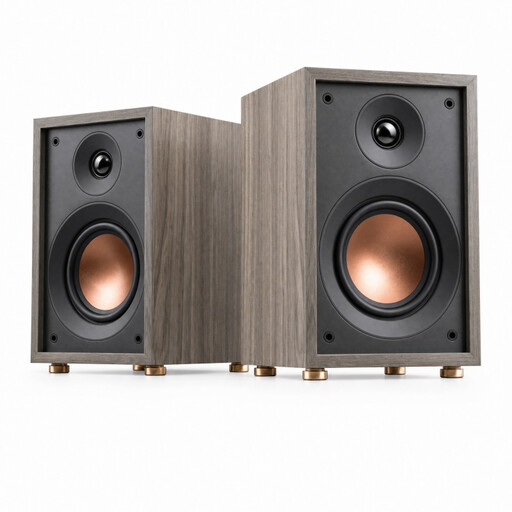
HiVi-Swans Oasis
Described as a passive speaker for spaces where room is limited. Check how many are included in the listing and allow for a suitable amplifier.
Specifications include a 4-inch woofer, a 20-mm dome tweeter, 60 Hz–20 kHz, 4 Ω and 10–50 W.
View at Joybuy
 No image available
HiVi D3.1MKII
For listening to music with a separately chosen amplifier. As a passive speaker, this model needs a suitable external amplifier.
The product specifications list a 6.5-inch mid/bass driver, a 28-mm dome tweeter, 8 Ω and 10–120 W.
View at Joybuy
Frequently asked questions
Do I need an amplifier for passive bookshelf speakers?
Yes. Passive bookshelf speakers need a suitable external amplifier. KEF describes the Q1 Meta as passive and specifies an amplifier requirement of 10–150 W. Check the specifications for your particular model against your amplifier.
How do I connect a pair of passive speakers?
For the Debut 3.0 range, ELAC recommends switching the equipment off before connecting it and making sure the positive and negative terminals are connected correctly. Make sure bare wires don’t touch each other. ELAC also recommends occasional dusting rather than using abrasive or solvent-based cleaners.
What should I know about returns and complaints in Germany?
According to Verbraucherzentrale, consumers who buy online generally have a 14-day right to cancel, although exceptions apply and the date the cancellation period starts should be checked. The statutory warranty for faulty goods is separate, and the seller is generally the point of contact.
What should I check about compliance for active or wireless speakers?
For certain electrical and wireless products, the Bundesnetzagentur lists requirements including CE marking, product and manufacturer details, instructions in German and a declaration of conformity. The EU requirements that apply depend on the specific product. CE marking doesn’t tell you whether the sound will suit your listening position.
Can I put old electrical speakers in household waste?
No. stiftung ear advises that waste electrical equipment from private households must not be disposed of with household waste. Public collection points are available for this purpose.


