Start by choosing two speakers that will fit your space, then make sure you have a complete signal path from the music source to the speakers. An active pair doesn’t need a separate amplifier, provided its inputs are compatible with your source; passive speakers do need a suitable amplifier. The best way to judge whether voices sound balanced from your favourite seat and other seating positions is to listen to familiar choir recordings in the room, from the places where you plan to sit.
Who listens in the communal room?
Listeners with a regular seat
If you want to assess voices and choral groups mainly from your favourite seat, compare familiar recordings there. Room acoustics and speaker placement affect what you hear, as Genelec explains in its speaker placement guidance.
Listeners in different seats
If you don’t always sit in the middle of the communal room, consider possible speaker positions and try listening from seats to the side as well. Genelec describes how the room and listening position affect the sound; a dispersion design such as KEF’s Uni-Q is not proof that the sound will be identical from every seat.
People looking after the shared music system
If several people will connect music sources, first check which devices are available and how they’ll connect to both speakers. Active models such as the Edifier R1280DBs have built-in amplification; passive models such as the KEF Q1 Meta need a suitable amplifier.
What should you look for when buying?
| Criteria |
What to check before buying |
Who is this important to? |
| Choral voices from your listening position |
Listen to familiar recordings from your intended seat; position the two speakers as similarly as possible. |
If I want to assess voices mainly from my regular seat, I’ll listen there using recordings I know well. Around 33% of consumers put sound from their preferred seat first. |
| Multiple seating positions |
Try the available positions and listen to the same recordings from several seats. |
If people use different seats in the room, I want to be able to judge how the music sounds away from the centre too. Around 27% of consumers prioritise sound from multiple seats. |
| Connections and signal path |
Check that the source and inputs are compatible, and include an amplifier and connections to both speakers if needed. |
If I want to keep using the devices I already have, I want to be able to connect them without missing any parts of the system. Around 20% of consumers prioritise connections and a complete signal path. |
| Space and shared use |
Check there’s room for both speakers, power and cable routes, and the planned setup. |
If several people use the room, I want to position the speakers appropriately and agree on their use with the others. Around 20% of consumers prioritise space and shared use. |
Common buying pitfalls
-
Expecting passive speakers to work straight away like Bluetooth speakers
A passive pair won’t produce any sound without a suitable amplifier. Before ordering, check every component and connection in your planned signal path.
You may need another speaker or additional system components.
Check the contents, full model number and generation for the specific offer.
Brands to consider
Edifier
Active bookshelf speakers such as the R1280DBs are worth considering if you’re not planning to use a separate amplifier and your source is compatible with the inputs.
- Edifier lists Bluetooth, several wired inputs, controls and a subwoofer output for the R1280DBs.
- The connections don’t indicate Wi-Fi functionality or guarantee a particular sound in a communal room. Check that one of the inputs is compatible with your intended source.
KEF
Compact passive models such as the Q1 Meta are designed to be used with a suitable amplifier.
- KEF describes the Q1 Meta as passive and specifies an amplifier range of 10–150 W.
- The more even sound distribution claimed for Uni-Q technology is a manufacturer statement, not proof that the sound will be the same from every seat.
DALI
Compact passive speakers such as KUPID may suit your room if you have a suitable amplifier and the available placement options work for your space.
- DALI says KUPID comes with a wall bracket.
- The sound quality described by the manufacturer is not independent proof of how the speakers will perform in your room. Check whether the offer is for one speaker or a pair.
Teufel
The passive ULTIMA 20 Mk4 is available as a pair of speakers; if you’re putting together a separate system, you’ll need a suitable amplifier.
- Teufel lists a shelf, stand and wall as placement options for the ULTIMA 20 Mk4.
- Check the model generation: Mk3 offers are not the same as Mk4.
ELAC
Passive Debut 3.0 bookshelf speakers such as the DB63 are designed for use in a system put together separately.
- ELAC explains how to connect the Debut 3.0 series to an amplifier.
- Manufacturer claims about tonal balance are no substitute for listening and comparing. Check the version and what’s included in the specific offer.
Klipsch
The RP-600M II is a larger passive bookshelf speaker, so make sure you consider both the space available and the amplifier you’ll need.
- Klipsch’s datasheet specifies a nominal impedance of 8 ohms and a 90° × 90° horn.
- The manufacturer’s claims about detail reproduction don’t prove how the speakers will sound from a seat to the side.
Joybuy product selection
This selection includes active and passive bookshelf speakers for different signal paths. For passive models, check the amplifier requirements and compare the sound from your intended listening position.
 No image available
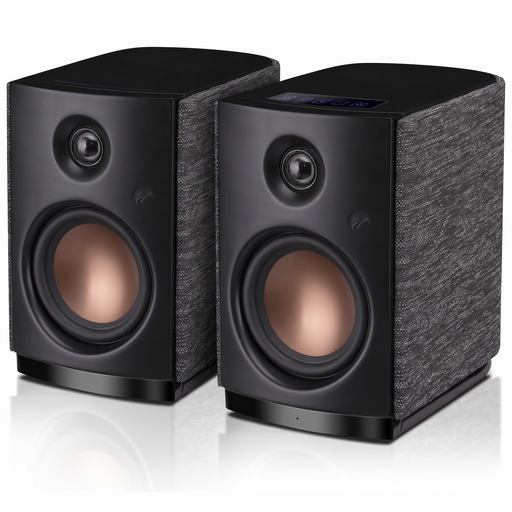
Lemega active bookshelf speaker pair, 40 W
This active stereo pair may suit you if you want to connect different music sources without planning for a separate amplifier.
It lists Bluetooth, HDMI ARC, optical, USB, AUX and RCA inputs, as well as bass and treble controls. The title specifies 40 W.
Listed with 4-inch bass drivers and 1.25-inch tweeters.
Joybuy
 No image available
HiVi-Swans OS-10 active Hi-Fi stereo bookshelf speakers
This active model is an option if Bluetooth or an AUX connection is compatible with your intended music source.
Specifications include Bluetooth 5.0, AUX, touch controls and a 4-inch woofer.
The stated output is 62 W RMS.
Joybuy
 No image available
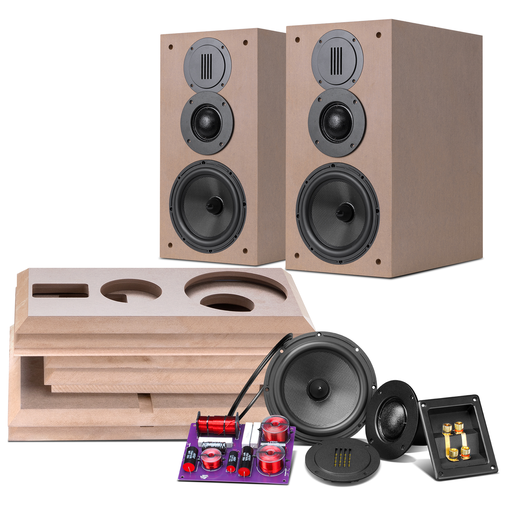
HiVi-Swans DIY3.1 passive bookshelf speakers, pair
This passive pair is worth considering if you already have a suitable amplifier or want to choose your amplifier and speakers separately.
The title specifies 6.5-inch woofers; sensitivity is listed as 86 dB, with a nominal impedance of 8 ohms.
A suitable amplifier is required.
Joybuy
 No image available
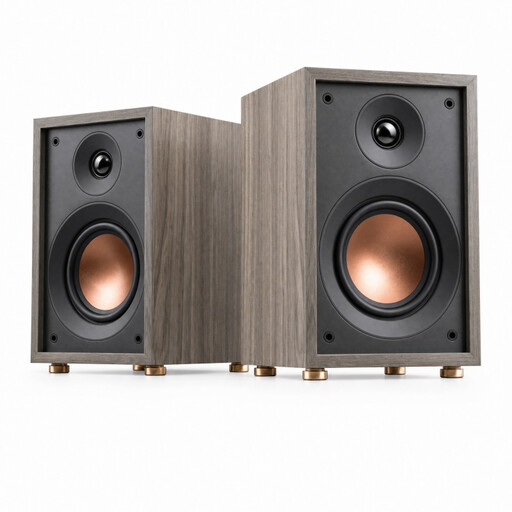
HiVi-Swans Oasis passive bookshelf speaker
This passive model may suit you if your system includes a suitable amplifier and its specifications meet the amplifier’s requirements.
It lists a 4-inch woofer, a 20 mm dome tweeter and a two-way bass reflex system.
Specifications include 60 Hz–20 kHz, 4 Ω and amplifier power of 10–50 W. A suitable amplifier is required.
Joybuy
 No image available
HiVi D3.1MKII passive Hi-Fi stereo bookshelf speakers
This passive model is designed for a system put together separately; check that your amplifier meets the speaker’s requirements.
The title specifies a 6.5-inch mid-bass driver, a 28 mm dome tweeter, 8 ohms and amplifier power of 10–120 W.
Listed as a two-way speaker with a rear bass reflex system. A suitable amplifier is required.
Joybuy
Frequently asked questions
Do I need an amplifier for passive bookshelf speakers?
Yes. Passive speakers need a suitable amplifier. KEF explicitly describes the Q1 Meta as passive and specifies its amplifier requirements; check the requirements for your chosen model and make sure you have a complete signal path.
How should I position two speakers for choral music?
Start by positioning the left and right speakers as similarly as possible in relation to your preferred listening position, then check the other seats people use. Genelec explains how position, symmetry and room reflections affect sound; the studio layout discussed there isn’t a rule that every communal room must follow.
How do I use an active speaker pair safely?
Follow the instructions for your specific model. For the R1280DBs, Edifier recommends keeping the ventilation openings clear and disconnecting the speakers from the mains before cleaning, among other things. These instructions apply to that model and don’t automatically apply to all bookshelf speakers.
What additional components should I plan for?
For passive speakers, you’ll need a suitable amplifier; depending on your system, you may also need a source device and speaker cables. For active models, check that your existing source is compatible with the listed inputs.


