For choral recordings in an open-plan home, a bookshelf speaker system is a good fit when you can position both speakers as symmetrically as possible around your intended listening position, and their connections suit your audio sources. With a suitable amplifier, passive pairs are an option; if you don't have a separate amplifier, an active pair may be simpler. In either case, the room, listening distance and actual inputs are key considerations.
Who is this guide for?
Choral music listeners with a regular listening spot
You want to assess the voices and their spatial positioning from a preferred seat, and can position a stereo pair for that spot. Genelec points out that similar reflective conditions for both speakers help create a stereo image.
Listeners in an asymmetrical open-plan kitchen and living area
Your open-plan home makes it difficult to achieve equal distances and similar reflective conditions on the left and right, so potential speaker placement becomes part of your buying decision. Genelec explains how walls, ceilings, furniture and floors can reflect, scatter or absorb sound.
Listeners without a separate amplifier
You want to connect your sources directly to an active stereo pair, so you’ll need to check the inputs on the specific model against your devices. Nubert describes active speakers as a solution that doesn't require an additional separate amplifier.
What should you look for when buying?
This table groups shoppers choosing bookshelf speakers for choral recordings in an open-plan home by their main buying priority.
| Buying priority |
What to check before buying |
Who is it most relevant to? |
| Vocal positioning from your listening spot |
Listen from your intended seat with recordings you know; check whether both speakers can be positioned at a similar height and angled in a comparable way. |
If I listen to choral recordings from a regular spot, I want to be able to make out individual voices and their spatial positioning. Around 33% of shoppers prioritise vocal positioning from their listening spot. |
| Placement and room acoustics |
Check the available surfaces and how close both speakers will be to the walls; follow the placement and ventilation guidance for the specific model. |
In an open-plan kitchen and living area, I want to find two suitable spots without overlooking differences in distance and reflections. Around 27% of shoppers consider placement their top priority. |
| Amplifier and source connections |
Check your existing amplifier’s specifications and device outputs against the model’s requirements or inputs. |
If my existing devices are the deciding factor, I want to know whether I can actually connect my amplifier and audio sources. Around 20% of shoppers put system connectivity first. |
| Total system cost |
Check what’s included and what additional equipment you’ll need; factor in cables and suitable stands where necessary. |
When I’m putting together a stereo system I can use, I need to consider more than the cost of a single speaker. Around 20% of shoppers focus primarily on the total cost of the system. |
Common misconceptions
-
Assuming frequency response or wattage proves choral vocals will sound clear
What you hear also depends on your listening position, reflections and the recording itself. Power ratings for different systems are no substitute for listening to them.
Use the specifications to check the system’s requirements and connections. If possible, assess how it reproduces choral music using familiar recordings from your intended listening spot.
-
Comparing passive and active speakers on the speakers alone
A passive speaker needs a suitable amplifier. Also, an offer for a single speaker isn’t directly comparable with one for a pair.
Check what’s included and compare complete stereo systems. If you don’t have a suitable amplifier, a passive pair may mean additional purchases. Cables and, where needed, stands should also be considered when planning where to put your speakers.
-
Assuming similar model names refer to identical versions
Wharfedale describes the Diamond 12.2i as an updated version of the Diamond 12 series. A similar name doesn’t prove that the 12.2 and 12.2i are the same version.
Check the full model name and specific version before comparing product details or accessories.
Brands to consider
KEF
The passive Q3 Meta is an option if you want to take other listening spots into account as well as your preferred one, and plan to use a suitable amplifier.
- KEF lists a Uni-Q driver array, bass reflex and an amplifier range of 15–150 W for the Q3 Meta.
- KEF’s claim of more even sound dispersion is a manufacturer statement, not independent proof of better choral reproduction in a particular home.
ELAC
The passive Debut 3.0 DB63 is another option for a stereo system with a separate amplifier.
- ELAC lists an aluminium tweeter, an aramid-fibre woofer and connections to an amplifier or receiver.
- Without a suitable amplifier, the speaker pair isn’t a complete playback system. The manufacturer’s claims about clarity or comparisons with more expensive models aren’t independent listening tests.
Wharfedale
The Diamond 12.2i adds another passive bookshelf speaker to the range and should be treated as a distinct model version.
- Wharfedale describes changes to the bass-reflex tuning and damping compared with the original Diamond 12 series.
- The manufacturer’s claim of improved bass control isn’t a measured comparison for a listening spot in an open-plan home; the 12.2i shouldn’t automatically be treated as identical to the 12.2.
Nubert
The active nuBoxx A-125 pro is worth considering if its inputs suit your sources and you don’t want to use a separate amplifier.
- Nubert lists USB-C, digital inputs and Bluetooth, as well as built-in amplification.
- Nubert describes the model primarily for desktop or TV use. That doesn’t automatically mean it’s suitable for every listening distance in an open-plan home.
Edifier
The active R1700BTs offers a selection of connections for compatible Bluetooth or RCA sources.
- Edifier lists two RCA inputs, Bluetooth and a subwoofer output.
- The stated total power of 66 W RMS isn’t a comparative test for choral recordings or longer listening distances.
Active stereo speakers at Joybuy
This selection includes active stereo speakers with a range of connection options. For each model, check that what’s included, its design and the space available suit your listening spot.
 No image available
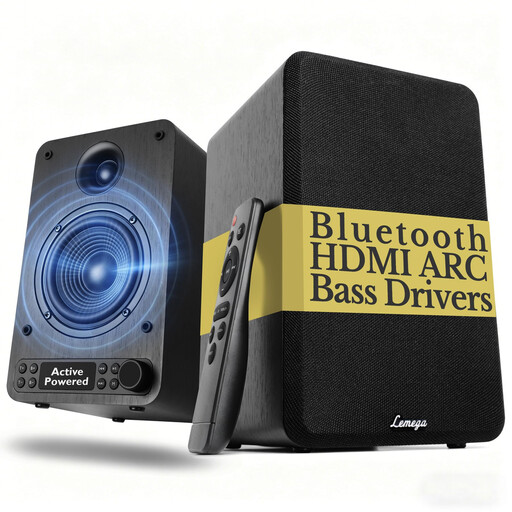
Lemega Active Bookshelf Speaker Pair, 40W
If you’re looking for an active stereo pair without a separate amplifier, check that the listed inputs suit your audio sources.
Bluetooth; HDMI ARC, optical input, RCA, AUX and USB; bass and treble controls; remote control included according to the product name.
Ensure there’s adequate ventilation during use.
View at Joybuy
 No image available
HiVi-Swans OS-10 Active Hi-Fi Stereo Speakers
This active stereo system has Bluetooth and an AUX input; check that these connections suit your audio sources.
Bluetooth 5.0; AUX input; 4-inch woofer; 62W RMS according to the product name; touch controls.
The manual requires clear ventilation and warns against placing the speakers in a bookcase or drawer if this obstructs airflow.
View at Joybuy
 No image available
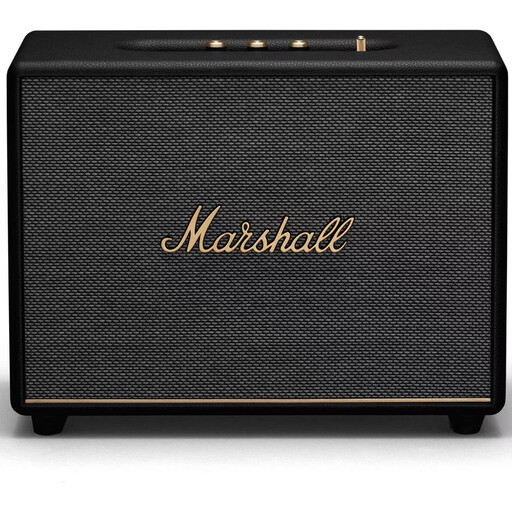
Marshall Woburn III Active Stereo Bluetooth Speaker
If you’re looking for an active stereo speaker with several listed connection options, check that they suit your sources and that the design and footprint work for your listening spot.
Bluetooth; 3.5 mm input, RCA and HDMI; 3-way system according to the product specifications.
View at Joybuy
Frequently asked questions
How can I try different speaker positions for choral recordings?
Start with a regular listening spot and position the two speakers at a similar height, as symmetrically as possible. Listen to the same familiar recording again after moving the speakers: Genelec explains that differences in reflective conditions can affect the stereo image. Also follow the guidance for your specific model, as there’s no single wall distance that suits every speaker.
Can I put an active bookshelf speaker in an enclosed bookcase?
That depends on ventilation and the instructions for the specific model. The HiVi-Swans OS-10 manual requires clear airflow and warns against placing the speakers in a bookcase or drawer if this restricts ventilation. For other speakers, follow their individual instructions.
Do I need Bluetooth or an amplifier for passive speakers?
For the passive models mentioned here, you’ll need a suitable amplifier and a way to send a signal from your source to it. A passive pair doesn’t automatically include Bluetooth; you’d need additional compatible equipment for that.
Does every Bluetooth speaker need a CE mark?
CE marking is only required for products that are expressly covered by harmonised EU rules. The Bundesnetzagentur lists marking, product identification and manufacturer details among the checks carried out during market surveillance. Check the details for the specific device on offer; mentioning a model doesn’t confirm that it complies.
What happens if a product develops a fault, and how does a voluntary guarantee work in Germany?
Your statutory rights against the seller are separate from any voluntary guarantee. If a product is faulty, the first step is usually to seek a remedy from the seller; check the terms of any additional guarantee separately. The Verbraucherzentrale explains the difference, but this doesn’t confirm that a particular speaker model comes with a specific manufacturer’s guarantee.


