Which type of speaker is right for you?

Dance fans who want plenty of bass

If bass is important when you’re listening to dance playlists, compare the sound where you’ll be listening and check whether there’s a subwoofer output and space for an additional unit. Edifier and KEF list subwoofer outputs for their respective models.

Listeners with limited space

If you want to fit a stereo pair into a small living room, check the speaker dimensions, positioning and connection between the speakers against the space you have available. ELAC publishes the dimensions of the Debut 3.0 DB63.

Listeners with an existing system

If you already have an amplifier or other source devices, you can add passive bookshelf speakers to your existing signal chain. Check the specifications of the amplifier and the connection you’ll need between your playlist device and the amplifier.

What should you look for when buying?

Active Bluetooth stereo pair

A good fit if: you want to play playlists from your smartphone easily and don’t want a separate amplifier.

Bear in mind: Bluetooth doesn’t automatically mean network streaming, and a subwoofer may be an additional purchase.

Active pair with TV connections

A good fit if: you want to connect the same pair of speakers to a TV as well.

Bear in mind: check that the TV has a compatible output and how the two speakers connect to each other.

Active Wi-Fi stereo system

A good fit if: network streaming and a choice of digital connections are important to you.

Bear in mind: KEF specifies home Wi-Fi and the Connect app for setting up the LSX II LT and using all its features.

Passive bookshelf speakers

A good fit if: you already have a suitable amplifier or want to choose your amplifier and source devices separately.

Bear in mind: you’ll also need a suitable way to receive or stream your smartphone playlists to the amplifier.

Buying priority What to check Who is this especially important to?
Bass and upgrade options Check whether you can connect an external subwoofer and whether you have space for one. When I listen to dance playlists, I want to know whether the pair will be enough without a subwoofer where I listen, and whether there’ll be room for an upgrade later. Around 31% of consumers put bass first.
Space and positioning Measure the available space and check the speaker dimensions and the connection between the speakers. In a small living room, I want to know in advance whether I can position both speakers sensibly and whether the cables will reach. Around 25% of consumers prioritise the space available.
Easy connectivity Check that your smartphone, streaming method and, if relevant, TV are compatible with the model’s inputs and set-up requirements. If I want to start playing a playlist without any fuss, I look for a suitable way to connect and the inputs I’ll actually use. Around 25% of consumers put ease of connectivity first.
Existing system and overall cost For passive speakers, check amplifier compatibility and factor in any source devices and cables you’ll need. If I already have an amplifier, I want to know what other devices I’ll need for my playlist rather than considering the speakers alone. Around 19% of consumers prioritise their existing system and the requirements of the complete set-up.

Common buying misconceptions

  • Assuming a subwoofer output means a subwoofer is included

    Edifier and KEF list a connection for an external subwoofer on their respective models. This output gives you the option to expand your system; it doesn’t mean a subwoofer is included with the speaker pair or tell you how the bass will sound where you listen.

    First decide whether the pair will give you enough bass on its own. If you might add a subwoofer later, check the connection and make sure you have space for it.

    An additional subwoofer needs its own space and must be factored into your set-up.

  • Judging passive speakers by the pair price alone

    Passive speakers need a suitable amplifier. You’ll also need a suitable way to connect your smartphone playlists.

    Compare the devices and cables you already have with everything you’ll need for a complete system with the right connections.

    An amplifier, source devices and cables may require extra space and more wiring.

  • Assuming ‘wireless’ means no set-up or connection between the speakers

    KEF specifies home Wi-Fi and the Connect app for setting up the LSX II LT and using all its features. You’ll also need to consider how the speakers connect to each other when planning where to put them.

    Check the signal path, set-up requirements and cable routing between the speakers for the specific model.

  • Thinking volume is only a matter of the speakers

    Music played at home can affect your neighbours. For noise caused by people’s behaviour, Germany’s Federal Environment Agency refers to state law, local rules and house rules.

    Check the rules where you live and consider your neighbours before planning loud playlists or additional bass equipment.

Key brands to consider

Edifier

The R1280DBs is an active Bluetooth bookshelf speaker pair with several wired inputs.

  • Edifier lists Bluetooth, optical, coaxial and dual RCA inputs, as well as a subwoofer output.
  • The stated total output of 42 W RMS is a manufacturer’s specification; it doesn’t tell you how the bass will sound in your living room. An external subwoofer is an additional purchase.

Teufel

The ULTIMA 25 AKTIV 2 combines an active speaker pair with Bluetooth and connections for other sources, including a TV.

  • Teufel lists HDMI TV ARC/eARC and a longer cable between the speakers than on the previous generation.
  • The speakers still need to be connected to each other. Check specifically whether the model variant you’re considering supports adding a subwoofer.

KEF

The LSX II LT is an active Wi-Fi stereo system for network streaming and digital sources.

  • KEF lists HDMI ARC, USB-C, an optical connection and a subwoofer output.
  • KEF specifies home Wi-Fi and the Connect app for set-up and access to all features. You’ll also need to plan for the connection between the speakers.

Wharfedale

The passive DIAMOND 12.1 is an option for an existing stereo system or one you’re putting together separately.

  • Wharfedale lists a 130 mm mid/bass driver.
  • You’ll need to provide a suitable amplifier and a way to connect your source. The manufacturer’s description doesn’t confirm Bluetooth connectivity or how the bass will sound in your room.

ELAC

The passive Debut 3.0 DB63 is an option for buyers with suitable amplification and enough space.

  • ELAC lists a nominal impedance of 6 Ω, a recommended amplifier power of 20–140 W and the cabinet dimensions.
  • These specifications help you check amplifier compatibility and available space, but they don’t allow you to compare sound across different brands.

Joybuy products

The products below are bookshelf speakers for listening to music in your living room. Before buying, check Bluetooth connectivity, whether an amplifier is required and the TV connections, depending on the model.

Lemega active bookshelf speakers, 40 W, pair

Lemega active bookshelf speakers, 40 W, pair

This active pair is listed as supporting Bluetooth for smartphone playlists and HDMI ARC for connecting to a TV.

Other listed connections include optical, RCA, AUX and USB inputs. The speakers measure 15,9 × 14,6 × 23,1 cm.

View at Joybuy
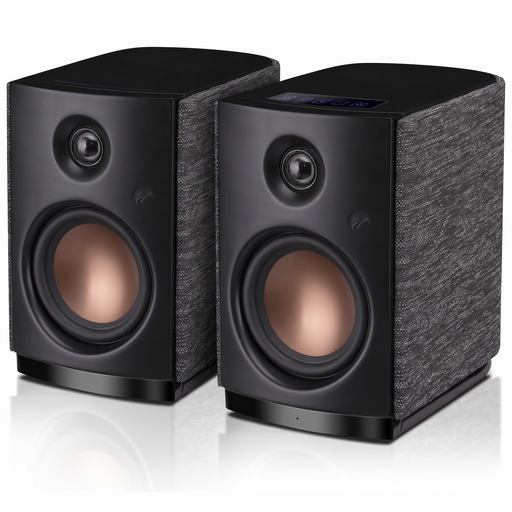
HiVi-Swans OS-10 HiFi stereo bookshelf speakers

HiVi-Swans OS-10 HiFi stereo bookshelf speakers

The product title lists Bluetooth 5.0 for music playback. Before buying, check whether the specific version has built-in amplification or needs a separate amplifier.

A 4-inch woofer is listed in the product title.

View at Joybuy
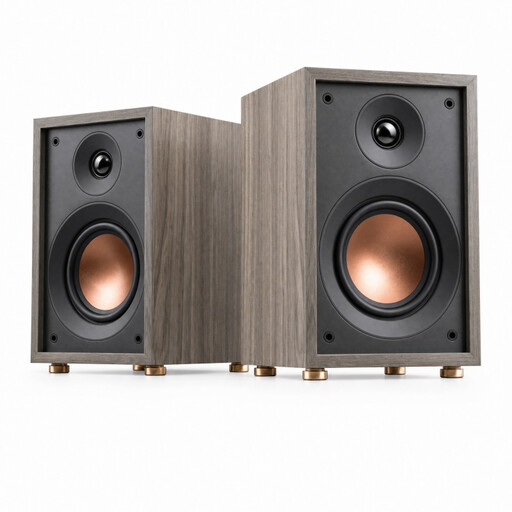
HiVi-Swans Oasis passive bookshelf speaker

HiVi-Swans Oasis passive bookshelf speaker

This passive bookshelf speaker is an option for a system with suitable amplification. Remember to plan for a suitable way to connect your playlists, too.

The product title lists a 4-inch woofer, a 20 mm dome tweeter, 60 Hz–20 kHz, 4 Ω and 10–50 W.

View at Joybuy

Frequently asked questions

Do I need an amplifier for passive bookshelf speakers?

Yes. Passive bookshelf speakers need a suitable amplifier and a suitable signal path from your playlist device. For the ELAC DB63, ELAC specifies a nominal impedance of 6 Ω and a recommended amplifier power of 20–140 W. Teufel says the ULTIMA 25 AKTIV 2 doesn’t need a separate amplifier.

What should I bear in mind when positioning and cleaning the speakers?

Check the instructions for your specific model. The Edifier R1280DBs manual recommends leaving at least 5 cm of space for ventilation. Before cleaning, it advises switching the speakers off, unplugging them and using a dry cloth. These specific instructions don’t necessarily apply to other models.

What rights apply to online purchases in Germany?

According to the Verbraucherzentrale, goods bought online generally come with a 14-day right of withdrawal; the terms of the specific contract apply. The Verbraucherzentrale also distinguishes between the statutory guarantee owed by the seller and a voluntary warranty. This information applies to Germany.

Can I play dance music loudly at any time in a small living room?

There isn’t one universal time that applies to all private music listening. For noise caused by people’s behaviour, Germany’s Federal Environment Agency refers to state law, local rules and house rules. Check the rules where you live and be considerate of your neighbours.

What should I check for compliance when buying a Bluetooth or Wi-Fi speaker?

The Bundesnetzagentur lists CE marking, product and manufacturer details, German-language instructions and a declaration of conformity among the checks it carries out as part of its market surveillance. A product listing alone doesn’t confirm that an individual device meets these requirements.