First, choose two suitable positions, then check that their inputs match your music sources. As Genelec explains in its speaker placement guidance, positioning and similar conditions on the left and right affect the stereo image at your desk. If you don’t have a suitable amplifier, an active pair is the simpler place to start. If you already have an amplifier or plan to buy one, a passive pair is also an option, but you’ll need to factor in the amplifier, cables and compatibility.
Who are bookshelf speakers at a desk suited to?
Folk listeners with a dedicated desk space
If you usually listen to vocals and acoustic instruments from one seat, you can position both speakers towards it. Genelec notes that similar conditions on the left and right are important for the stereo image.
Listeners short on space
If you need to fit two cabinets on your desk or shelf, check their dimensions, cable routing and how close they can sit to a wall or furniture before you buy.
Listeners without a separate hi-fi system
If you want to connect a computer or other sources without choosing an amplifier first, an active pair could be a good fit. The inputs on the specific model are what matter; Edifier, PreSonus and KEF offer different connection options across their ranges.
What should you consider when choosing?
For acoustic folk at your desk, it’s worth first checking your listening position and available space, then matching the source connections and finally working out what you’ll need for a complete system.
Active pair with analogue inputs
A good fit if: Your computer or audio interface has a compatible analogue output and you’re not planning to use a separate amplifier. Edifier lists TRS, RCA and AUX inputs for the MR4; PreSonus lists analogue inputs for the Eris 3.5 2nd Gen.
Bear in mind: Check that the connections and cables you need are compatible with your devices. The connection details don’t prove that the speakers will sound better in your own listening position.
Active pair with Bluetooth or digital inputs
A good fit if: You want to connect different sources without a separate amplifier. Edifier lists Bluetooth and optical inputs among the features of the R1280DBs; KEF lists USB-C, HDMI ARC and streaming for the LSX II LT.
Bear in mind: Inputs vary by model. You’ll also need to allow for a connecting cable between the speakers with the KEF LSX II LT, as specified by KEF.
Passive bookshelf speaker pair
A good fit if: You already have a suitable amplifier or want to choose your speakers and amplifier separately. Q Acoustics describes the 3020c as a passive compact speaker.
Bear in mind: Your setup will need an amplifier, speaker cables and compatible components. Teufel specifies 4–8 Ω for the ULTIMA series; still check this against the specific amplifier you plan to use.
| Buying priority |
What to look for when buying |
Who is this especially important to? |
| Stereo image |
Check whether you can position both speakers at a similar height and angle them towards your listening position. |
If I usually listen to vocals and acoustic instruments from the same seat, I want to be able to position both speakers accordingly. Around 36% of consumers put the stereo image first. |
| Space and placement |
Measure the space for both cabinets and their connections; follow the placement and ventilation guidance for the specific model. |
When desk space is limited, I want to know in advance whether two cabinets and their cables will fit sensibly. Around 29% of consumers prioritise the space required. |
| Connecting music sources |
Compare the outputs on each of your devices with the inputs on the specific speaker model. |
If I want to connect a computer or other sources, I need a compatible input rather than a long list of features. Around 21% of consumers prioritise source connections. |
| What’s needed for a complete system |
Check what you already have and what additional amplifier, power and connecting cables you’ll need. |
If I want to keep extra components to a minimum, the requirements of the complete setup matter to me. Around 14% of consumers focus on what’s needed for the whole system. |
Which buying and placement mistakes should you avoid?
-
‘Bookshelf speakers’ doesn’t automatically mean a shelf is the right place for them
Two cabinets need suitable positions. Nearby furniture and surfaces can affect the conditions at your listening position, and differences between the left and right sides can affect the stereo image.
Measure both spaces and check whether you can position the speakers in a similar way from your usual seat.
If your existing spaces aren’t suitable, you may need to plan for alternative positions or suitable stands.
-
Assuming a passive pair is a complete playback system
Passive speakers need a suitable amplifier. Without one, they aren’t equivalent to an active speaker system.
Check your existing amplifier, its compatibility and what’s included before comparing passive and active models.
If you still need an amplifier or speaker cables, factor them into the additional cost of your system.
-
Assuming Bluetooth means the speaker pair is completely wireless
The KEF LSX II LT has a connecting cable between the speakers, despite its wireless streaming options.
For this specific model, check the power supply, connecting cable and cable routing separately from its streaming features.
Depending on where you place the speakers, you may need a longer, suitable connecting cable.
A guide to relevant brands
Edifier
The MR4 and R1280DBs ranges cater for different connection needs in active speakers.
- Edifier lists TRS, RCA and AUX inputs, as well as a headphone output on the front, for the MR4. The manufacturer lists Bluetooth and optical input among the features of the R1280DBs.
- The connections on one model don’t automatically apply to the other. Manufacturer specifications aren’t an independent listening comparison.
PreSonus
The Eris 3.5 2nd Gen is an active pair for analogue sources at your desk.
- PreSonus lists analogue TRS, RCA and 3.5 mm inputs, along with a level control and a headphone output on the front.
- When checking a listing, make sure the specific generation you want is available in your market. Product specifications aren’t a substitute for an independent sound comparison.
KEF
The active LSX II LT combines a compact stereo setup with several digital connections and streaming.
- KEF lists connections including USB-C and HDMI ARC, as well as streaming features.
- You’ll need to allow for a connecting cable between the speakers. Check whether you’ll need any additional accessories for your chosen setup, too.
Q Acoustics
The passive 3020c is an option if you already have a suitable amplifier or plan to choose one.
- Q Acoustics describes the 3020c as a compact standmount speaker.
- A passive pair needs a suitable amplifier system. Manufacturer claims about sound or bass aren’t an independent listening comparison.
Teufel
The passive ULTIMA series is a speaker pair that needs to be considered alongside a suitable amplifier.
- Teufel specifies an impedance of 4–8 Ω for the ULTIMA series.
- Check the specifications for the exact speaker generation against your amplifier. A series-wide specification isn’t a substitute for checking the specific combination.
Joybuy products for your desk
This selection includes active pairs with Bluetooth or other inputs, as well as passive bookshelf speakers that need a suitable amplifier as part of the setup.
 No image available
Lemega active bookshelf speaker pair, 40 W
For an active desktop setup if you want to use Bluetooth or several wired sources.
Active pair with Bluetooth, HDMI ARC, optical, USB, AUX and RCA inputs; 40 W according to the product name.
View at Joybuy
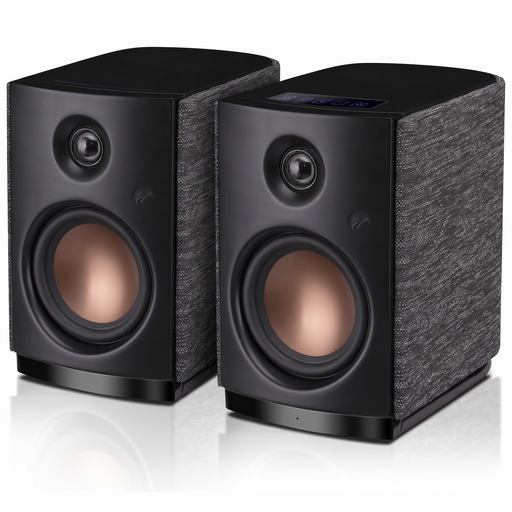 No image available
HiVi-Swans OS-10 active stereo bookshelf speakers
For an active desk setup if you want to use Bluetooth or an AUX input.
Bluetooth 5.0 and AUX; 4-inch woofer and 62 W RMS according to the product name.
View at Joybuy
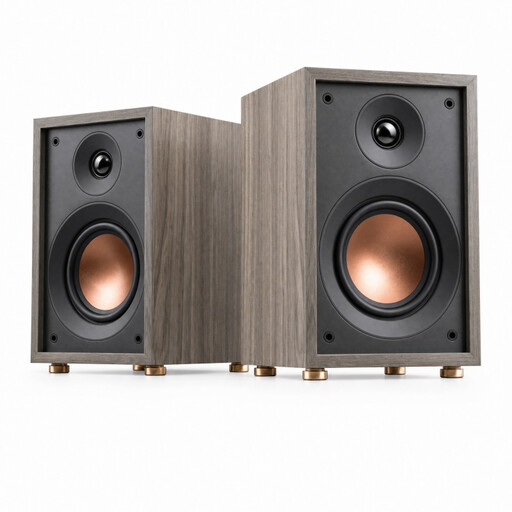 No image available
HiVi-Swans Oasis passive two-way bookshelf speaker
For a passive bookshelf speaker setup if you have a suitable amplifier or plan to include one.
4-inch woofer and 20 mm dome tweeter; frequency range 60 Hz–20 kHz and 4 Ω impedance according to the product name.
The stated amplifier power is 10–50 W. A suitable amplifier is required for use.
View at Joybuy
 No image available
HiVi D3.1MKII passive stereo bookshelf speakers
For a passive stereo setup if you want to choose your amplifier and speakers separately.
Two-way design with a 6.5-inch mid/bass driver, 28 mm dome tweeter and rear bass reflex according to the product name.
8 Ω impedance; stated amplifier power 10–120 W. A suitable amplifier is required for use.
View at Joybuy
Frequently asked questions
How should I position two speakers for my usual listening spot?
Angle both towards your usual seat and aim for similar distances and surroundings on the left and right. Genelec explains that comparable reflections on both sides are important for an accurate stereo image. Adjust the position to suit your room if needed.
Can I connect active speakers directly to my laptop?
It depends on whether your laptop’s output is compatible with an input on the specific model. KEF lists USB-C for the LSX II LT; Edifier lists analogue inputs for the MR4. Check the specifications for the model you’re considering and the output on your laptop.
What should I bear in mind when positioning and cleaning an active pair?
Follow the instructions for the model you’ve bought. Edifier recommends leaving at least 5 cm of space around the R1280DBs for ventilation and advises switching the unit off and unplugging it before cleaning. This specific clearance recommendation applies to this model, not to all speakers.
What are my rights if I return a product or find a fault after buying online in Germany?
According to Verbraucherzentrale, online contracts generally come with a 14-day right of withdrawal, which you must exercise by notifying the seller. Your statutory rights against the seller and a voluntary guarantee are two different things.
What markings should I check on electrical or Bluetooth speakers?
Check the markings and accompanying product information for the specific listing. Within its remit, the Bundesnetzagentur checks matters including CE markings, manufacturer details, German-language instructions and declarations of conformity. A product description alone doesn’t prove that a listing meets these requirements.


