What to look for when buying
First, work out whether a passive pair will suit your amplifier, or whether an active system is a better match for your sources and listening position.
Active stereo pair
A good fit if: you want to get started without a separate amplifier and connect devices using compatible inputs. Edifier lists Bluetooth, RCA, optical and coaxial inputs for the R1280DBs.
Consider: whether the inputs and power supply will suit your system. A wide choice of connections doesn’t tell you how the pair will sound when playing folk quietly.
Passive stereo pair
A good fit if: you already have a suitable amplifier and the right signal path.
Consider: the system won’t be ready to play without a suitable amplifier and speaker cables. Check the impedance of the specific model against your amplifier’s specifications.
Networked active pair
A good fit if: you specifically want to use Wi-Fi streaming or digital connections. KEF lists AirPlay 2, Google Cast, HDMI ARC and USB-C among the connections available on the LSX II LT.
Consider: according to the manufacturer, the KEF LSX II LT has no analogue 3.5 mm input. KEF recommends using the supplied cable or a C-Link cable to connect the speakers.
| What matters to you |
What to check before buying |
Who it matters to most |
| Assessing sound at low volumes |
Compare familiar recordings at your usual volume; check for a Loudness function or tone controls if available. |
If I mainly listen to voices and instruments quietly, I want to assess them at exactly that volume. Around 29% of consumers put sound quality at low volumes first. |
| Positioning speakers in the room |
Measure the available space and listening distance; check whether both speakers can be positioned similarly in relation to your listening spot. |
Those who need to fit two speakers into a limited space and position them for their own listening spot pay particular attention to placement. Around 23% of consumers give this priority. |
| Using an existing amplifier |
Check impedance, connections, cables and the signal path from your music source against the specifications for the specific devices. |
If I want to keep using my existing amplifier, I want to be sure it’s compatible with the speakers I choose. Around 18% of consumers prioritise their existing system. |
| Connecting music sources |
Check the outputs on each of your actual source devices against the inputs on the speaker system. |
If you want to connect a smartphone, computer or other existing sources, check for the inputs you need rather than just counting the features. Around 18% of consumers put connecting their music sources first. |
| Planning a complete system |
Allow for the amplifier, any connection cables you’ll need and the accessories supplied for your sources. |
If I want to put together a stereo system that’s ready to connect, I also compare the components I’ll need. Around 12% of consumers prioritise the cost of the complete system. |
Joybuy products for different systems
These products include an active stereo pair for Bluetooth or AUX sources, and a passive pair for a system with a suitable amplifier.
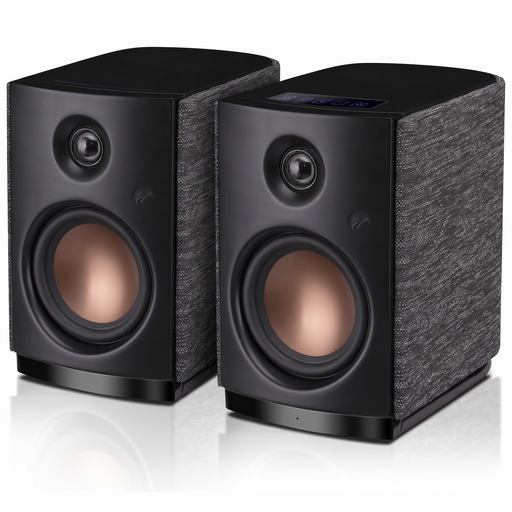 Image unavailable
HiVi-Swans OS-10 active hi-fi stereo speakers, Bluetooth 5.0
This active stereo pair is worth considering if you want to use Bluetooth or AUX and don’t want to add a separate amplifier.
Features listed in the product title: 4-inch mid-bass drivers, 62 W RMS, Bluetooth 5.0 and touch controls. The power rating alone doesn’t prove sound quality at low volumes.
View at Joybuy
 Image unavailable
HiVi D3.1MKII passive 2-way bookshelf speakers, 8 ohms
This passive speaker pair suits a system with a suitable amplifier; remember to allow for the right speaker cables too.
Features listed in the product title: 6.5-inch mid-bass driver, 28 mm soft-dome tweeter, rear bass reflex port, 8 ohms and 10–120 W. Check amplifier compatibility against the specifications for both devices.
View at Joybuy
Frequently asked questions
Do I need an amplifier for passive bookshelf speakers?
Yes. The passive speakers covered here need a suitable amplifier or receiver. Check its stated compatibility against the impedance of the specific speakers, and factor in the signal path from your music source.
How do I assess bookshelf speakers for listening to folk at low volumes?
Compare vocals and acoustic instruments at your usual listening volume, in the spot where you plan to listen. A wattage rating or frequency range alone doesn’t prove how they’ll sound there. Also take speaker placement and any available tone controls into account.
How should I position two speakers for my listening spot?
Angle both speakers towards your listening spot and aim for similar conditions on the left and right. Genelec highlights the importance of similar reflection conditions for stereo imaging; the recommended distances depend on the manual for the specific model.
Can I connect an analogue source to the KEF LSX II LT?
According to KEF, the LSX II LT has no analogue 3.5 mm input. Check the output on your source device and plan a suitable signal path before choosing this model.
What should I look for with mains-powered or Bluetooth speakers?
The Federal Network Agency lists several checks in its market surveillance of affected electrical and radio products. These include correct CE marking, product and manufacturer details, German-language instructions and a declaration of conformity. This doesn’t mean that every passive speaker cabinet is subject to the same requirements, or that a particular offer has already been checked against them.


