First, choose two possible locations for your speakers and decide how you want to play your festive playlist. An active pair needs no separate amplifier, a connected pair can stream through compatible services, and passive speakers are suited to a compatible existing system. Genelec recommends similar reflection conditions on the left and right for precise stereo imaging, but this does not guarantee even sound throughout an open-plan living space.
Which option is right for you?
Hosts with an open-plan living space
If you want to listen to music in your living and dining areas, first check where both speakers can be placed sensibly. Listening position and reflections affect stereo imaging; Genelec recommends similar reflection conditions on the left and right.
Playlist starters without an amplifier
If you want to play music straight from your smartphone or another device you already own, an active pair could be a good choice. Check the connections and streaming options you actually need on the model you’re considering.
Hi-Fi owners with an amplifier
If you want to keep using your existing system, check that the passive speakers and their placement are compatible with your amplifier or receiver.
What should you look for when buying?
Active pair with Bluetooth or inputs
A good fit if: You want to get started without a separate amplifier and connect your smartphone, computer or television using suitable inputs.
Keep in mind: Check the inputs on the specific model, and plan for power and the connection between the speakers.
Active Wi-Fi stereo pair
A good fit if: You want to include compatible network streaming or multi-room audio in the way you listen to music.
Keep in mind: Check network and service compatibility, as well as how you’ll route the cable between the speakers. Wireless playback doesn’t necessarily mean the speakers connect to each other wirelessly.
Passive speaker pair
A good fit if: You already have a suitable amplifier or receiver, or want to choose your speakers and amplifier separately.
Keep in mind: Your amplifier, source device and speakers all need to work together. If you don’t already have a system, you’ll need additional equipment and cables.
| Priority |
What to check when buying |
Who is this especially important to? |
| Placement and sound |
Measure the available spaces and plan the position, height and angle of both speakers. Assess them from the places where you’ll actually listen. |
If I want to listen to music in my living and dining areas, I need two suitable places for the speakers and want to assess the sound from the listening spots that matter. Around 36% of consumers put placement and sound in multiple listening spots first. |
| Playing your playlist |
Check your smartphone, television or computer against the inputs and streaming features explicitly listed for the speakers. |
If I want to start my festive playlist easily using devices I already own, I’ll first compare the connections and services I need. Around 29% of consumers prioritise easy playback. |
| Existing system |
For passive models, check compatibility with your amplifier or receiver, and make sure the complete signal path to your playlist is covered. |
If I want to keep using my Hi-Fi system, I need to know whether passive speakers will work with my amplifier. Around 21% of consumers put integration with an existing system first. |
| Bass and neighbours |
Check for a subwoofer output if you might want to expand your system. Take local rules and your building’s house rules into account. |
If I want more bass for festive music but also need to be considerate of my neighbours, both matter to me. Around 14% of consumers prioritise this balance. |
Common pitfalls
-
Assuming “wireless” means there’s no cable between the speakers
Wireless music playback doesn’t rule out a cable connecting the speakers. You’ll need to allow for one with the KEF LSX II LT.
Plan separately for the power supply and the connection between the two speakers, as well as for streaming.
If necessary, allow space and plan cable routing for the connection between the speakers.
-
Expecting passive speakers to be ready to play straight away
The ELAC Debut 3.0 DB63 and Teufel ULTIMA 20 Mk4 are designed to connect to an amplifier or receiver. Without suitable equipment, the signal path from your playlist to the speakers isn’t complete.
Before buying, plan the complete signal path and check that your amplifier, source device and speakers will work together.
If you don’t already have a suitable amplifier, you’ll also need to buy one, along with the necessary connecting cables.
-
Assuming a manufacturer’s claims about room-filling sound apply to every listening spot
In an open-plan living space, placement and reflections affect what you hear from different listening spots. A promise about sound doesn’t tell you how the speakers will sound in your home.
Assess your planned setup for both the seating and dining areas, rather than relying on claims about room-filling sound alone.
Key brands to consider
The features listed below apply to the specified model ranges. They don’t replace checking the exact connections, placement requirements and compatibility with your system.
Edifier
The active R1855DB is a pair of bookshelf speakers with Bluetooth, several wired inputs and a subwoofer output.
- Edifier lists Bluetooth, as well as line-in, optical and coaxial inputs for this model.
- Wi-Fi streaming isn’t listed for this model. The manufacturer’s power output figure isn’t an independent measurement of how sound carries in your home.
Teufel
The ULTIMA 25 AKTIV 2 is an active pair; the ULTIMA 20 Mk4 is a passive alternative for a system with an amplifier.
- According to Teufel, the ULTIMA 25 AKTIV 2 doesn’t need a separate amplifier and offers HDMI and Bluetooth, among other features.
- Check the exact model generation: ULTIMA 25 AKTIV and ULTIMA 25 AKTIV 2 are different model names, and their features aren’t necessarily the same.
KEF
The LSX II LT is an active Wi-Fi stereo pair for compatible network streaming.
- For this model, KEF lists AirPlay 2, Google Cast, HDMI ARC and a subwoofer output.
- Even though music can be played wirelessly, you’ll need to allow for a connection between the speakers. The manufacturer’s claims about sound don’t tell you how they’ll perform in your home.
ELAC
The Debut 3.0 DB63 is a passive bookshelf speaker option for a system with a suitable amplifier or receiver.
- ELAC describes it as connecting to amplifiers and receivers.
- A suitable amplifier is still part of the system. The manufacturer’s claims about sound and bass don’t prove what you’ll hear in your planned location.
DALI
According to DALI, the compact KUPID can be placed on a shelf or mounted on a wall using the supplied bracket, among other options.
- The wall bracket gives you another placement option if space is limited.
- DALI’s claim of room-filling sound doesn’t prove that playback will be even throughout a particular open-plan living space.
Joybuy products
The following Joybuy products include active Bluetooth speaker pairs and passive bookshelf speakers for connecting to an existing system.
 No product image available
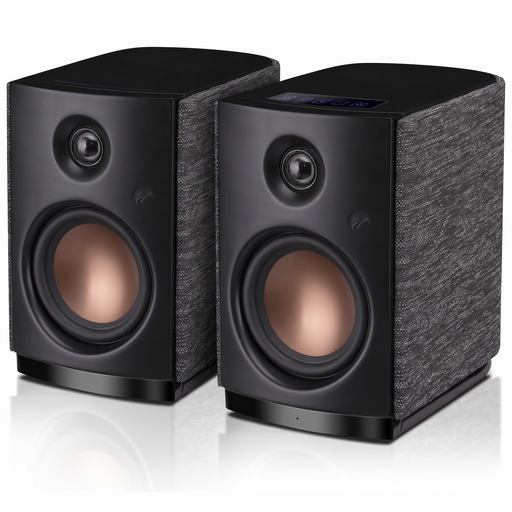
Lemega active bookshelf speakers, 40 W, pair, black
This active pair is a good choice if you want to get started without a separate amplifier and connect devices using suitable inputs.
Bluetooth; HDMI ARC, optical input, USB, AUX and RCA.
View at Joybuy
 No product image available
HiVi-Swans OS-10 active Hi-Fi bookshelf speakers
This active pair is a good fit if you want Bluetooth and compact speakers for a shelf or desk.
Bluetooth 5.0; 4-inch woofer; 62 W RMS.
View at Joybuy
 No product image available
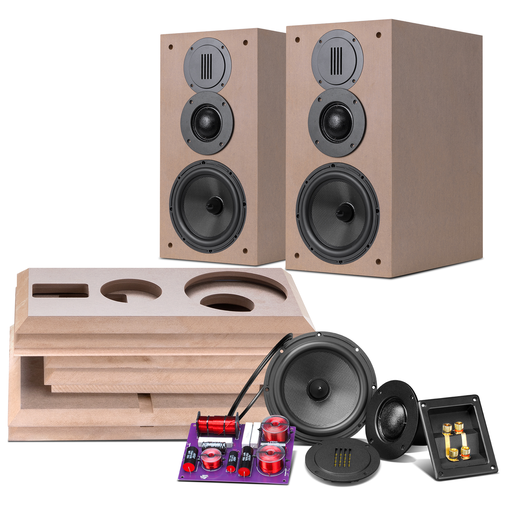
HiVi-Swans DIY3.1 passive bookshelf speakers, pair
This passive pair could be a good addition to an existing system with a suitable amplifier or receiver.
6.5-inch drivers.
Requires a suitable amplifier or receiver.
View at Joybuy
 No product image available
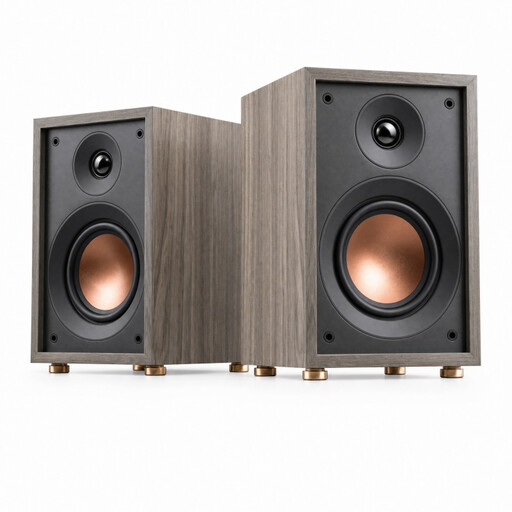
HiVi-Swans Oasis passive bookshelf speakers
This passive model is a good choice if you’re looking for a compact speaker pair for a system with a suitable amplifier.
4-inch woofer; 20-mm dome tweeter; bass reflex; 60 Hz–20 kHz; 4 Ω; 10–50 W.
Requires a suitable amplifier.
View at Joybuy
 No product image available
HiVi D3.1MKII passive bookshelf speakers
This passive pair is a good fit if you want to play music through an existing system with a suitable amplifier or receiver.
6.5-inch drivers; 28-mm dome tweeter; rear bass reflex; 8 Ω; 10–120 W.
Requires a suitable amplifier or receiver.
View at Joybuy
Frequently asked questions
Is the wattage enough to help me choose speakers for my open-plan living space?
No. The Edifier R1855DB’s 70 W RMS is a manufacturer’s power output figure, not a measurement of how sound carries in your home. Check possible locations for the speakers and, if you can, assess them from the listening spots that matter.
What should I consider when placing and connecting a stereo pair?
Plan two speaker locations and a route for the connection to your music source. Genelec recommends similar reflection conditions on the left and right for precise stereo imaging; with the KEF LSX II LT, you’ll also need to allow for a cable between the speakers. Check the instructions for the specific model.
Can I add more bass later?
Models with a suitable subwoofer output, such as the Edifier R1855DB or KEF LSX II LT, are designed to be expanded. The connection alone won’t tell you whether you need one for your listening spot or whether it’s suitable for your neighbours.
Can I play my speakers as loudly as I like at a party?
No. Buying a speaker doesn’t mean you can play it at any volume. The German Environment Agency notes that state law, local regulations and house rules may all govern noise affecting neighbours. The rules that apply to your home therefore depend on where you live and your building’s house rules.


