What should you look for when buying?
For quiet blues listening, assess the sound balance, signal path and speaker placement from your listening position. Yamaha Music explains that bass and treble can sound less prominent than the midrange at low volumes, so it’s important to compare speakers at the volume you usually listen at.
Active stereo pair
A good fit if: You don’t have an external amplifier and your music source is compatible with the inputs on the specific model.
Bear in mind: Connections and controls vary by model. With networked systems, you’ll also need to consider device compatibility and how the speakers connect to each other. KEF, for example, supplies a cable for the LSX II LT.
Passive bookshelf speakers
A good fit if: You already have a suitable amplifier and a compatible way to connect your music source.
Bear in mind: Your amplifier and speakers need to be compatible, and the complete signal path will also require an amplifier and speaker cables.
| What matters |
What to check when buying |
Who should prioritise it |
| Sound balance at low volumes |
Listen to familiar blues recordings from your intended listening position and at your usual volume. Check whether your amplifier has an adjustable Loudness function. |
If I want to hear vocals, guitar and bass in balance even at low volumes, I’d compare speakers from my listening position. Around 36% of consumers put sound balance at low volumes first. |
| Music source and system type |
Match your source’s outputs to the inputs on the speakers or amplifier. Don’t confuse Bluetooth with network streaming. |
If I want to connect my music collection without extra steps, I’ll first check the equipment I already have and the complete signal path. Around 29% of consumers prioritise connections and a system that suits their needs. |
| Available space and listening position |
Measure the space for both speakers, including room for connections and cables. Follow the placement guidance for the specific model. |
If I’m setting up a stereo pair in a fixed position, I’ll check that there’s enough space and that the speakers can be positioned sensibly in relation to my listening spot. Around 21% of consumers put speaker placement first. |
| Complete system |
Check whether you’re buying a pair or a single speaker, and whether you’ll also need an amplifier, cables or stands for your set-up. |
If I want to work out the cost of a stereo system I can connect, I’ll add up the parts I actually need. Around 14% of consumers prioritise the total cost of the system. |
Joybuy products
The Joybuy products below include active and passive bookshelf speakers for different signal paths. Passive models need a suitable amplifier.
 No image available
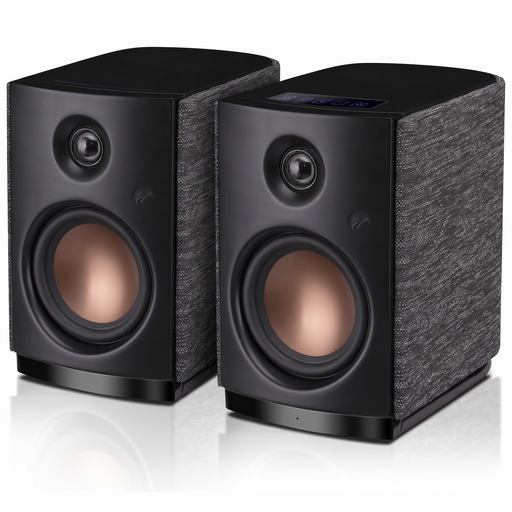
HiVi-Swans OS-10
An active option if Bluetooth 5.0 suits your music source.
Specifications listed in the product name: 4-inch woofer, 62 W RMS and touch controls.
View at Joybuy
 No image available
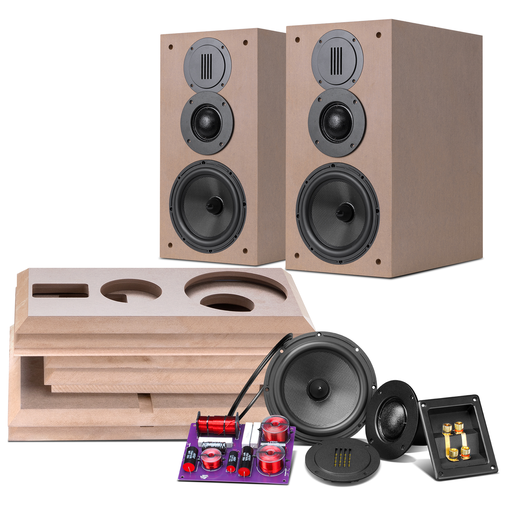
HiVi-Swans DIY3.1, passive pair
A passive option if you have a suitable amplifier in your system.
Specifications listed include a 6.5-inch driver, a 26-mm dome tweeter and a rear bass reflex port.
View at Joybuy
 No image available
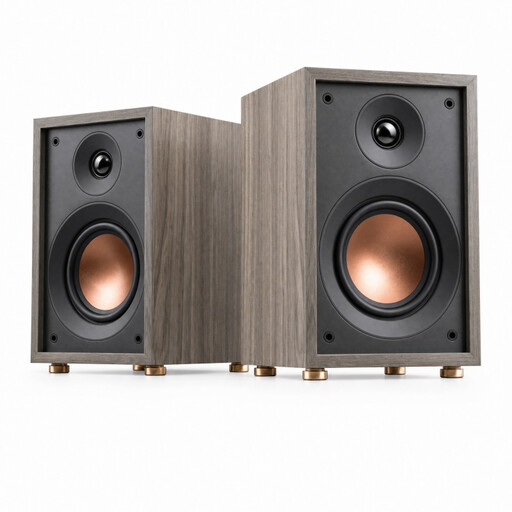
HiVi-Swans Oasis, passive
A passive bookshelf speaker for a system with a suitable amplifier. Check how many you need for your stereo set-up.
Specifications listed: two-way bass reflex system, 4-inch woofer, 20-mm dome tweeter, 60 Hz–20 kHz, 4 Ω and 10–50 W.
View at Joybuy
 No image available
HiVi D3.1MKII, passive
A passive option if your signal path includes a suitable amplifier.
Specifications listed in the product name: 6.5-inch driver, 28-mm dome tweeter, 8 Ω and 10–120 W.
View at Joybuy
Frequently asked questions
Do I need an amplifier for passive bookshelf speakers?
Yes. Passive bookshelf speakers need a suitable amplifier or receiver. Teufel explicitly states that the passive ULTIMA 20 needs one; also check that you can connect your music source to it.
Does a Loudness function help when listening quietly?
It may help balance the perception of bass and treble at low volumes, if your particular amplifier has this function and you set it appropriately. This doesn’t mean that a particular pair of speakers will sound better in your room.
How should I position two speakers for a fixed listening spot?
Try to position both speakers at comparable distances from your listening spot, and take room reflections into account. Genelec explains how similar conditions on the left and right affect stereo imaging; adapt its guidance to your room and the instructions for your specific model.
What costs and consumer rights should I check when buying online?
Check whether the listing is for one speaker or a pair, and which other parts you’ll need for your system. The Verbraucherzentrale explains that many online purchases generally come with a 14-day right to cancel; when the period starts and whether any exceptions apply depend on the specific purchase. The statutory guarantee of conformity is separate from a voluntary guarantee.
What should I look out for with active speakers or Bluetooth models in Germany?
For products covered by the relevant rules, the Bundesnetzagentur checks matters including CE marking, product identification and manufacturer information. The CE mark is the manufacturer’s declaration of conformity, not an independent sound or quality mark. Check the details for the specific model on offer.


