Who might enjoy listening to chamber music quietly?

Quiet listeners

If you usually listen to strings, piano and voices at low volume, assess the sound using familiar recordings rather than relying on a power rating. Yamaha describes an amplifier’s loudness function as a way to adjust the tonal balance at low volumes.

Listeners with a regular stereo setup

If you want to place instruments in space from your preferred seat, consider both speaker placement and the room. Genelec highlights the importance of having similar reflection conditions on the left and right for a stereo pair.

Listeners without a separate amplifier

An active stereo system could be a good alternative if you don’t want to buy a separate amplifier. Make sure the inputs, power supply and connection between the speakers suit your sources and intended setup.

What should you look for when choosing?

Passive bookshelf speakers

A good fit if: you already have a suitable amplifier or want to choose your speakers and amplifier separately.

Things to consider: You’ll need an amplifier and speaker cables for a complete setup. Whether you have a loudness function depends on your amplifier.

Active stereo or streaming system

A good fit if: you don’t want a separate amplifier and the system’s inputs suit your sources.

Things to consider: Check how the speakers connect to each other. “Wireless” doesn’t necessarily mean that the two speakers connect without a cable.

Active nearfield monitors

A good fit if: you mainly listen from a fixed position at close range and want to fine-tune the setup.

Things to consider: The source and controls need to suit your home system. A studio design in itself doesn’t prove that a speaker is better for quiet chamber music.

What matters What to check when buying Who is this important to?
Tonal balance at low volumes Listen to familiar recordings at your usual volume and check whether the amplifier has a suitable loudness setting. If I want voices and instruments to sound balanced even at low volumes, I compare playback at my usual listening level. Around 33% of consumers say tonal balance is their top priority.
Stereo imaging and instrument placement Check whether both speakers can be positioned in a similar way, and follow the guidance for the specific model. I want to be able to place instruments in space from my regular listening position, so I pay attention to the arrangement of the stereo pair. Around 27% of consumers give instrument placement from their listening position top priority.
Space and placement Measure the available space and check the mounting options, clearance and placement guidance for the specific model. If there’s little room alongside my furniture, the key question is whether both speakers will fit where I plan to put them. Around 20% of consumers consider available space first.
Connecting to your existing system Check your sources and equipment against the inputs, items included and cables required for the specific product. I want to connect my existing sources without needing an unsuitable amplifier or cable setup. For around 20% of consumers, connecting to their existing system is the top priority.

Which common mistakes should you avoid?

  • Assuming “wireless” means a completely cable-free stereo pair

    KEF specifies a cable connection between the speakers for the LSX II LT. Depending on where you place them, you’ll need to route the cable carefully.

    Before choosing, check where the speakers will go, the connection route you’ll need and the inputs on your sources.

  • Choosing based only on high power or a description of the sound

    These details don’t tell you how the speakers, system, room and listening position will work together at your usual low volume.

    Compare familiar recordings at the volume you actually want to listen at, and take speaker placement into account.

  • Comparing passive speakers with a complete active system

    Passive speakers and active systems differ in the amplifier and connection components needed for a complete setup.

    Compare what’s included with each option and check which equipment and cables you already have.

Which brands could help guide your choice?

DALI

DALI offers the KUPID as a compact passive speaker option. The manufacturer now lists the OBERON 1 as discontinued.

  • DALI says that the KUPID comes with a wall bracket.
  • Manufacturer descriptions of the sound aren’t an independent listening comparison at low volumes. With a passive setup, you’ll also need to factor in a suitable amplifier.

ELAC

The Debut 3.0 DB53 is an example of a passive bookshelf speaker range designed for use with an amplifier.

  • ELAC describes its tweeter and woofer, and says the speakers can be connected to AV amplifiers and receivers.
  • This doesn’t prove that they’re particularly suited to quiet chamber music.

KEF

The LSX II LT is an active streaming stereo system for buyers who don’t want a separate amplifier.

  • KEF lists USB-C, HDMI ARC and streaming among its features.
  • The two speakers need a connection cable. The listed features don’t prove that the system performs better at low volumes.

Neumann

The KH 80 DSP is an active nearfield monitor for a fixed listening position and a carefully tailored setup.

  • Neumann documents options for adjusting the speakers to their placement, as well as other tools for room correction.
  • These are the manufacturer’s details for the model, not an independent listening test for chamber music at low volumes.

Q Acoustics

The 3020c is a passive compact speaker in the 3000c family and can be compared with an amplifier setup you already own.

  • Q Acoustics places the 3020c in its 3000c speaker family.
  • Manufacturer descriptions of the sound aren’t independent comparative measurements.

Joybuy products

The following Joybuy models include both active and passive bookshelf speakers. Passive models need a suitable amplifier; for active models, check the inputs and connections required.
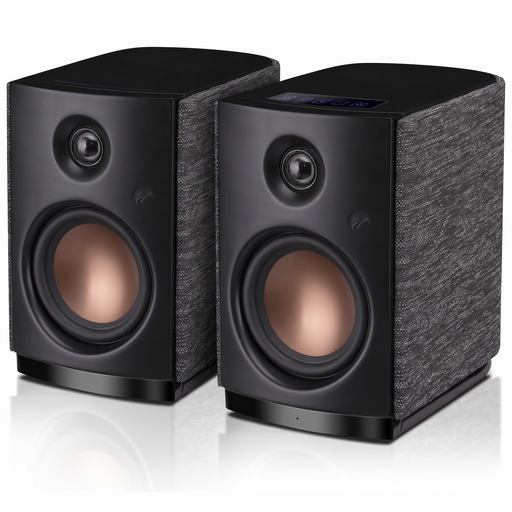
HiVi-Swans OS-10, active HiFi bookshelf speakers with Bluetooth 5.0

HiVi-Swans OS-10, active HiFi bookshelf speakers

For compatible Bluetooth sources and an active stereo setup on a desk. Check that the connections suit your devices.

Bluetooth 5.0, 4-inch woofer and 62 W RMS, according to the product name.

The product name lists touch controls.

Joybuy
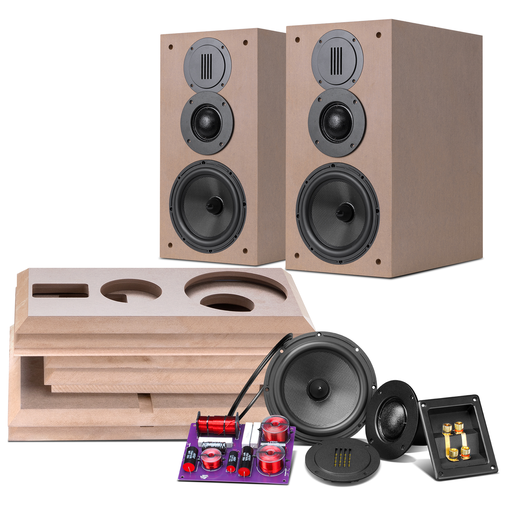
HiVi-Swans DIY3.1, pair of passive bookshelf speakers with 6.5-inch mid-bass driver

HiVi-Swans DIY3.1, passive bookshelf speakers (pair)

For a stereo system with a suitable amplifier. Check compatibility with your amplifier.

The product name lists a 6.5-inch mid-bass driver and a 28 mm dome tweeter.

As passive speakers, they need a suitable amplifier.

Joybuy
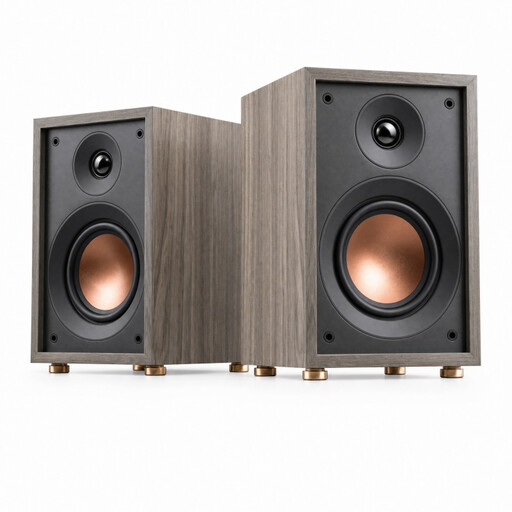
HiVi-Swans Oasis, passive 2-way bass reflex speaker with 4-inch woofer

HiVi-Swans Oasis, passive 2-way bass reflex speaker

For a system with a suitable amplifier. Check in advance that the connection and power specifications are compatible with your amplifier.

The product name lists a 4-inch woofer and a 20 mm dome tweeter.

Frequency range: 60 Hz–20 kHz; impedance: 4 Ω; stated amplifier power: 10 W–50 W.

As a passive speaker, it needs a suitable amplifier.

Joybuy

Frequently asked questions

Do I need an amplifier for passive bookshelf speakers?

Yes, you’ll need a suitable amplifier. Check the specifications for the speakers and amplifier in question rather than assuming they’re compatible based on the product category alone.

Can a loudness setting help when listening quietly?

On amplifiers with this feature, loudness can adjust the tonal balance at low volumes. Set it by ear. Yamaha notes that on the R-N1000A, switching to Pure Direct after adjusting the loudness setting can cause the volume to rise suddenly.

Should the speakers be angled towards the listening position?

There’s no one-size-fits-all answer: recommendations vary by model. Genelec recommends angling its monitors towards the listening position, while DALI recommends placing the OBERON series parallel to the rear wall. Follow the instructions for the model you choose and assess the result from your listening position.

What should I know about faults and disposing of old electrical speakers in Germany?

The statutory guarantee you have against the seller is different from a voluntary manufacturer’s guarantee, as Germany’s Verbraucherzentrale consumer advice centre explains. The German Environment Agency (Umweltbundesamt) points out that waste electrical equipment must not be put in household rubbish. Use an appropriate collection or take-back scheme instead. Whether a product needs CE marking depends on the EU rules that apply to it; CE marking is not a general, independent quality certificate.