Listeners short on space
You want to fit two speakers into a small living room and find a sensible position for them, even if you have shelves or furniture close to the walls.


If you want to set up two speakers without a separate amplifier, an active stereo pair could be a good choice, provided its inputs match your audio sources. Passive speakers require a suitable amplifier. A Wi-Fi speaker is another option if network and app playback matter to you. Make room for both speakers and plan where to position them: Genelec’s guidance on symmetry and reflections applies to studio monitors and doesn’t set universal distances for living-room speakers.
You want to fit two speakers into a small living room and find a sensible position for them, even if you have shelves or furniture close to the walls.
You want to play ambient music without having to find a separate amplifier, and choose between Bluetooth input and Wi-Fi control.
You already have an amplifier and want to check whether compact passive speakers will work with it.
A good fit if: you want to use two speakers without a separate amplifier and connect them using the right inputs.
Worth noting: Bluetooth alone doesn’t mean the speakers have Wi-Fi or every TV connection you might need.
A good fit if: you already have a suitable amplifier or want to choose your amplifier and speakers separately.
Worth noting: To play music from your smartphone, you’ll need a suitable amplifier and audio source.
A good fit if: network and app playback matter to you.
Worth noting: One speaker isn’t the same as two speakers positioned separately for stereo.
| What matters | What to check before buying | Who it matters most to |
|---|---|---|
| Space and positioning | Check the cabinet dimensions, space for both speakers and the positioning guidance for the specific model. | If I need to fit two speakers into a small room, their position is key. Around 31% of consumers put suitable positioning first. |
| Connection without an amplifier | Make sure the model’s inputs match your source’s outputs. Only plan to use HDMI ARC if both devices have this connection. | If I want to listen directly from my smartphone or another suitable source without adding a separate amplifier, the connection options matter. Around 25% of consumers prioritise easy connectivity. |
| Stereo with two speakers | Check whether the product includes a pair or a single speaker, and whether two devices can be linked for stereo. | If I want to position separate left and right speakers, I need to know whether the offer includes two compatible devices. Around 19% of consumers put a room-filling stereo setup first. |
| Wi-Fi and app | Check Wi-Fi, supported playback options, app setup and any accessories you may need for your audio source. | If I want to control network music playback through an app, I check that the speaker supports the exact option I need. Around 13% of consumers prioritise Wi-Fi playback and app control. |
| Existing amplifier | Compare the requirements of the exact speaker model with the specifications of your existing amplifier. | If I want to keep using my hi-fi system, the amplifier and passive speakers need to be compatible. Around 12% of consumers put using an existing amplifier first. |
Placing speakers close to a wall or in different positions can affect the bass and stereo image. Genelec’s guidance covers studio monitors and isn’t a general rule for how far living-room speakers should be from walls.
Before buying, check that you can position both speakers sensibly and follow the guidance for the specific model.
Suitable positioning may take up more space than a narrow shelf can offer.
The KEF Q1 Meta and ELAC Debut 3.0 DB53 are passive speakers and need a suitable amplifier.
Compare the requirements of the specific model with your amplifier and make sure you have a suitable audio source.
If you don’t already have a suitable system, you may also need an amplifier, an audio source and cables.
Sonos says the Era 100 SL can be used on its own or paired with a second device for stereo. One speaker therefore isn’t the same as two separately positioned speakers.
Check the number of speakers included, how they can be paired and what accessories are supplied with the specific offer.
A stereo pair may require a second device, while the AUX connection described requires an input adapter.
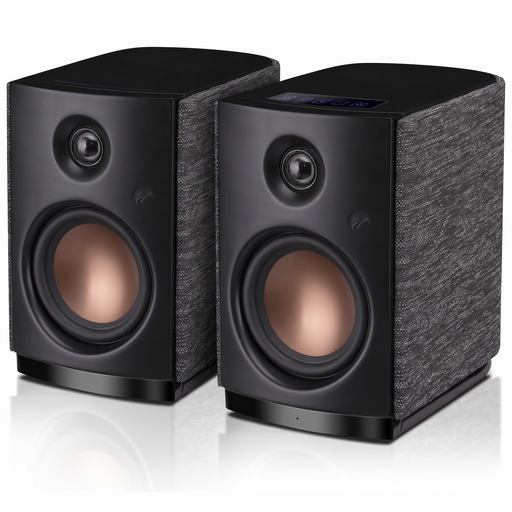
The active R1280DBs stereo pair is an option for Bluetooth and wired audio sources when space is limited.
The active FENRIS A4 pair combines compact living-room use with Bluetooth and HDMI ARC.
The passive Q1 Meta is worth considering if you already have a suitable amplifier or plan to choose one separately.
The Era 100 SL offers Wi-Fi and Bluetooth playback; Sonos says two devices can be connected for stereo.
The passive Debut 3.0 DB53 adds another option for an existing or planned amplifier system.
The options below are active bookshelf stereo pairs for Bluetooth and wired audio sources.
 No image available
Listed as an active pair with Bluetooth and several wired connections, for anyone looking to connect two speakers without a separate amplifier.
The product name lists HDMI ARC, optical, USB, AUX and RCA inputs, as well as a remote control.
 No image available
Described as an active stereo system with Bluetooth, for anyone looking for compact bookshelf speakers without a separate amplifier.
The product name lists Bluetooth 5.0, 4-inch woofer, 62 W RMS and touch controls.
Aim both speakers towards your listening position in as similar a way as possible, and check whether furniture or walls surround one speaker differently from the other. Genelec’s guidance explains symmetry and reflections for monitors; for other models, follow the instructions and consider the layout of your room.
Yes. Passive speakers such as the KEF Q1 Meta need a suitable amplifier. Check that your amplifier meets the requirements of the model you choose, and make sure you have a suitable audio source too.
For a qualifying distance purchase from a business seller, you generally have 14 days from delivery to withdraw from the contract; exceptions and rules on return costs apply. Your Europe states that qualifying purchases of goods come with a legal guarantee of at least two years from receipt. This is separate from any voluntary manufacturer’s warranty.
For the specific offer, check whether it includes German-language instructions with the necessary usage and safety information. The Bundesnetzagentur lists these details in its market surveillance guidance.
In Germany, old electrical equipment must not be put in household waste. The Umweltbundesamt lists local recycling centres and retailer take-back options; removable batteries should be handed in separately.