Choose a stereo pair that fits neatly on your desk and works with your music sources. If you don’t have a separate amplifier, active bookshelf speakers are usually the more straightforward option. Studio monitors are better suited to a fixed listening position with wired connections, while passive speakers need a suitable amplifier. Before you buy, check the dimensions, connections and placement options – model specifications alone can’t predict how your soul records will sound in your room.
Who are the different types of speaker suited to?
Music lovers with a small desk
If you want to place two speakers at a fixed listening position, the cabinet dimensions and how evenly they can be positioned both matter. Genelec recommends using an equilateral stereo triangle as a guide for studio monitors. At your particular desk, the available space will also affect how you position them.
Playlist listeners without an amplifier
If you want to connect your phone or computer directly, choose an active pair with the right inputs. Edifier lists Bluetooth, as well as analogue and digital inputs, for the R1280DBs. The Audioengine A2+ Gen 3 is listed with USB-C audio and Bluetooth.
Listeners with an existing hi-fi system
Passive bookshelf speakers are also an option if you have a suitable amplifier. Check the specifications for the specific speakers against your amplifier’s requirements. For example, ELAC lists a nominal impedance of 6 Ω and recommended amplifier power of 20–120 W for the DB53.
What should you look for when buying?
First, measure the space available for both speakers, then check that their inputs match your phone and computer. If you already own an amplifier, factor its requirements into your choice of passive speakers.
| What to consider |
What should you look for? |
Who should pay particular attention? |
| Space and stereo image |
Measure the footprint and cabinet depth needed for both speakers; plan for them to be positioned and angled as evenly as possible towards your listening position. |
If my desk has limited space, I want to be able to position both speakers so I can sit at a fixed listening point. Around 36% of consumers are likely to prioritise space and positioning. |
| Connections and controls |
Check your phone and computer’s outputs against the inputs on the exact model; don’t assume Bluetooth, USB audio and wired connections are interchangeable. |
If I want to play my playlist directly from my phone or computer, I need a suitable connection without unnecessary extra equipment. Around 29% of consumers are likely to prioritise connecting to their music source. |
| Bass and expandability |
Consider placement and playback at your usual listening volume; only factor in a subwoofer output if you might want to expand the system later. |
If I want more flexibility with bass when listening to my playlist, I’d like the option to expand the system without rushing into buying another device. Around 21% of consumers are likely to consider bass and possible expansion first. |
| Existing amplifier |
For passive speakers, compare the specifications of the exact model with the amplifier manufacturer’s requirements. |
If I want to keep using my hi-fi system, the passive speakers need to be compatible with my existing amplifier. Around 14% of consumers are likely to prioritise using their amplifier. |
Avoid common buying mistakes
-
Assuming passive speakers are ready to connect
Passive speakers need a suitable amplifier. For the ELAC DB53, the nominal impedance of 6 Ω and recommended amplifier power of 20–120 W are specifications to check against your particular amplifier.
Before you buy, check which devices you already own and whether they’re compatible with the speakers. Don’t compare active and passive options based on the speaker pair alone.
If you don’t have a suitable amplifier, you’ll need to budget for one as well.
-
Assuming similar model names and generations are interchangeable
Edifier lists the R1280DB and R1280DBs as different models. The subwoofer output listed for the R1280DBs can’t be assumed to be available on the other model just because their names are similar.
Check the full model name and connections for the exact version you want in the product listing.
-
Judging bass or stereo sound from individual specifications
A subwoofer output tells you how you can connect the speakers; it doesn’t tell you how a complete system will sound. Placement also affects how the speakers perform on your desk.
First, check where you can put both speakers and, if possible, listen at your usual volume. Only plan to expand the system if it suits your specific needs.
Key brands at a glance
Edifier
Active bookshelf speakers for connecting a range of audio sources directly; the R1280DBs is one specific example.
- According to Edifier’s German product page, the R1280DBs offers Bluetooth, two analogue RCA inputs, optical and coaxial inputs, and a subwoofer output.
- These are model specifications, not an independent assessment of sound quality. Check the cabinet dimensions and connections against your workspace.
Yamaha
Compact active studio monitors in the HS3/HS4 series, designed for a fixed listening position with wired connections.
- Yamaha lists RCA, stereo mini and XLR/TRS inputs, along with ROOM CONTROL and HIGH TRIM, for the HS4 pair.
- Bluetooth isn’t included in the listed inputs. If you want wireless playback, check whether a suitable additional audio source is available.
Audioengine
Compact active desktop speakers; make sure you check the exact generation of the A2+.
- Audioengine lists USB-C audio, Bluetooth, an analogue input and an output for adding a subwoofer for the A2+ Gen 3.
- The manufacturer’s sales offer is aimed at the US market, so it doesn’t tell you what the terms or included items are for a German offer.
Teufel
Passive ULTIMA 20 bookshelf speakers for a system with an existing or planned amplifier.
- The German product page describes the offer reviewed as a pair of ULTIMA 20 Mk4 25 speakers for use with an amplifier or receiver.
- An amplifier isn’t listed as part of the speaker pair. Check compatibility with your particular device.
ELAC
Passive Debut 3.0 bookshelf speakers for a system with a separate amplifier.
- ELAC lists a nominal impedance of 6 Ω and recommended amplifier power of 20–120 W for the DB53.
- These specifications apply to the DB53 and shouldn’t be assumed to apply to other Debut models.
Joybuy product selection
This selection includes active bookshelf speakers for direct playback, as well as passive models for use with a suitable amplifier.
 No image available
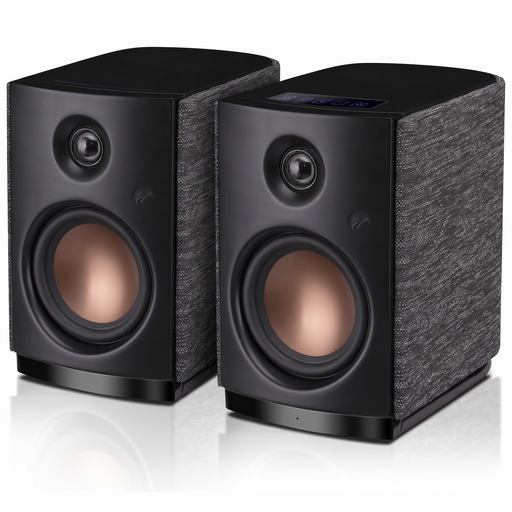
Lemega active bookshelf speakers, 40 W
For listening to a playlist without a separate amplifier; listed as an active stereo pair.
40 W; Bluetooth, HDMI ARC, optical, USB, RCA and AUX inputs; bass and treble controls and a remote control are listed in the product name.
View on Joybuy
 No image available
HiVi-Swans OS-10
For your desk, if you want active speakers with Bluetooth or AUX connectivity.
Specifications listed in the product name: Bluetooth 5.0, AUX, 4-inch woofer, 62 W RMS and touch controls.
View on Joybuy
 No image available
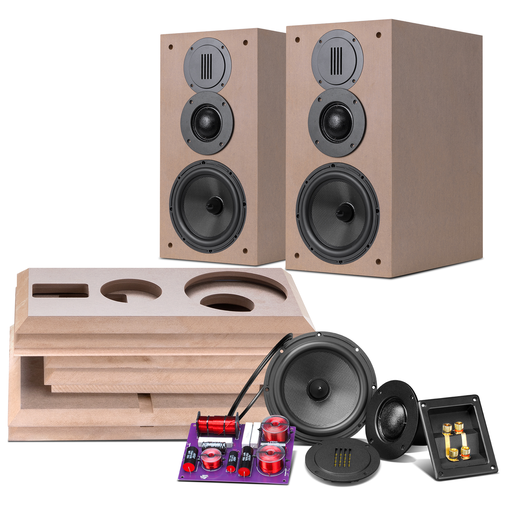
HiVi-Swans DIY3.1
For a hi-fi system with an existing amplifier or receiver; described as a passive speaker pair.
The product name lists a 6.5-inch driver. A suitable amplifier or receiver is required.
View on Joybuy
 No image available
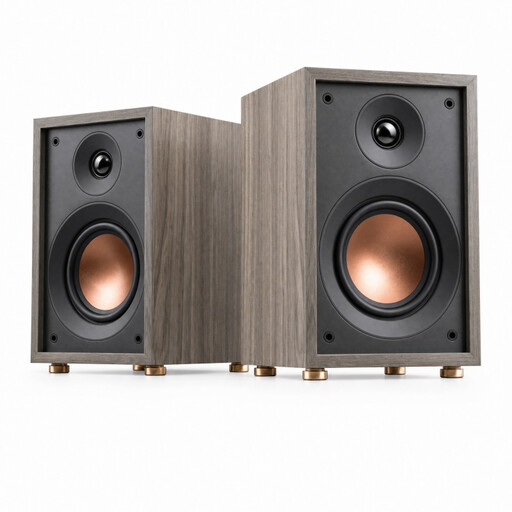
HiVi-Swans Oasis
A passive option for a system with separate components; a suitable amplifier is required.
The product name lists a 4-inch woofer, a 20 mm dome tweeter, 60 Hz–20 kHz, 4 Ω and 10–50 W.
View on Joybuy
Frequently asked questions
How should I position two speakers on my desk?
Position both speakers as evenly as possible and angle them towards your listening position. Genelec describes an equilateral stereo triangle as ideal for monitors, but the room and available desk space will affect how closely you can follow this guidance.
Do I need an amplifier for passive bookshelf speakers?
Yes, passive speakers need a suitable amplifier. Before you buy, compare the specifications of the exact models and check whether you already have an amplifier and audio source.
What costs and rights should I consider when buying speakers?
If you don’t already have one, passive speakers may require you to buy an amplifier. Adding extra bass may also mean buying another device. In Germany, the statutory guarantee you have against the seller is separate from any voluntary warranty. For online purchases, consumers generally have a 14-day right to cancel; check the terms of your specific purchase.
What should I look for with powered or Bluetooth speakers?
As part of its market surveillance, the Federal Network Agency checks things including correct CE marking, product and manufacturer details, and German-language instructions with any necessary warnings. Check the documents for the specific offer; this doesn’t mean that a particular model or offer has already been checked.


