
Lieferung heute & morgen

Qualitätsgarantie

Willkommens-Angebote freischalten: KOSTENLOSE Lieferung | Bis zu 80 % RABATT | Kostenlose 30-Tage-JoyPlus-Testphase
App herunterladen
When milk is needed at night or while out and about, warming it should be reliable and involve no unnecessary waiting. A bottle warmer can offer more control than a bain-marie or microwave. However, devices vary considerably in terms of temperature control, bottle compatibility, cleaning and portability.
Anyone who focuses only on terms such as “fast”, “multifunctional” or “suitable for all bottles” can easily overlook important limitations. The following points will help you choose a suitable baby bottle warmer for everyday use in the UK.
Manufacturers often state the time required for a specific quantity of milk, bottle shape and starting temperature. For example, a fast bottle warmer may achieve considerably shorter warming times with 60 ml of milk at room temperature than with a larger, cold glass bottle.
Before buying, you should therefore check:
Even if a device can accommodate many types of bottle, large wide-neck bottles, jars or specially shaped bottles will not necessarily fit. For a bottle warmer intended for home use, the internal dimensions are crucial. When using one away from home, adapters and a secure connection are also important.
It is best to compare the bottle diameter and shape with the device specifications. The Momcozy Travel Series Portable Bottle Warmer includes several adapters. However, according to the product information, the green venting system must be removed when using Dr. Brown’s bottles.
A bottle warmer with a keep-warm function can maintain the temperature for a certain period. This does not mean that milk or prepared baby food should be left in the device for any length of time. The permitted storage time depends on the type of milk or food, how it was prepared and the applicable recommendations.
The keep-warm period should therefore be viewed as a convenience feature, not as permission for longer storage. After warming, the temperature should always be checked immediately before feeding.
When warming milk for babies, it should be heated as evenly as possible. Controlled settings are particularly useful when warming breast milk, as excessive heat or uneven temperature distribution should be avoided. However, blanket claims about preserving nutrients are not appropriate; the relevant factors are the specific temperature, duration and guidance for the milk in question.
Useful programmes include:
A device with a timer and automatic shut-off reduces the amount of supervision required. Nevertheless, the milk must be checked before feeding by gently swirling it and testing its temperature.
A suitable baby bottle warmer should securely accommodate the bottles used in your household. Important factors include diameter, height, bottle base and adapters. A basket for smaller containers is useful if you also want to warm jars or accessories.
For families with twins, a device that can run consecutive heating cycles may be more practical than a model designed for just one use at a time. If you want to warm two bottles simultaneously, you should specifically check whether the internal space and power output are designed for this.
Water-based devices require regular maintenance, as limescale can build up on the heating surface. Removable parts, easily accessible surfaces and clear descaling instructions are useful features. Stated materials such as BPA-free plastic, polypropylene, ABS or stainless steel should be clearly listed in the product description.
Buyers should also look for the following safety features:
The CE mark and manufacturer information are important formal indicators. However, they do not replace checking the instructions for use, voltage specifications and specific compatibility.
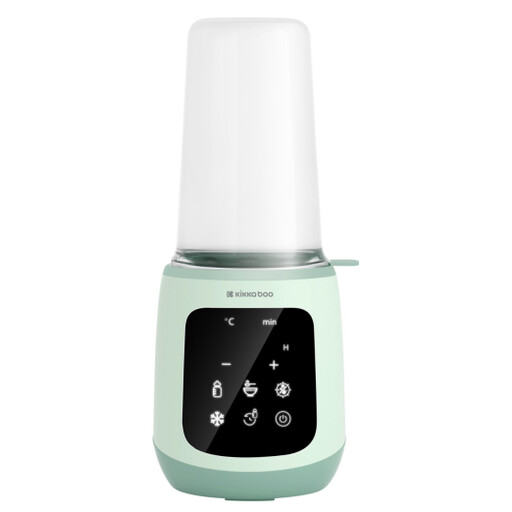
Why this product suits this profile: This device combines four functions in one compact unit, making it suitable for households that want to warm milk, baby food and smaller accessories with a single appliance.
The product description lists functions for warming, defrosting, keeping warm and sterilising. This means these tasks do not necessarily require several different devices.
Touchscreen, timer with keep-warm function, automatic shut-off and compact dimensions.
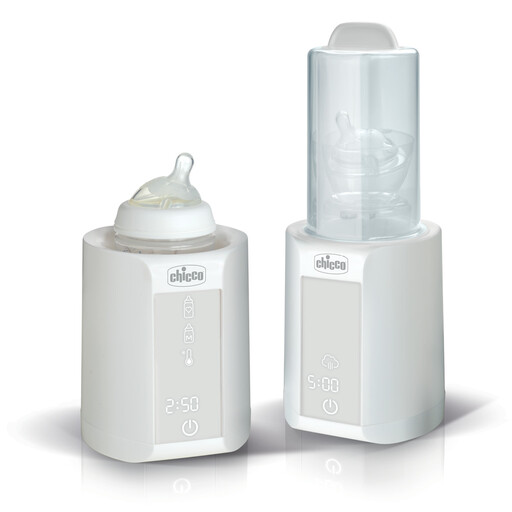
Why this product suits this profile: This model is aimed at parents who want programmable heating cycles, a spacious interior and an additional steam sterilisation function.
The choice of container type, size and starting temperature addresses the limitation of blanket time estimates. According to the product description, a descaling indicator highlights when cleaning is required.
Programmable operation, sterilisation programme and a keep-warm period of up to one hour according to the product information.
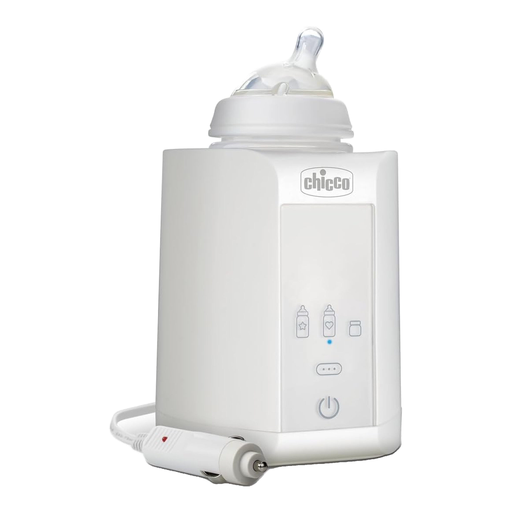
Why this product suits this profile: For families who want to use a bottle warmer at home and in the car, the supplied 12-volt adapter is a practical addition.
The power supply is specified for 220–240 V at home and 12 V in the vehicle. This means mobile use is not limited to a USB connection.
Five programmes, defrosting function, breast milk programme, automatic shut-off and audible signal.

Why this product suits this profile: With its integrated battery and multiple adapters, this model is an option for day trips, travel and situations without direct access to mains power.
Compatibility is addressed through the supplied adapters. Before using it for the first time, check the bottle connection, seal, charge level and that it is placed on a stable surface.
USB-rechargeable battery, leak-proof design and adapters for multiple brands according to the product description.
The Momcozy Baby Bottle Warmer for Breast Milk and Formula is another option for home use. According to the product description, it offers settings for cold or already warmed milk and for different bottle materials. The Philips Avent SCF355/09 also features continuous circulation, a defrosting function and a keep-warm setting, according to the manufacturer. Before ordering either device, check whether your existing bottles actually fit inside the warmer.
We have put together a complete, regularly updated list of products that fully meet these strict selection criteria and the safety regulations applicable in the EU.
The device heats water in a heating chamber. The heat is transferred to the bottle or jar. Depending on the model, you can set the temperature, quantity of milk, starting temperature and container material. The bottle should be positioned securely, and the manufacturer’s instructions for use should be followed.
Many devices are designed for expressed breast milk, according to their product descriptions. The key factors are a low, controlled setting and even heating. The milk should not be overheated, kept warm for longer than necessary or left unchecked before feeding. The recommendations of your midwife, paediatrician or relevant health authorities apply to preparation and storage.
Its service life depends on how frequently it is used, limescale build-up, cleaning and the condition of the cable, heating surface and seals. Regular descaling in accordance with the instructions, allowing the device to dry completely after use and storing it in a dry place can help support reliable everyday use. If there are cracks, damaged cables or uneven heating, stop using the device.