
Lieferung heute & morgen

Qualitätsgarantie

Willkommens-Angebote freischalten: KOSTENLOSE Lieferung | Bis zu 80 % RABATT | Kostenlose 30-Tage-JoyPlus-Testphase
App herunterladen
A bouncy castle with a water slide can transform your garden into a private outdoor play centre for kids. But the selection is vast, and not every model lives up to its advertising. Before you make a purchase, it's crucial to understand the common pitfalls that often only become apparent after a few uses, turning summer fun into an expensive disappointment. This guide will help you identify the key quality features to look for.
Many inflatable play sets look sturdy at first glance, but the devil is in the details. Pay attention to these three critical points to avoid a bad purchase:
To make an informed decision, you should focus on objective, technical features rather than marketing promises.
The longevity of a water castle for kids depends directly on the material. Look for products with clearly stated material specifications.
The blower is the heart of any inflatable water playground. It must be not only powerful but also safe.
Children's safety is the top priority. A good inflatable water playground is distinguished by its well-designed safety details.
Instead of making a one-size-fits-all recommendation, we have identified models that meet specific family needs and avoid the pitfalls mentioned above.
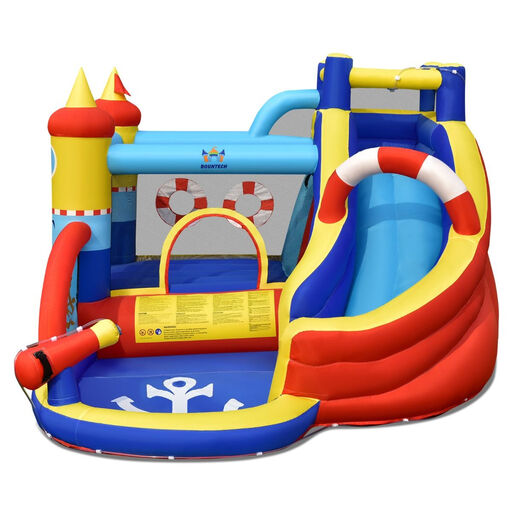
Why this model is a good fit: With its compact dimensions of 3.6 x 2.9 metres, this playground fits well in standard-sized gardens without taking up the entire lawn. It still offers a variety of play options for younger children.
The set comes with an appropriately sized blower that ensures a consistently stable structure. The slide features raised side walls for enhanced safety.
Combines six functions (including a slide, pool, and climbing area) on a relatively small footprint. Includes all necessary accessories like the blower and ground stakes.
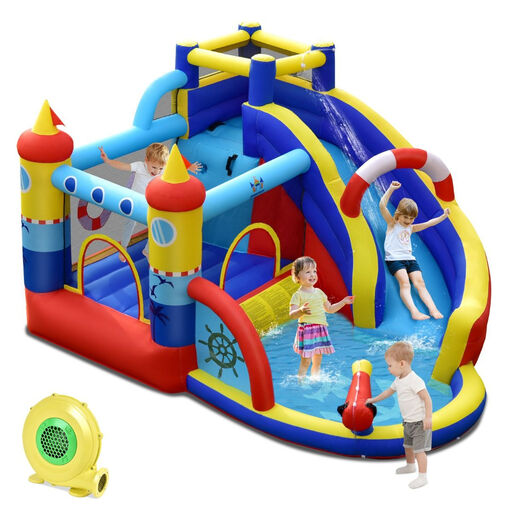
Why this model is a good fit: This model is an all-rounder that offers a good balance between size, variety of features, and price. The integrated water cannon and pool area provide varied water fun.
The included 550-watt blower is designed for the water park's size, ensuring constant, safe pressure. The use of reinforced material on the slide and climbing surfaces addresses the weakness of material fatigue.
The 6-in-1 configuration with a slide, pool, water cannon, and climbing wall offers high play variety. The complete package includes all necessary components for immediate setup.
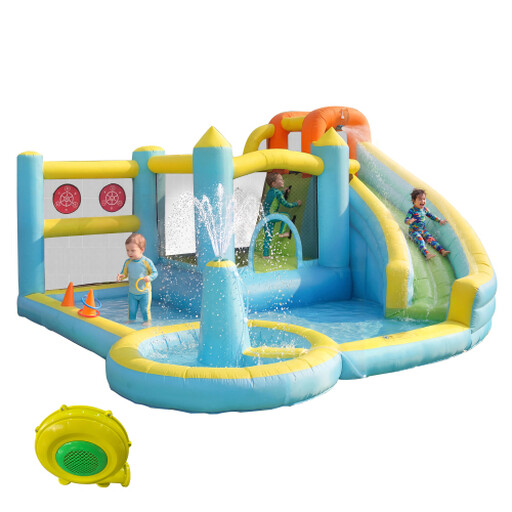
Why this model is a good fit: With an impressive size of 4.3 x 3.9 metres, this model is designed for families with plenty of space and is perfect for children's birthday parties or for multiple kids to play at once. It features a large slide and a generous pool area.
According to the manufacturer, the material is made of thick, tear-resistant Oxford fabric. The maximum weight capacity of 135 kg (distributed among up to 3 children) indicates a robust construction and sturdy seams.
Generous dimensions for maximum fun and use by multiple children simultaneously. Includes interactive elements like a ring toss game, which increases the play value.
We have compiled a complete, up-to-date list of products that fully meet these strict selection criteria and European safety regulations.
1. How long does it take to set up and take down a bouncy castle with a water slide? Setup is usually quick. Inflation with the included blower typically takes only 2 to 5 minutes. Securing it with ground stakes and connecting the water hose takes another 10 to 15 minutes. Takedown requires more time, as the bouncy castle must be completely dry to prevent mould and mildew. Depending on the weather, plan for several hours or even a full day for it to dry before you fold and store it.
2. What type of ground is suitable for an inflatable water park? A flat, level lawn is the ideal surface. Avoid hard or uneven surfaces like concrete, asphalt, or gravel, as they can damage the material. Before setting it up, carefully clear the area of sharp objects such as stones, branches, or roots. Using an additional groundsheet or tarp is recommended for extra protection.
3. What are the running costs (power consumption) for a blower? The operating costs depend on the blower's power rating (in watts) and your electricity rate. A typical 450 to 600-watt blower consumes 0.45 to 0.60 kilowatt-hours (kWh) per hour. Assuming an electricity price of 35 cents per kWh (as of 2026), the cost would be approximately 16 to 21 cents per hour of operation.