
Lieferung heute & morgen

Qualitätsgarantie

Willkommens-Angebote freischalten: KOSTENLOSE Lieferung | Bis zu 80 % RABATT | Kostenlose 30-Tage-JoyPlus-Testphase
App herunterladen
For professional tradespeople and ambitious DIY enthusiasts, the efficiency and precision of power tools are paramount. When using a nail gun, however, the final result depends heavily on choosing the right consumables. Incorrect or incompatible nails can not only damage the workpiece but also lead to costly delays. This article serves as a practical guide to help you find the perfect brad nails for your project and your tool. We will focus on objective criteria such as compatibility, material, and the correct nail length to ensure your fastening jobs are precise and long-lasting.
Selecting the right collated nails is straightforward once you know the key parameters. The following points will help you make an informed decision.
Brad nails, often simply called "brads," are fine pins for pneumatic or cordless nailers with a very small, barely visible head (the brad head). This minimal head sinks easily into the wood, leaving only a tiny hole that can be easily filled. The most common type for finishing work is Type 8 brads (also known as Type J or SKN8). Before purchasing, always check your nail gun's user manual. It will specify exactly which nail types and lengths are compatible with the tool. Using incompatible nails for your nail gun can lead to jams and damage to the tool.
The length of the nail is crucial for the strength of the joint. A general rule of thumb is that the nail should be about three times as long as the thickness of the material being fastened.
For most interior applications, galvanised nails are the standard choice. The zinc coating provides solid corrosion protection against humidity and prevents unsightly rust stains on the wood. For projects permanently exposed to the elements, stainless steel nails should be considered.
For professional users or large renovation projects, bulk packs of 5000 pieces are particularly economical. They ensure that you always have enough material on hand and reduce the need for frequent repurchasing.
Based on the quality criteria mentioned, we have compiled a selection of PROBUILDER nails suitable for a wide variety of applications.
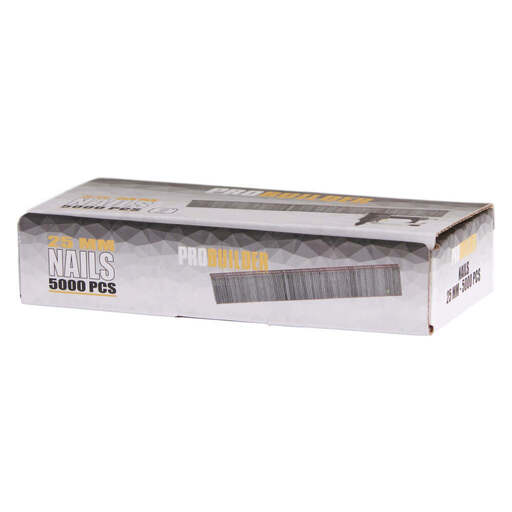
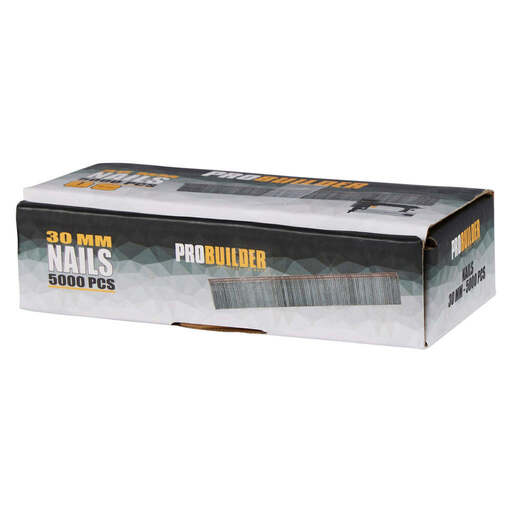
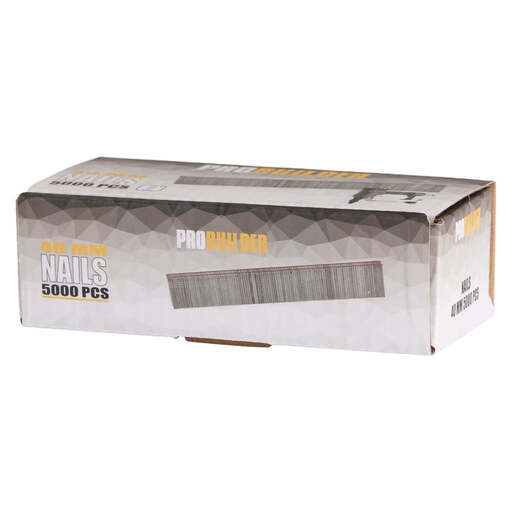
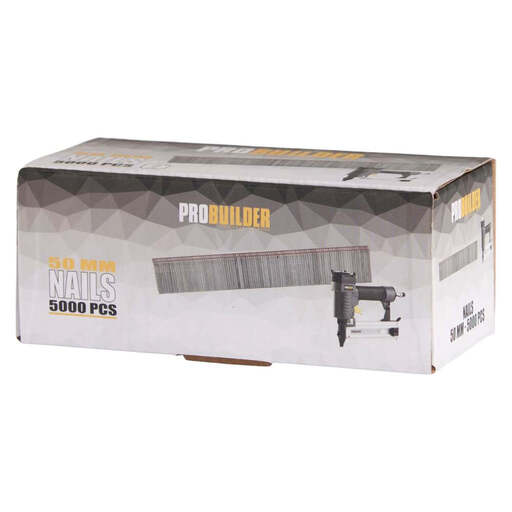
Need different dimensions, materials, or special fasteners for your next project? A wide range of consumables and accessories for hand and power tools is available.
Explore Our Full Range of Screws & Fasteners
Brad nails have a very small, T-shaped head that is slightly wider than the nail shank. This head provides greater holding power than headless pins. Pins, on the other hand, have almost no head and are even more inconspicuous, but they offer less pull-out resistance. Brad nails are therefore the standard for most finishing and trim work.
The goal is to sink the nail head slightly below the wood surface (approx. 0.5–1 mm). This creates a clean surface and allows the small nail hole to be filled with wood filler and painted over. Almost all modern nail guns feature an adjustable depth control. It is recommended to test the drive depth on a scrap piece of the original material beforehand to avoid damaging the workpiece.
Galvanised steel nails offer good protection against corrosion and are suitable for indoor use as well as for sheltered outdoor areas (e.g., covered patios). For applications that are directly and permanently exposed to weather like rain and snow, using stainless steel nails (A2 or A4) is recommended, as they have higher corrosion resistance.