For brass band music listened to from a regular seat, a stereo pair is an obvious choice if you can position two speakers sensibly. If you often move between the kitchen and living area, you could instead consider a single, stationary Wi-Fi speaker. Whichever option you choose, listening distance, suitable sources and a volume that works for your home all matter; more amplifier power or a subwoofer is no substitute for checking these things.
Which option suits you?
Brass band fans with a regular listening spot
You want to pick out the different groups of instruments in a recording from your favourite listening spot, and you have room to position two speakers in your living area. Teufel highlights listening distance and positioning as important factors when choosing speakers.
Listeners moving between the kitchen and living area
You move around your open-plan home while listening and value easy connections and flexible placement more than a soundstage designed for a single seat. Denon describes the Home 600 as a single Wi-Fi speaker with HEOS.
Considerate listeners in a home with thin walls
You want to enjoy music at a low volume while also considering the impact on neighbouring homes. For noise between neighbours, the German Environment Agency refers to state law, local regulations and house rules.
What to look for when buying
Active or streaming stereo pair
A good fit if: You mainly listen from a regular spot and can position two speakers.
The trade-off: You’ll need two places for the speakers; depending on the model, they may need to be connected by cable. Spreading them widely won’t guarantee the same sound throughout an open-plan living area.
A single Wi-Fi or multi-room speaker
A good fit if: You often listen in different places, have room for only one speaker or want to start with a single device.
The trade-off: A single cabinet doesn’t necessarily create the same left-right separation as a stereo pair positioned apart. The rules for adding a second speaker later vary from system to system.
Passive speakers with an amplifier
A good fit if: You already own a suitable amplifier and want to choose your music source and amplification separately.
The trade-off: Without a suitable amplifier, the speaker pair isn’t ready to use; the connections and components need to be compatible.
| Buying consideration |
What to check before buying |
Who it matters most to |
| Soundstage |
Check whether you can position two speakers and use them as a pair; consider your preferred listening spot. |
If I want to pick out the different groups of instruments from my regular listening spot, left-right imaging matters to me. Around 28% of consumers put this first. |
| Listening in different areas |
Consider listening spots, available space and listening distance together; according to Teufel, floor area alone doesn’t determine which speakers to choose. |
When I’m cooking or relaxing, I want to listen from different places rather than only from the sofa. Around 22% of consumers prioritise being able to listen in different locations. |
| Being considerate to neighbours |
Check the volume from your actual listening spot and how the bass carries; follow your house rules and local regulations. The German Environment Agency refers to several levels of regulation. |
If my home has thin walls, I want to listen to music without disturbing my neighbours unnecessarily. Around 22% of consumers make this their main concern. |
| Compatible music sources |
Check that the services and devices you use work with the connections on the specific model; allow for any accessories you’ll need. |
I want to connect or keep using my existing music sources without having to find a suitable solution after buying. Around 17% of consumers prioritise compatibility with their sources. |
| Total cost and system set-up |
Consider the complete system: the speakers, amplification, connections and accessories you’ll need. Teufel describes the passive ULTIMA 40 as requiring a suitable amplifier. |
When I put together a complete system, I care about the cost of all the components I need, not just one device. Around 11% of consumers put the total cost first. |
Common buying mistakes
-
Judging by floor area alone
Listening distance and speaker placement affect what you need; bass can also sound different in different parts of a room. Teufel lists room volume, listening distance and positioning as relevant factors.
First, sketch out your listening spots and possible speaker positions. Then decide whether bookshelf speakers, floorstanding speakers or a single device will work best in your room.
-
Assuming a single speaker is the same as a stereo pair
Both options play music, but they differ in how they create left-right imaging from a regular listening spot.
First decide whether a favourite listening spot or sound in different places matters more to you. Sonos requires two speakers of the same model for its stereo pair feature.
If you want a stereo pair later, you may need to buy a second compatible device.
-
Assuming existing connections mean you won’t need accessories
Streaming support alone doesn’t tell you whether you can connect a CD player or another analogue source directly.
Check every source you actually use against the connections on the exact model, and make sure you have any accessories you’ll need. Sonos says an adapter is required to connect an analogue source to the Sonos Era 300.
-
Expecting more bass or volume to solve an open-plan room
Bass can have a different effect in different parts of the room, while turning up the volume may also disturb your neighbours more.
Try different speaker positions and a considerate listening volume first, rather than assuming you need an extra subwoofer. The German Environment Agency notes that noise between neighbours is also covered by house rules and local regulations.
Key brands at a glance
KEF
The LS50 Wireless II is an active stereo pair for a favourite listening spot, with several ways to connect digital sources.
- For this model, KEF lists HDMI eARC, AirPlay 2, Google Cast, Bluetooth and a subwoofer output.
- You’ll need to position two speakers for the stereo pair; app-based sound adjustment doesn’t guarantee a particular result in your home.
Nubert
The nuPro SP series includes active speaker pairs connected by cable, for music and, if required, TV.
- Nubert lists built-in amplifiers; according to the manufacturer, the SP-200 includes HDMI eARC and Bluetooth aptX HD, among other features.
- The two speakers need to be connected by cable.
Denon
The Home 600 is a single, stationary Wi-Fi speaker with HEOS.
- For the Home 600, Denon lists Wi-Fi, Bluetooth, AirPlay 2 and built-in subwoofers.
- If you want two listening points or a stereo pair, check your planned system set-up and compatibility with the specific models.
Audio Pro
The C20 W is a single, stationary multi-room speaker that can also connect to a TV or turntable.
- For this model, Audio Pro lists HDMI ARC, an optical input, Line-in, Phono and Wi-Fi streaming.
- According to the specifications, it isn’t designed to run on battery power.
Sonos
The Era 300 can be used as a single Wi-Fi speaker or paired with a second identical model.
- For the Era 300, Sonos lists Wi-Fi, Bluetooth and Trueplay.
- Sonos says you need an input adapter for an external analogue source; a stereo pair requires two speakers of the same model.
Teufel
The ULTIMA 40 AKTIV 3 is an active floorstanding speaker pair; the passive ULTIMA 40 is a different option for anyone with a suitable amplifier.
- Teufel describes the ULTIMA 40 AKTIV 3 as ready to use without an external amplifier.
- According to Teufel, the passive ULTIMA 40 pair needs a suitable amplifier or AV receiver.
Speakers at Joybuy
The Joybuy products below range from active stereo and bookshelf speakers to wired PC sets. Before buying, check that the connections, placement and intended listening spot suit your home.
 No image available
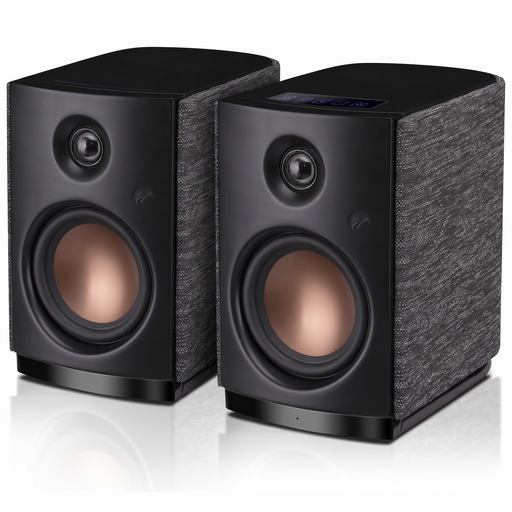
HiVi-Swans OS-10 active Hi-Fi bookshelf speakers
A good option if you’re looking for an active stereo speaker set with Bluetooth connectivity.
Bluetooth 5.0; 4-inch woofer; 62 W RMS.
View at Joybuy
 No image available
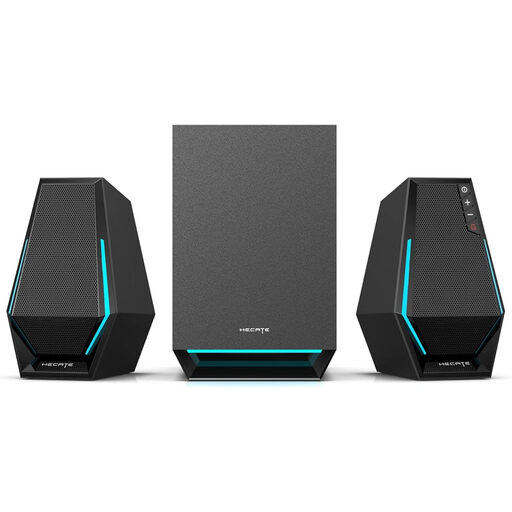
Edifier Hecate G1500 MAX 2.1 gaming speaker system
An option to consider if you’re looking for a 2.1 system with a choice of wired and wireless connections.
60 W; Bluetooth 5.3; USB, Type-C and 3.5 mm AUX.
View at Joybuy
 No image available
Lemega active bookshelf speakers, 40 W pair
Worth considering if you’re comparing an active pair with a TV connection and several inputs.
40 W; Bluetooth, HDMI ARC, optical input, RCA, AUX and USB. The passive speaker connects to the active one using speaker cable.
View at Joybuy
 No image available
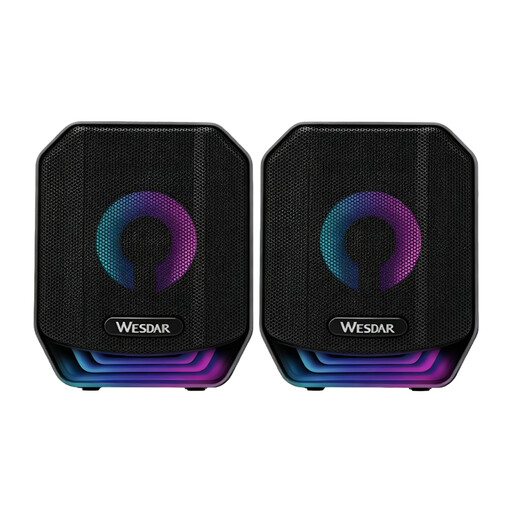
USB PC stereo speaker set with RGB lighting
Designed for straightforward stereo playback from a computer; check that the USB connection suits how you plan to use it.
Wired set of two speakers.
View at Joybuy
 No image available
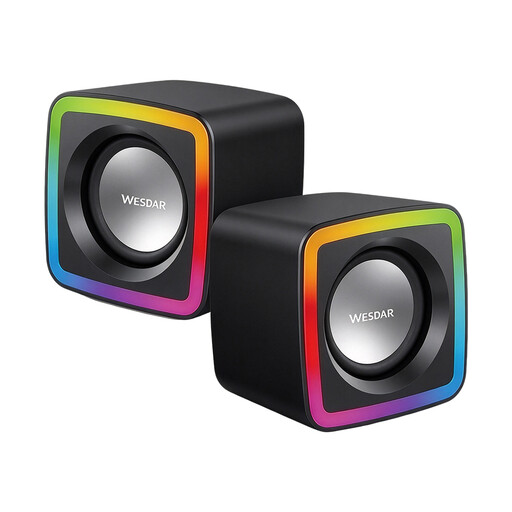
PC Speaker Set CS116 with RGB lighting
A good fit for a wired PC set-up if you’re looking for a two-piece speaker set.
USB-A power supply; separate audio cable required.
View at Joybuy
Frequently asked questions
Do I need a subwoofer for brass band music?
No, not just because of the type of music. Check the bass response and speaker positioning from your own listening spot: room dimensions and reflections can make the bass sound different in different places. You should also consider the possible impact on your neighbours when listening at home.
Can I pair any two Wi-Fi speakers for stereo?
No, you can’t assume that will work. Sonos generally requires two speakers of the same model for its stereo pair feature; with other systems, check that the specific models are compatible with each other and the app.
What happens if something I buy online in Germany is faulty?
The seller is generally your point of contact if an item is faulty; statutory consumer rights are separate from a voluntary guarantee. The Verbraucherzentrale states that the statutory period for goods to be free from defects at the time of delivery is two years, and that repair or replacement is the first step when something is faulty. Many goods ordered online are also generally covered by a 14-day right to cancel, starting from the day you receive them.
At what times can I play music loudly in Germany?
There isn’t one time that applies to every home. For noise between neighbours caused by people’s behaviour, the German Environment Agency refers to state law, local regulations and house rules, so check the requirements where you live and in your building. Noise can disturb neighbours outside formally designated quiet hours, too.


