
Lieferung heute & morgen

Qualitätsgarantie

Willkommens-Angebote freischalten: KOSTENLOSE Lieferung | Bis zu 80 % RABATT | Kostenlose 30-Tage-JoyPlus-Testphase
App herunterladen
An induction frying pan needs to do more than simply stick magnetically to the hob. In UK homes, even heat distribution, a practical size, easy cleaning and a durable coating are among the key considerations. At the same time, unclear manufacturer information and features that seem convenient can often lead to disappointing purchases.
The claim pan suitable for all hob types should be clearly explained. As well as being suitable for gas, electric and ceramic hobs, a pan designed for induction must be explicitly approved for use on induction hobs. Compatibility may vary with halogen or infrared hobs. So check the product description rather than relying on the picture on the packaging.
A coated frying pan makes it easier to cook with less oil and to clean up afterwards. But that doesn’t mean all coatings are equally durable. Metal utensils, scouring pads, prolonged heating while empty and sudden changes in temperature can damage the surface. Even a pan described as a dishwasher-safe frying pan may lose the quality of its coating more quickly if it is regularly cleaned in the dishwasher.
“Oven-safe” may refer only to the body of the pan. The handle, lid and coating may each have their own temperature limits. So, when choosing an oven-safe pan, check the maximum temperature and whether it can be used with or without the lid. A plastic handle, for example, isn’t necessarily suitable for high oven temperatures.
A 28 cm frying pan is a good fit for many family meals, vegetable dishes, several eggs or larger cuts of meat. The diameter at the top isn’t the only thing that matters: check the size of the base, too. For induction, the pan base should be as close as possible in size to the cooking zone so heat can be transferred efficiently.
Smaller models, from 20 to 24 cm, are suited to individual portions, side dishes or smaller kitchens. A frying pan set with several diameters can be a good choice if you often cook multiple dishes at once. Higher sides and a larger cooking surface are useful for braised dishes, sauces and one-pot recipes.
Aluminium is lightweight and heats up quickly. For induction, however, the pan needs a magnetic layer or a suitable stainless-steel base. Multi-layer designs often combine stainless steel with an aluminium core. This can help distribute heat more evenly, but often adds weight.
A sturdy base helps reduce the risk of hot spots. Even so, coated pans should generally be used over low to medium heat. High settings are usually only suitable for briefly preheating the pan, unless the manufacturer says otherwise.
When choosing a non-stick pan, three things are particularly important:
Ceramic coatings are often described as “diamond-reinforced” or “titanium-reinforced”. These terms shouldn’t be considered in isolation. The care instructions, temperature limit and information about induction compatibility are more important.
A detachable handle can save space and make it easier to move the pan from the hob to the oven. Before using it, check that the handle is securely attached and whether it has its own temperature limit.
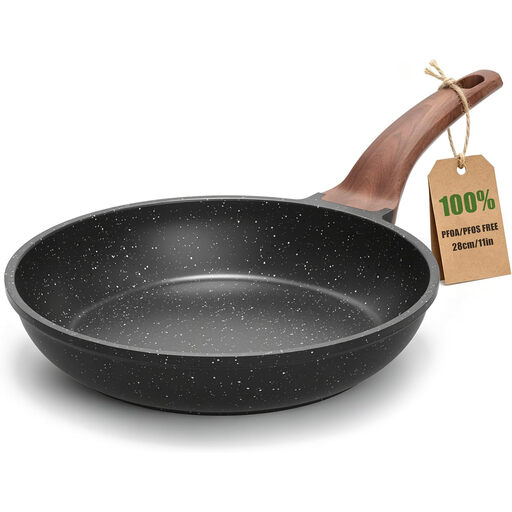
Why this product suits your needs: This 28 cm pan is designed for everyday cooking and, according to the product description, is compatible with induction, gas, electric and ceramic hobs. The handle has a hanging hole.
Hob compatibility is clearly specified. The product information also explicitly states that the pan should be hand-washed and isn’t suitable for oven use.
28 cm diameter, magnetic base and a coating that the manufacturer states is free from PFOA, PFOS and PTFE.

Why this product suits your needs: The two sizes cover everything from individual portions to larger meals. According to the product description, the pans are made from Cromargan 18/10 stainless steel and feature a TransTherm universal base.
The set contents and both pan diameters are clearly stated. The ceramic coating is described as heat-resistant up to 400 °C; check the instructions for details of how to use the pans in the oven.
Two practical sizes and a universal base designed for induction.
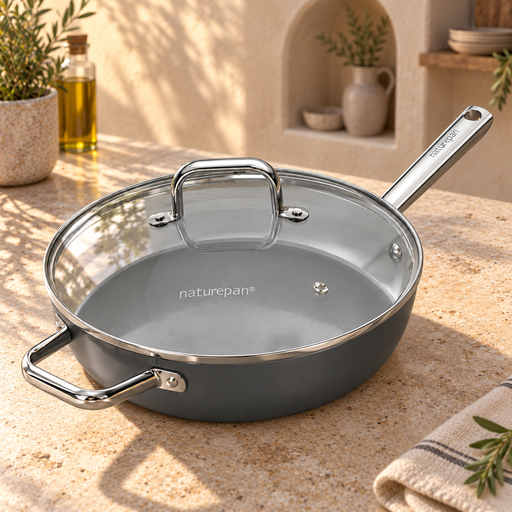
Why this product suits your needs: According to the product information, the high sides and glass lid make this pan suitable for sauces, braised dishes and larger one-pan meals.
The product information explicitly states that it is oven-safe up to 260 °C, dishwasher-safe and suitable for use with appropriate plastic, wooden or silicone utensils.
Ceramic coating, high sides, a lid and compatibility with induction, gas, electric and ceramic hobs.
We’ve put together a complete, regularly updated list of products that meet these strict selection criteria and fully comply with the safety regulations in force in the EU.
A 28 cm frying pan has enough room for several portions and is suitable for many family meals. A 24 cm model may be more practical for smaller meals or individual ingredients. A set with 24 cm and 28 cm pans covers a range of cooking needs.
Only if the manufacturer explicitly says it can. Even with a dishwasher-safe frying pan, hand-washing with mild washing-up liquid can help protect the coating. Wait for the pan to cool and don’t use abrasive sponges.
Its lifespan depends on heat, utensils, cleaning and storage. Use low to medium heat, avoid heating the pan empty for long periods, and use wooden, silicone or plastic utensils. If the coating starts to peel visibly or is badly damaged, stop using the pan.