Bread bakers weighing small amounts of salt
If you prepare salt separately from the dough, compare the increments across the weight range you need. Beurer specifies different increments for the KS 36 depending on the weight.


If you prepare small amounts of salt separately, focus on the increments and usable weighing range of a precision scale. For ingredients weighed in a large mixing bowl, the platform size, tare function and capacity—including the bowl—are more important. With combination scales, fine increments do not automatically apply across the full weighing range.
If you prepare salt separately from the dough, compare the increments across the weight range you need. Beurer specifies different increments for the KS 36 depending on the weight.
If you weigh ingredients in the bowl, the bowl and its contents must stay within the maximum capacity. The platform size and tare function should also suit your bowl.
If your ingredients are ready before you continue, check that the display remains easy to read and see how the specific model behaves during longer pauses.
A good fit if: you weigh small amounts of salt in a separate container and don’t need to put the mixing bowl on the same scale.
Trade-off: A small weighing platform and limited capacity may mean you need a second scale for the bowl.
A good fit if: you usually weigh ingredients in a container and the increments shown suit the amount of salt you need.
Trade-off: A display that measures in whole grams won’t show fractions of a gram directly; the bowl’s weight also counts towards the maximum capacity.
A good fit if: you want to weigh both small amounts of salt and larger batches of dough with one appliance.
Trade-off: On the CASO KitchenDuo, 0.1 g increments apply to the precision range up to 1 kg, not the standard range up to 15 kg, which measures in 1 g increments.
| Priority | What to check before buying | Who is this important for? |
|---|---|---|
| Weighing small amounts of salt | Increments across the weight range you need; minimum weight and platform size for your salt container. | If I weigh small amounts of salt separately, the display needs to suit the quantity. Around 36% of consumers prioritise being able to read small amounts of salt accurately. |
| Weighing the bowl and dough | Maximum capacity including the container, a suitable platform size and an easy-to-read display. | If I weigh ingredients directly into the mixing bowl, the bowl and its contents need to fit on the scale together. Around 29% of consumers focus mainly on bowl size and capacity. |
| Preparing ingredients in advance | Check how easy the tare function is to use and how the scale behaves during pauses. | If I prepare ingredients and weigh more later, I want the display to remain easy to read as I work. Around 21% of consumers place the greatest importance on handling several steps. |
| Power supply and ongoing costs | Check the battery type and what’s included with the specific model. | If I don’t want to buy batteries separately, what’s included matters to me. Around 14% of consumers focus primarily on the power supply and the associated costs and effort. |
The stated increment describes the display steps within a given weighing range. On its own, it doesn’t confirm an independently measured margin of error.
Compare the stated range with the amount of salt you need, and distinguish the manufacturer’s specification from an accuracy test.
With a scale for bowls, the bowl’s weight counts towards the total load. A compact precision scale may also be impractical for a large or heavy bowl.
Check the total weight and platform size with the container you actually plan to use.
According to CASO, the KitchenDuo has separate weighing ranges with different increments.
Use the appropriate range for each task and check its limit before you start weighing.
Batteries and automatic switch-off vary by model and may matter when you’re preparing ingredients in stages.
Before buying, check the power supply, what’s included and how the specific model switches off.
The KS 36 is a compact precision scale for small quantities of ingredients prepared separately.
The KitchenDuo combines a precision range for small amounts with a separate range for larger batches of dough.
The PREZISO combines a precision display with a kitchen scale for smaller containers.
The Digital Kitchen Scale, 20 × 20 cm, is designed for weighing ingredients in larger containers.
The Joybuy models below are kitchen scales for prepared baking ingredients and weighing ingredients in a container. For each model, check that the increments, platform size and maximum capacity suit the amount of salt and the bowl you use.
 No image available
If 1 g increments are suitable for the amount of salt you need, this model is described as suitable for weighing ingredients in a bowl.
 No image available
For weighing ingredients in a container, the tare function and stated maximum capacity may suit your needs, provided the bowl and ingredients together stay within the limit.
 No image available
If you want to weigh ingredients in a larger container, check that the total load stays within the stated maximum capacity.
 No image available
The product description specifies a removable bowl for weighing ingredients directly.
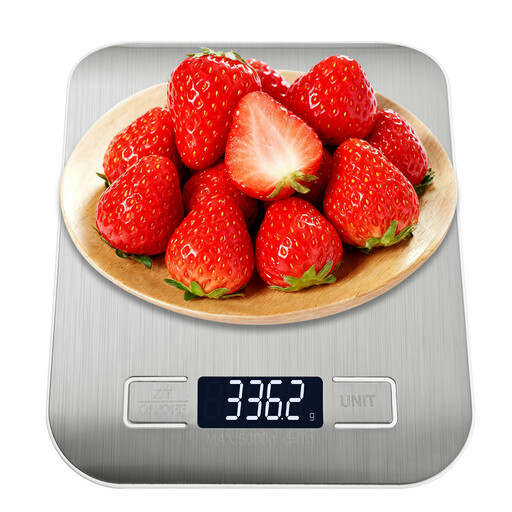 No image available
If 1 g increments suit the amount of salt you need, the product description says this model is designed for baking and ingredient preparation.
With baker’s percentages, the flour weight is the point of reference. King Arthur Baking gives 1.8–2% salt based on the flour weight for a general bread-making example; this isn’t a recommendation for every recipe. Follow your specific recipe and weigh out the calculated amount of salt in grams.
On models with a tare function, you can subtract the weight of the container before weighing ingredients. Even so, check that the bowl and its full contents stay within the maximum capacity, and that the increments on the platform you’re using suit the amount of salt.
Always follow the instructions for your specific model. Beurer recommends calibrating the KS 36 before first use and describes checking it with the calibration weight. GEFU states that the PREZISO is not dishwasher-safe.
Check the battery type and what’s included with the specific model: CASO specifies three AAA batteries for the KitchenDuo, which are not included, while GEFU includes two AAA batteries with the PREZISO. GEFU also specifies a five-year manufacturer’s warranty for this model; read the relevant terms before buying.
As part of its market surveillance of electrical products, the German Federal Network Agency lists the CE marking, product identification, manufacturer details and German-language instructions among the points to check. A CE mark does not mean that a product was made in the European Economic Area. The German Environment Agency recommends taking used batteries and electrical equipment to the designated collection points rather than putting them in household waste.