Sandwich bread planners
If you want to bake a loaf in your holiday cottage that’s easy to slice for sandwiches, consider the bread programme, loaf shape and recipe together rather than focusing only on the number of programmes.


Choose a bread maker based first on the loaf size you need and the shape that will give you easy-to-slice sandwich bread for your recipe. A dedicated toast bread programme, such as the one on the Rommelsbacher BA 550, is a useful indicator, but it doesn’t guarantee evenly sliced bread. A compact machine may suit a small kitchen and modest quantities; variable loaf sizes and a delay timer offer greater flexibility, provided the machine fits the available space, power supply and recipe for your holiday cottage kitchen.
If you want to bake a loaf in your holiday cottage that’s easy to slice for sandwiches, consider the bread programme, loaf shape and recipe together rather than focusing only on the number of programmes.
If you only have a small area of worktop available, compare the machine’s dimensions with the space in your holiday cottage kitchen that’s actually suitable for setting it up and using it.
If you want to plan when baking starts, remember to factor in the programme duration and cooling time before slicing, as well as the delay timer.
First, compare your recipe and the amount of bread you want with the baking tin and the machine’s dimensions. Then check whether a delay timer suits your breakfast plans.
| What matters | What to check before buying | Who is it important to? |
|---|---|---|
| Slices suitable for sandwiches | Check for a toast bread or white bread programme, the shape of the loaf and a recipe to match. | If I want to bake a loaf for sandwiches, I focus on the recipe and loaf shape so the bread is easy to slice. Around 33% of consumers put the sandwich result they want first. |
| The right amount of bread | Match the loaf size options to your recipe and the number of meals you’re planning for. | If I’m baking for several meals or guests, I want to make sure there’s enough bread without automatically choosing the largest loaf. Around 27% of consumers base their decision primarily on how much bread they need. |
| Worktop space and transport | Compare the machine’s dimensions and weight with the available worktop space, storage space and the guidance in the appliance manual. | If the kitchen is small or I need to put the machine away, I want to know in advance whether it can be set up and stored there comfortably. Around 20% of consumers prioritise the space it takes up. |
| A baking schedule you can plan around | Consider the delay timer, programme duration and cooling time separately. | If the bread needs to be ready for a planned breakfast, I want to set the start time in good time while still allowing it to cool. Around 20% of consumers prioritise timing. |
The stated weight describes the intended amount of bread, not how evenly the slices will be cut or what shape they’ll be.
First choose a recipe with a suitable quantity, then check the baking tin and the bread programme designed for it.
The baking programme still needs to run after the machine starts, and a freshly baked loaf also needs time to cool before it can be sliced.
Plan the start time, end of baking and cooling as separate steps.
Unold sells a suitable replacement baking tin separately for the Backmeister Edel 68456. According to the manufacturer, the kneading blade must also be ordered separately.
Check what accessories are included with the specific model and which spare parts are available for it. Also distinguish your statutory rights from a voluntary guarantee.
If the baking tin is damaged or the kneading blade is lost, you may need to source a replacement part separately.
The BA 550 is worth considering for sandwich bread: Rommelsbacher lists a toast bread programme and settings for 700 g and 900 g loaves.
According to Panasonic, the SD-PN100 is designed for a small loaf of around 400 g and measures 255 × 307 × 290 mm (W × D × H).
For the Design Bread Maker Advanced 42823, Gastroback lists three loaf sizes from 500 g to 1,000 g, as well as a white bread programme.
For the Pain Délice PF240E38, Tefal lists three loaf sizes from 500 g to 1 kg and a 15-hour delay timer.
For the Backmeister Edel 68456, Unold lists loaf sizes of 750 g or 1,000 g and an adjustable browning level.
This selection features bread makers with stated loaf size options. For some models, the product title also mentions features for planning when baking starts.
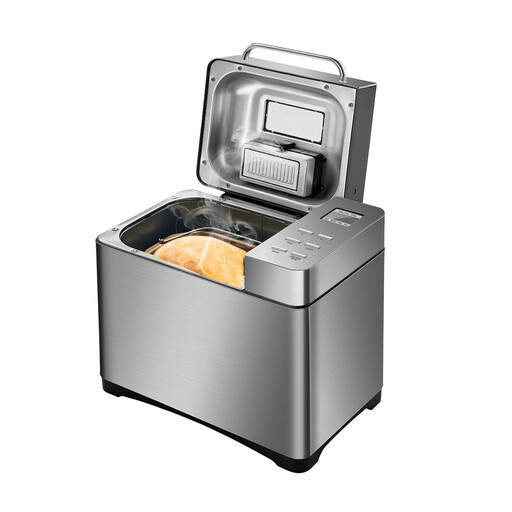 No image available
The three loaf sizes may be useful if the amount of bread you need varies. Match the loaf size to your recipe.
Listed in the product title: 650 W, 19 programmes, 3 browning levels, 15-hour timer, 1-hour keep-warm function, non-stick baking tin and a capacity of 2.2 lbs.
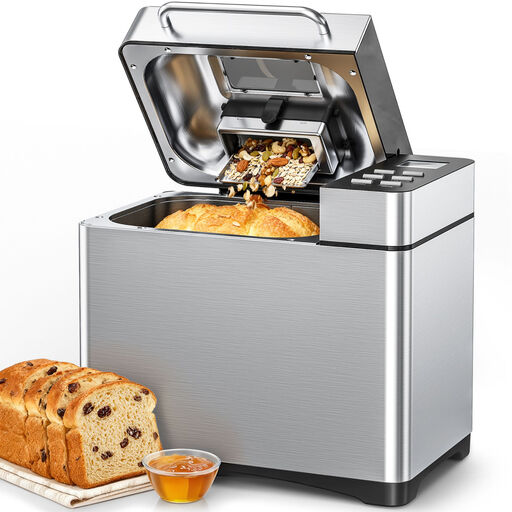 No image available
If the amount of bread you need varies, the three sizes listed in the product title may help you choose. Check that the maximum capacity suits your recipe.
Listed in the product title: 1 kg capacity, 3 loaf sizes, 3 browning levels, 19 programmes, an automatic ingredient dispenser and a 15-hour timer.
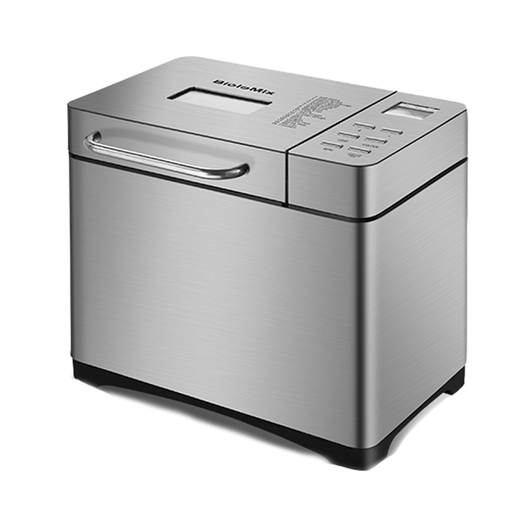 No image available
The product title mentions a delay timer, which may be useful if you want to plan when baking starts. Remember to allow for the programme duration and cooling time too.
Listed in the product title: 17 programmes, dual heating tubes, a fruit and nut dispenser, 1-hour keep-warm function and a timer with up to 15 hours’ delay.
No. A toast bread programme alone doesn’t guarantee evenly sliced bread. Rommelsbacher lists one for the BA 550; also check that the recipe and baking tin are suitable, and allow time for the loaf to cool.
Compare the machine’s dimensions and power supply requirements with the conditions in the kitchen. Before using it, read and follow the safety instructions in the manual for the model you’ve bought; the Gastroback manual specifically emphasises this.
The seller is generally responsible for your statutory rights, which are separate from any voluntary guarantee. For goods ordered online, you’ll usually also have a 14-day right to cancel, although the conditions of your specific purchase apply. Verbraucherzentrale explains the difference and the relevant conditions.
No. The German Environment Agency advises that waste electrical equipment must be disposed of separately from household waste. Take the machine to a suitable collection or return point.