Seeded bread fans with limited worktop space
If you want to make seeded bread at home but can’t leave a large bread maker on the worktop, consider its external dimensions, the room needed to open the lid and the loaf size that suits you.


If you have a small kitchen, start by measuring the space available, including room to open the lid, then decide what size loaf you want to make. A compact model may suit smaller loaves, while an ingredient dispenser can make it easier to add ingredients automatically. Check the instructions for the model you choose to make sure it’s suitable for your seeds and recipe.
If you want to make seeded bread at home but can’t leave a large bread maker on the worktop, consider its external dimensions, the room needed to open the lid and the loaf size that suits you.
If you want seeds or nuts to be added to the dough during the baking programme without you having to intervene, check whether the model has an ingredient dispenser and whether it’s suitable for your chosen recipe.
If you sometimes bake smaller loaves and sometimes larger ones, compare the available loaf sizes with how much bread you get through and the space you have available.
First, measure the space available and check that the ingredient dispenser is suitable for your recipe. Then decide what quantity of bread suits your household and whether the care instructions are practical for you.
| What to consider | What to check | Who it matters most to |
|---|---|---|
| Footprint and positioning | Compare the external dimensions and the space needed to open the lid with the positioning instructions for the specific model. Rommelsbacher recommends leaving at least 10 cm of clearance on all sides and 60 cm above the BA 550. | If my worktop space is limited, the space above the appliance matters too. Around 31% of consumers put available space first. |
| Seeds and nuts | Check whether the bread maker has an ingredient compartment, which ingredients it’s designed for and when the recipe calls for them to be added. | If I don’t want to add seeds or nuts myself during the programme, I look for a suitable dispenser. Around 31% of consumers prioritise automatic ingredient dispensing. |
| Loaf size | Compare the available loaf sizes with the recipe quantities rather than relying on a general capacity figure alone. | If my household sometimes needs more bread and sometimes less, I want to be able to choose a suitable portion size. Around 25% of consumers prioritise the amount of bread they need. |
| Cleaning and spare parts | Read the care instructions for the bread pan and kneading blade, and check whether spare parts are available for the exact model number. | If I want the bread pan to be easy to care for and to be able to buy replacement parts, I check both in advance. Around 13% of consumers put care and spare parts first. |
You’ll also need space above the appliance to open the lid. Rommelsbacher’s instructions for the BA 550 also specify clearances.
Measure the intended space in several directions and read the instructions for your chosen model before buying.
If there isn’t enough room in your chosen spot, you may need to find another place for it.
A programme for a particular type of bread doesn’t tell you whether the appliance has an ingredient dispenser or what it can hold.
Check the dispenser, the ingredients it’s designed for and when they’re added separately, using the instructions and recipe.
Rommelsbacher advises against washing the BA 550’s bread pan and kneading blade in the dishwasher.
Follow the care instructions for the specific model and, if needed, check whether the right spare parts are available for its exact model number.
The SD-PN100 is designed for small loaves and limited worktop space, while the SD-YR2540 belongs to a different model range and has ingredient dispensers.
The BA 550 may suit buyers who want an automatic compartment for nuts and fruit, as well as a choice of loaf sizes.
According to Unold, the Backmeister Bernd offers a choice of three loaf sizes; the reference to a seeded loaf applies to the Top Edition.
The Pain Delice PF240E is an alternative to consider if a choice of loaf sizes matters more to you than confirmed external dimensions or an additional ingredient dispenser.
This selection includes bread makers that may be suitable for recipes with automatic dispensing of ingredients such as fruit or nuts. Before buying, check whether each model’s features are suitable for the seeds you use and the steps in your recipe.
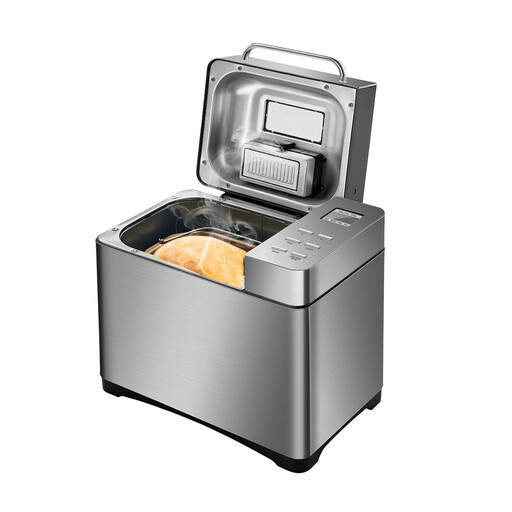 No image available
If you’re looking for automatic ingredient dispensing, check whether the dispenser is designed for your seeds and chosen recipe.
The product name lists 19 programmes, three browning settings, three loaf sizes, a 15-hour timer, a one-hour keep-warm function and a non-stick bread pan.
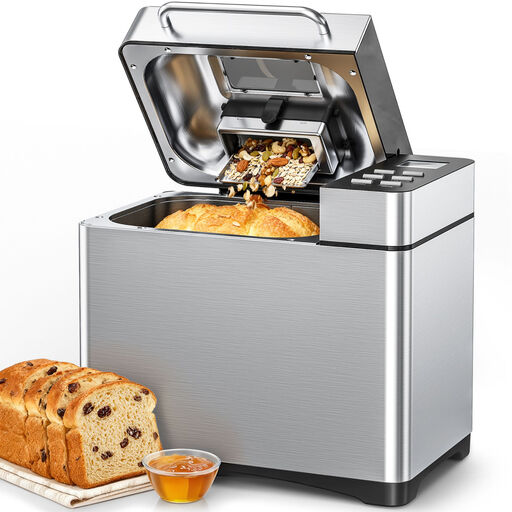 No image available
The automatic ingredient compartment may suit buyers who don’t want to add ingredients themselves during the programme. Check the instructions to see whether it’s suitable for your seeds.
The product name lists three loaf sizes, a 1 kg capacity, three browning settings and a 15-hour timer.
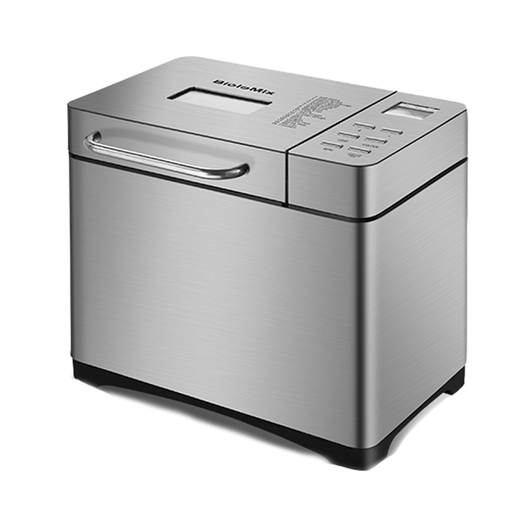 No image available
The fruit and nut dispenser mentioned in the product name may be useful for recipes that call for ingredients to be added later. Check whether your seed mix is suitable.
The product name lists 17 menus, a one-hour keep-warm function and a 15-hour timer.
Compare the appliance’s dimensions with the space needed to open the lid and the positioning requirements in the relevant instructions. Rommelsbacher specifies at least 10 cm of clearance on all sides and 60 cm above the BA 550; these measurements don’t automatically apply to other models.
It depends on the model. Rommelsbacher advises against putting the BA 550’s bread pan and kneading blade in the dishwasher and recommends washing them by hand.
Allow for ingredients and, if necessary, the future replacement of the bread pan or kneading blade. Check whether the spare part you need is available for your exact model number.
Appliances covered by the EU Low Voltage Directive must meet requirements for being placed on the market and for conformity. Germany’s Federal Network Agency points out that the CE marking is not an indication of origin or an independent mark of quality. Check the marking and the details for the specific appliance.
In Germany, electrical and electronic waste must not go in household rubbish. The Federal Environment Agency lists options for separate disposal, including recycling centres and suitable retail take-back points.