Hosts who need a small portion of bread
You want to bake a small loaf for a family gathering and focus on the loaf size you can actually select, rather than relying on the appliance’s name alone.


For a single loaf of around 400 g, the Panasonic SD-PN100 is an obvious choice, as Panasonic specifies this loaf size. If you might need more bread for a family gathering, the Tefal Pain Delice PF240E and Unold Backmeister Bernd 68120 offer selectable sizes starting at around 500 g. The Rommelsbacher BA 550 starts at 700 g, and smaller batches need enough dough to knead properly.
You want to bake a small loaf for a family gathering and focus on the loaf size you can actually select, rather than relying on the appliance’s name alone.
You’re planning your baking around the gathering and comparing the delay timer with programme length, so you don’t mistake a delayed start for a quick baking time.
You want to choose your own recipes or ingredients. If a guest needs to eat gluten-free because of coeliac disease, you’ll also need to consider the risk of cross-contamination in the kitchen.
A good fit if: A very small loaf is enough; Panasonic specifies a loaf size of around 400 g for the SD-PN100.
The trade-off: A model designed specifically for small loaves gives you less flexibility for a larger gathering.
A good fit if: The amount you need varies from one gathering to another; the Tefal PF240E and Unold Backmeister Bernd 68120 offer settings starting at around 500 g.
The trade-off: The smallest selectable size is larger than the SD-PN100’s approximately 400 g loaf.
A good fit if: You also want to make larger loaves; the Rommelsbacher BA 550 offers selectable sizes of 700 and 900 g.
The trade-off: Rommelsbacher says smaller batches are possible, provided there’s enough dough to knead properly.
| What matters | What to check before buying | Who is this important to? |
|---|---|---|
| Suitable loaf size | Panasonic specifies around 400 g for the SD-PN100. The Tefal PF240E and Unold Backmeister Bernd 68120 start at around 500 g; Rommelsbacher lists selectable sizes of 700 and 900 g for the BA 550. Smaller recipe batches need to contain enough dough for kneading. | If I don’t want to bake too little or more bread than we need for the gathering, I’ll check the smallest selectable setting and find a suitable recipe. Around 36% of consumers would say loaf size is their main concern. |
| Bread ready for a set time | Panasonic specifies a 13-hour delay timer, while Tefal and Unold each offer a 15-hour timer. CHIP says bread makers take several hours to bake a loaf. | If I want to serve the bread at the start of the family gathering, I’ll work backwards from the serving time and check how long the chosen programme takes. Around 29% of consumers would prioritise serving time. |
| Ingredients and recipe adjustments | Panasonic lists four gluten-free programmes and Tefal lists three. A programme doesn’t replace checking that the ingredients are suitable and preparing the food with minimal risk of cross-contamination; the German Coeliac Society also highlights this. | If a guest needs to eat gluten-free because of coeliac disease, I’ll check the ingredients and kitchen environment as well as the programme. Around 21% of consumers would put checking the ingredients first. |
| Worktop space and care | Check the appliance dimensions against the space you have available, and read the cleaning instructions for the baking tin and kneading blade on the specific model. | If the machine needs to be put away after the gathering, I’ll check its dimensions against the space available and find out how to care for it. Around 14% of consumers would prioritise space and ease of use. |
The Rommelsbacher BA 550 offers selectable sizes of 700 and 900 g. Rommelsbacher says smaller batches are possible if there’s enough dough in the tin for kneading.
Before choosing based on maximum capacity, compare the smallest programme setting with the recipe you plan to use.
A recipe that isn’t suited to the machine could mean leftovers or having to bake another batch.
A delayed start doesn’t shorten the time needed for kneading, proving and baking. CHIP says bread makers take several hours to bake a loaf.
Work backwards from when you want to serve the bread and check the duration of the programme you’ve selected.
For people with coeliac disease, gluten-containing traces and unsuitable ingredients can also be a concern. The German Coeliac Society highlights the risk of cross-contamination at home.
Check what your guest needs and, as well as choosing the right programme, use suitable ingredients and prepare the food in a way that minimises the risk of cross-contamination.
The SD-PN100 is designed for a small loaf of around 400 g.
The Pain Delice PF240E offers selectable loaf sizes from 500 g to 1 kg.
According to Unold, the Backmeister Bernd 68120 offers loaf sizes of around 500, 750 or 1,000 g.
The BA 550 offers selectable loaf sizes of 700 and 900 g.
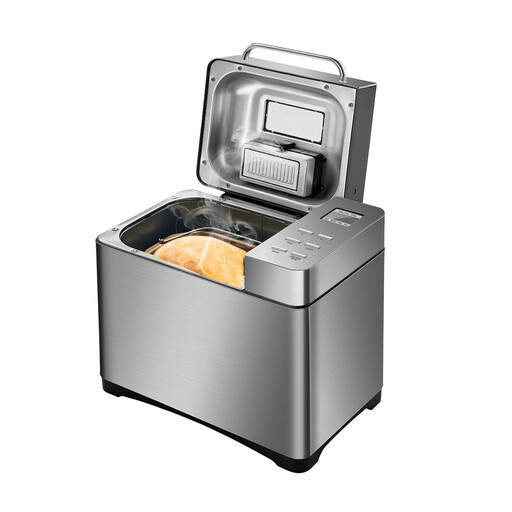
Joybuy bread maker options for smaller loaves at a family gathering.
 No image available
Three loaf sizes and a delay timer give you options when planning your baking time.
The product title lists three browning levels, a 15-hour timer, a 1-hour keep-warm function, a non-stick tin and a capacity of 2.2 lbs.
 No image available
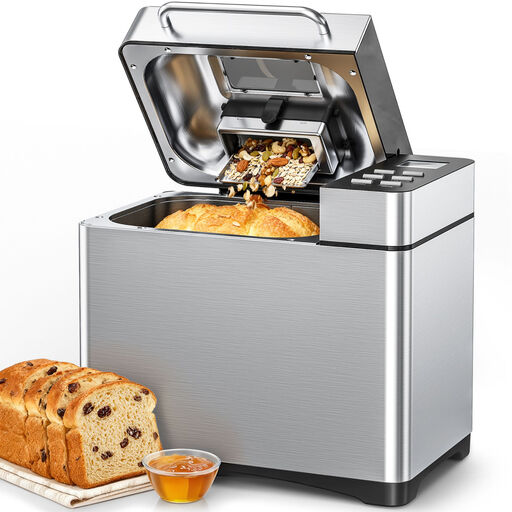
The smallest stated size is 500 g, which is worth noting if you want to vary the amount of bread you make for different gatherings.
This model is listed with three sizes of 500, 750 and 1,000 g, as well as a 15-hour timer. The title also lists 19 programmes, three browning levels and an automatic ingredient dispenser.
 No image available
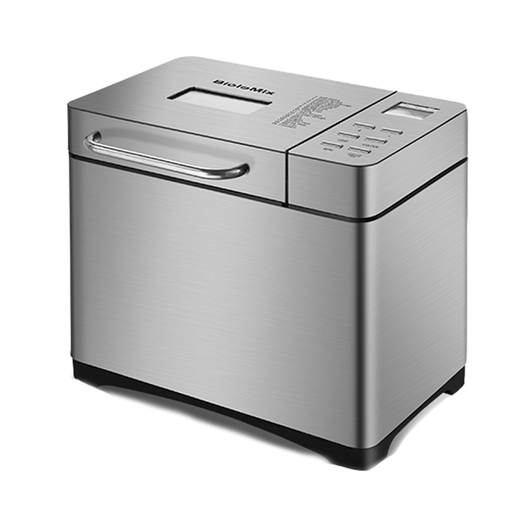
You can factor in the delay timer when planning when to start baking around your family gathering.
The product title lists a 15-hour timer, an automatic ingredient dispenser for fruit and nuts, a 1-hour keep-warm function and a dual-tube baking function.
No. Check the smallest loaf size you can explicitly select. According to the manufacturers, the Tefal PF240E and Unold Backmeister Bernd 68120 start at around 500 g; the Rommelsbacher BA 550 offers selectable sizes of 700 and 900 g, although smaller batches are possible under the stated kneading condition.
Work backwards from your preferred serving time, allowing for the duration of the specific programme, and use the delay timer within the limits of your model. A timer doesn’t replace baking time; in its test updated on 2 November 2026, CHIP says bread makers take several hours to bake a loaf.
No. As well as using a suitable recipe, you need to protect the ingredients and kitchen environment from contamination. The German Coeliac Society highlights the risk of cross-contamination at home.
Check the cleaning instructions for the baking tin and kneading blade on your exact model, and find out whether suitable spare parts are available. If a fault develops, remember that your statutory rights against the seller are separate from any voluntary guarantee; the consumer advice centre also highlights this distinction.
CE marking is compulsory for electrical and electronic equipment covered by the relevant EU rules. It’s a declaration by the manufacturer, not a certificate issued by a central EU testing body, so check the information on the specific item you’re buying. The European Union explains this on its Your Europe information site.
In Germany, waste electrical equipment is collected separately. Local collection points generally accept it free of charge, as the Federal Environment Agency explains.