If you only need a few rolls
If you only need one or two rolls for your next meal, you can buy exactly that amount from the in-store bakery. That way, you won’t be left with an opened pack to store.


If you’re on a tight shopping budget in retirement, choose bread rolls based on how many you usually eat. Buying individual rolls from the in-store bakery suits immediate needs; packs of bake-at-home or frozen rolls can work for planned stock-ups, but they need storage space and an oven. If you need to avoid certain ingredients, check the information for the specific product.
If you only need one or two rolls for your next meal, you can buy exactly that amount from the in-store bakery. That way, you won’t be left with an opened pack to store.
Bake-at-home or frozen rolls are a good option if you’re planning several portions over a longer period and have storage space and an oven. The Verbraucherzentrale (German consumer advice centre) recommends freezing bread and rolls so you can defrost them as needed; also follow the instructions on the individual pack.
What matters is not the variety name but the information for the specific roll. For packaged products, check the ingredients list; for loose products, ask about allergen information at the point of sale.
First decide whether you want to eat the rolls straight away or spread them over several days. Then it’s easier to weigh up pack size, ingredients and the effort involved in baking them.
| What matters to you | What to check when buying | Who it matters most to |
|---|---|---|
| Buying individually to avoid leftovers | When comparing similar rolls, consider the variety, size and number you need. | I only need a few rolls today and don’t want to store the rest of a pack. This immediate, individual need is the main priority for around 36% of shoppers. |
| Stocking up and storage | Match the pack size to how much you plan to eat; check storage and preparation instructions. | If I shop less often, I want to store several portions so I can use them later. Planning ahead this way is the main priority for around 29% of shoppers. |
| Ingredients and allergens | For packaged products, read the ingredients list and allergen information; for loose products, ask specifically. | I need to avoid certain ingredients, so I can’t rely on names such as ‘multigrain’. Clear information about ingredients is the main priority for around 21% of shoppers. |
| Ready to eat or bake at home | Check whether the rolls are ready to eat or need an oven and time to prepare. | What matters to me is being able to eat the rolls without any extra preparation. Keeping everyday effort to a minimum is the priority for around 14% of shoppers. |
Leftover rolls are no use if they go stale before you can eat them or end up being thrown away.
Estimate how many you’ll eat soon. If you plan to freeze portions, make sure you have enough space.
‘Multigrain’ or ‘Kaiser roll’ doesn’t tell you exactly which ingredients and allergens are in a particular product.
Check the allergen information at the point of sale or ask a member of staff before buying a roll that contains ingredients that aren’t suitable for you.
Bake-at-home rolls need to be prepared. For example, REWE says its ja! wheat rolls take around 10 to 12 minutes in a preheated oven; other products may have different instructions.
Read the preparation and storage instructions on the specific pack. If you want to eat the rolls straight away, choose a product that’s ready to eat.
These retailers offer different ways to shop. Check the individual product to see which rolls are available locally and what information applies to them.
REWE sells, among other things, frozen ja! wheat rolls for baking at home.
GUT&GÜNSTIG breakfast rolls are a packaged bake-at-home option.
Lidl showcases its bakery range under ‘Unser Brot’.
ALDI Nord and ALDI SÜD offer individual rolls from their in-store bakeries.
Kamps is an option if you want to buy ready-to-eat rolls from a bakery.
Der Meisterbäcker is a regional bakery option if you’re looking for the baking methods described.
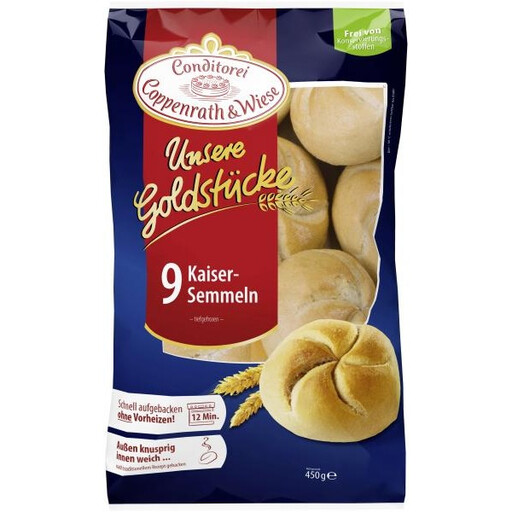
The product below is a pack of Kaiser rolls for a planned stock-up. If you only need individual rolls to eat straight away, this pack size may not be right for you.
 No image available
For a planned stock-up, if you have space in your freezer and an oven. The pack contains 9 rolls weighing 450 g in total; check the ingredients and preparation instructions on the pack before buying.
Ask at the bakery or in-store bakery for allergen information about the specific roll. According to Lebensmittelklarheit, for loose products this information may be available on a sign, noticeboard or in a folder, or from a member of staff.
Keep rolls somewhere dry and out of direct light, or freeze any portions you won’t need. The Verbraucherzentrale advises against keeping bread and rolls in the fridge for everyday storage, as they dry out more quickly there. If baked goods show visible mould, throw the whole item away.
No. The term ‘multigrain’ doesn’t mean that a roll is gluten-free. For packaged rolls, check the ingredients and allergen information; for loose products, ask for details about the specific item.