Short-trip campers without baking equipment
If you need rolls for your first meal, a small quantity of fresh ones is an obvious choice. That way, you won’t need to bring baking equipment or make room for chilled or frozen bake-at-home products.


For a short camping trip without baking equipment, fresh bread rolls make sense in a quantity you can eat soon. Bake-at-home rolls are an option if you can store and prepare them as directed at your campsite. For longer trips, also consider the storage instructions and whether the pack size suits your meals.
If you need rolls for your first meal, a small quantity of fresh ones is an obvious choice. That way, you won’t need to bring baking equipment or make room for chilled or frozen bake-at-home products.
You can plan to have bake-at-home rolls, provided your appliance is suitable for the product you choose and you can follow its storage instructions. Before you shop, work out how many you’ll actually need.
For a trip lasting several days, pack size, storage conditions and instructions for after opening all matter. For packaged products, ingredient and allergen information can also help you choose.
First, decide when you want to eat the rolls and what storage and baking facilities will actually be available at your pitch.
Best for: Travelling or an overnight stay without baking equipment, if you’ll eat the rolls soon.
Consider: They need no preparation, but are less suitable for stocking up in larger quantities.
Best for: When you have a suitable baking appliance and can follow the storage instructions for the specific product.
Consider: Depending on the product, you may need to plan for chilled or frozen storage, as well as the energy required to bake them.
Best for: A longer trip, if the storage instructions and use-by period fit your plans.
Consider: Check how to store them after opening, too; an unopened pack doesn’t tell you what to do once it’s open.
| What matters | What to check when buying | Who it matters to |
|---|---|---|
| Quantity and leftovers | Match the number of rolls and pack size to the meals you have planned. | If I’m only planning a few breakfasts, I don’t want leftover rolls that I can’t store properly. Getting portions right is a priority for around 33% of consumers. |
| Storage and preparation | Read the storage instructions and check whether you’ll need refrigeration, a freezer or a baking appliance. | On a multi-day trip, I need to be able to keep the rolls under the recommended conditions until mealtime. Reliable storage is the main concern for around 45% of consumers. |
| Ingredients and allergens | For packaged products, read the ingredient and allergen information; for loose products, ask the seller. | If someone in our group needs to avoid certain ingredients, I need information about the specific product rather than making assumptions based on its name. Around 22% of consumers put this first when choosing. |
A large pack won’t help you plan your shopping if some of the rolls go stale before you eat them or can’t be stored as directed.
Count the meals you have planned and compare them with the number of rolls in the pack.
Products that must be kept chilled or frozen need to be stored accordingly while you’re travelling and at your pitch.
Check the storage information before buying and only choose products you can keep under the right conditions until you’re ready to prepare them.
Mould can spread through bread and rolls beyond the visible patch. The consumer advice centre therefore recommends throwing away the entire affected product.
Don’t eat mouldy rolls or simply cut off the visible patch.
A roll’s name is no substitute for information about its specific ingredients. The Federal Office of Consumer Protection and Food Safety cites undeclared allergens as one reason for food recalls.
For packaged products, read the allergen information. For loose products, ask for the relevant details before buying.
REWE’s bakery range includes, among other things, wheat rolls and pretzel rolls. For a short camping trip, check which fresh varieties are available at your chosen branch.
EDEKA24 lists packaged varieties of bread and rolls. The EDEKA Herzstücke stone-baked rolls listed there come in a pack of four, weighing 300 g in total.
Lidl describes LIDL Unser Brot as a range of fresh baked goods for immediate consumption.
ALDI SÜD and ALDI Nord list different bake-at-home rolls, including frozen wheat rolls and organic bake-at-home rolls.
This bake-at-home product could suit a camping trip if you have access to a freezer and an oven. Before buying, check that the pack size and storage requirements work for your trip.
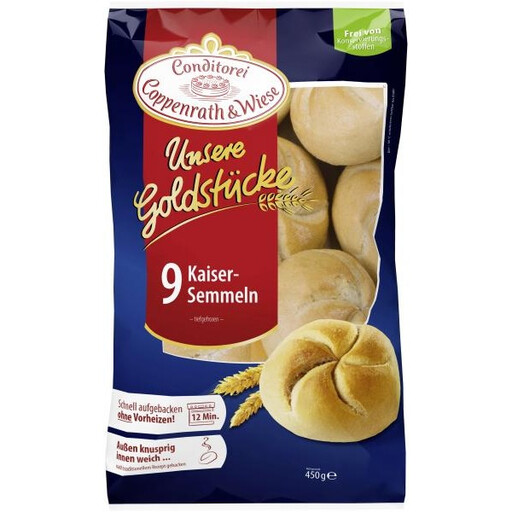 Image unavailable
For camping with reliable freezer access and an oven. Check that you can follow the storage and preparation instructions on the pack.
The pack contains 9 Kaiser rolls, weighing 450 g in total. Match the quantity to the meals you have planned.
Without baking equipment, fresh rolls are more practical if you’ll eat them soon. Bake-at-home rolls are a good fit if you can store the product you choose as directed and prepare it at your campsite. Make sure the quantity suits your meals, too.
According to the consumer advice centre, bread and rolls can generally be stored at room temperature in a dry place away from light. Packaged products may have additional storage instructions, particularly if they need to be kept chilled or frozen.
It depends on the type of roll and how it’s stored; general information about types of bread doesn’t provide a fixed freshness period for individual rolls. Plan to eat fresh rolls soon, and follow the instructions on the pack for packaged products.
Before buying, ask for the allergen information for the specific roll or check the details provided at the point of sale. Don’t rely on the product name or appearance alone.