Hosts who plan their menu carefully
If you’re serving bread rolls with cheese, dips or a starter, you’ll want to choose a type and flavour that complement the other dishes.


For dinner for two, what matters less than the label ‘premium’ is choosing a type of bread roll that suits the menu and can be served at the right time. If you shop shortly before dinner, you’ll save time at the oven; bake-at-home rolls, on the other hand, can be prepared just before you eat. Check the ingredients and allergens for every type you choose.
If you’re serving bread rolls with cheese, dips or a starter, you’ll want to choose a type and flavour that complement the other dishes.
You want to prepare the rolls just before dinner and can fit the oven and baking time into your plans.
If either of you needs to avoid allergens, check the information for each type particularly carefully – even when buying loose rolls.
A good choice if: You’re shopping shortly before dinner and don’t want to plan for oven time at home.
Things to consider: The type of roll and when it was baked depend on the store. ALDI Nord and ALDI SÜD describe baked goods prepared several times a day, but don’t guarantee that a particular type will be available.
A good choice if: You have an oven free and can prepare the rolls just before serving.
Things to consider: Preheating and baking take time. EDEKA gives a finishing time of 8–10 minutes for its GUT&GÜNSTIG breakfast rolls; follow the pack instructions for other products.
A good choice if: A particular type of roll or its stated method of preparation is part of your menu plans, and there’s a suitable bakery nearby.
Things to consider: Information about how the dough is made applies to that particular bakery and, on its own, isn’t proof of better flavour.
| What to consider | What to check | Who it matters to |
|---|---|---|
| Pairing with the menu | Choose a type that goes with the dishes you’ve planned; check the ingredients in varieties containing nuts, seeds or cheese. | With delicate spreads, I want a roll whose flavour won’t overpower everything else. Around 36% of consumers would put matching the rolls to the menu first. |
| Serving time | Plan your shopping or preparation backwards from mealtime; follow the pack instructions for bake-at-home rolls. | If the rolls need to be ready when I’m plating up, I have to allow time for the oven or a trip to the shops. Around 29% of consumers would prioritise serving time. |
| Ingredients and allergens | For packaged products, read the current labelling; for loose rolls, ask for information about the specific type. | If a guest needs to avoid certain ingredients, I need reliable information rather than guessing from the name of the roll. Around 21% of consumers would make this their first consideration. |
| Quantity | Compare the number of rolls and pack size with what two people need. | For our dinner, I don’t want to buy far more rolls than we’ve planned for. Around 14% of consumers would put getting the right quantity first. |
The label doesn’t tell you whether the flavour, crust and ingredients will suit your menu.
First decide what you’ll serve the rolls with, then look at the specific type and its ingredients.
The time between shopping and eating can affect how fresh the rolls are when you serve them.
Shop as close to mealtime as you can, or prepare bake-at-home rolls according to the pack instructions. For storage, the Verbraucherzentrale recommends keeping them at room temperature in a dry place away from light.
With varieties containing seeds, nuts or cheese in particular, the name alone isn’t enough to tell you what’s in the specific product.
Check the packaging or, for loose rolls, ask for allergen information about the type you’ve chosen.
REWE shows its range by location, EDEKA points out that ranges vary between stores, and Kamps lists specific delivery areas.
Before setting a dinner date, check that the type you want is available at your chosen shop or in the relevant delivery area.
A possible place to shop if you want to check the range available at your local store in advance.
A place to find packaged bake-at-home rolls with product-specific information.
A bakery range available to shop in store.
In-store bakery ranges that depend on the retailer and individual store.
A bakery that delivers to certain areas.
A regional bakery for shoppers interested in its stated methods of preparation.
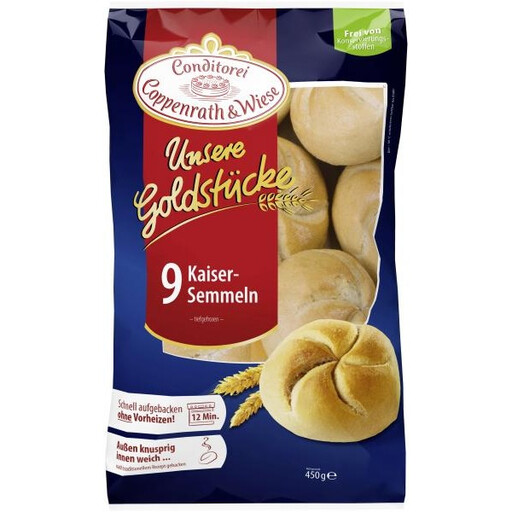
These bake-at-home rolls could work for dinner if you’re planning to use the oven and a pack of nine Kaiser rolls is the right size for you.
 No image available
For hosts who want to bake Kaiser rolls in the oven for dinner. The pack contains 9 rolls weighing 450 g in total; check the pack instructions before baking, and the ingredient and allergen information before serving.
Allergenic ingredients must also be identified for loose bread rolls. The Federal Ministry of Agriculture, Food and Home Affairs and the Lower Saxony State Office for Consumer Protection and Food Safety explain the labelling requirements; ask at the point of sale for information about the specific type.
Allow time for the oven and preheating according to the instructions on the pack of rolls you’ve chosen. EDEKA gives a finishing time of 8–10 minutes for its GUT&GÜNSTIG breakfast rolls; don’t assume the same applies to other types.
Until then, keep them at room temperature in a dry place away from light, as the Verbraucherzentrale recommends for bread and rolls. If you want a particular type of crust, also factor in the time between buying or preparing the rolls and serving them.
No. Kamps lists specific delivery areas, including parts of Berlin, Düsseldorf and Krefeld. Check whether delivery is available to your planned location using your address.
The label alone doesn’t tell you whether you’ll like a particular type or whether it will suit your menu. Instead, compare the type of roll and its ingredients, then decide when you’d like to serve it.