What to consider when buying
For school mornings, first decide whether you want to keep a stock or buy rolls for the same day. Then check that the quantity, preparation method and ingredients suit your needs.
Long-life bake-at-home rolls
A good choice if: You need a few rolls on several days and have an oven available.
Bear in mind: The pack size needs to match how many you’ll use, and you’ll need time in the morning to bake them.
Frozen bake-at-home rolls
A good choice if: Your needs vary from day to day and you want to take out only as many rolls as you need.
Bear in mind: You’ll need space in the freezer, and the rolls must be prepared according to the pack instructions.
Fresh rolls bought individually
A good choice if: You know how many you need for the day or don’t want to use the oven in the morning.
Bear in mind: Buying them needs to fit into your daily routine; plan to use any leftovers soon.
| Criteria |
What to check when buying |
Who it matters to |
| Quantity and leftovers |
Number of rolls, needs over several days and space for freezing. |
If we only have a few breakfasts planned, I don’t want to buy more rolls than we can use. Around 36% of consumers prioritise getting the right quantity. |
| Time in the morning |
Baking time, oven settings and whether preheating is needed, as stated on the pack. |
Breakfast needs to fit into the morning routine before school. Around 29% of consumers focus first on how much time preparation will take. |
| Choosing wholemeal |
Product name and ingredients list, rather than colour or a coating of seeds alone. |
I’m specifically looking for wholemeal rolls and don’t want to rely on a hearty appearance. This choice is a priority for around 21% of consumers. |
| Ingredients and allergens |
Allergen information; for loose bakery products, also check information about possible cross-contamination. |
If certain ingredients need to be avoided, I need reliable information about the specific product. For around 14% of consumers, this check is their main buying criterion. |
Frozen bread rolls at Joybuy
These rolls are worth considering if you have a freezer and an oven, and want to keep a stock that matches your actual needs. When choosing between the packs, pay particular attention to the stated quantity and the ingredients of each variety.
 No image available
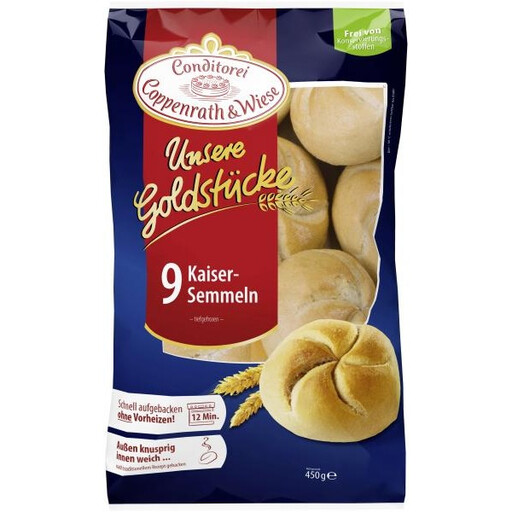
Coppenrath & Wiese Our Gold Pieces Kaiser rolls, 9 pieces, 450 g
A frozen stock of bread rolls, if nine pieces suits your planned use. The product name states that the pack contains 450 g; check the preparation and allergen information for the specific product before a school morning.
View at Joybuy
 No image available
Coppenrath & Wiese Unsere Goldstücke multigrain rolls, 300 g
A frozen multigrain option for households that want to take seeds and different types of grain into account when choosing. The product name states that the pack contains 300 g; “multigrain” alone doesn’t indicate a wholemeal content. Before buying, check the number of rolls, ingredients and allergen information, as well as the preparation instructions.
View at Joybuy
Frequently asked questions
Are bake-at-home or fresh rolls better if I want to avoid leftovers?
Neither option automatically avoids leftovers: what matters is how many rolls you actually need. Small bake-at-home packs, frozen rolls taken out in portions or buying exactly the number of fresh rolls you need can all work. The Verbraucherzentrale lists freezing as a way to keep leftover rolls for later.
How long do bake-at-home rolls take on a school morning?
Follow the preparation instructions for the specific product. EDEKA gives a baking time of 8–10 minutes for its baguette rolls; also check whether your oven needs preheating and when the rolls will be ready to eat after baking.
Does gluten-containing cereal need to be listed for bread rolls?
Yes. Gluten-containing cereals are among the allergens that must be declared under Annex II of the EU Food Information Regulation. For packaged rolls, check the ingredients list and highlighted allergens; for loose bakery products, use the allergen information provided or ask for details. If you need to avoid gluten, don’t assume standard wheat or spelt rolls are suitable based on their name alone.
Is a multigrain roll automatically a wholemeal roll?
No. “Multigrain” doesn’t indicate a particular wholemeal content. If you specifically want to buy wholemeal rolls, check the product name and ingredients list rather than relying on the colour or seeds on top.
Can I still use packaged rolls after their best-before date?
A passed best-before date doesn’t automatically mean that the rolls can no longer be eaten. According to the Verbraucherzentrale, food may still be safe to eat after this date if the packaging is unopened and it has been stored correctly. So check the storage instructions and the condition of the product. Mouldy rolls should not be eaten.


