For homemade bread with a firm crust, a serrated blade is a sensible place to start; GRAEF recommends its serrated blade for crusty loaves. Choose a thickness setting that suits the slices you want, and check that the loaf, support and carriage are compatible. If you’re cutting several slices, also check the operating and cleaning instructions. If space is tight, compare the dimensions when in use and when folded.
Who is a bread slicer suitable for?
Anyone who bakes crusty bread
If you’ve baked a loaf at home, you’ll want to slice it to your preferred thickness, even when it has a firm crust. Check the blade type, thickness settings and how securely the loaf can be guided. GRAEF recommends its serrated blade for hard bread crusts.
Hosts preparing a shared meal
If you’re slicing several portions, it’s important to guide the loaf steadily and follow the instructions for your specific model. Remember to plan for cleaning, too: the German Federal Institute for Risk Assessment advises avoiding the transfer of germs between foods.
Occasional bakers with limited storage space
If you only use your slicer now and then, compare its folded dimensions with your available storage space, while also allowing enough room to use it. For the ritter icaro 7, the manufacturer gives a width of 10 cm when folded; SEVERIN describes the AS 3912 as having a folding base plate.
What should you look for when buying one?
| Buying priority |
What to check |
Who is most concerned |
| Slicing crusty bread |
Check the blade type, adjustment range, loaf support and carriage travel for the exact model. |
If I’m slicing a loaf with a firm crust, I want to set the slice thickness to suit and guide the bread securely. Around 36% of consumers prioritise how bread is sliced and the thickness they want. |
| Preparing several slices |
Check the food holder, switch, stability, working space and the model’s operating instructions. |
When preparing several portions, I want to guide the loaf steadily and follow the operating instructions, rather than assume the slicer can run continuously. Around 29% of consumers prioritise preparing a large number of slices safely. |
| Cleaning surfaces that come into contact with food |
Check which parts can be removed and how the blade, carriage and contact surfaces should be cleaned according to the instructions. |
After a meal, I want to be able to reach any food residue easily and clean the contact surfaces as instructed, especially if I use the appliance for other foods too. Around 21% of consumers put cleaning at the top of their list when buying. |
| Storing the appliance |
Compare the folded and in-use dimensions separately, and allow space for the carriage to move. |
If I only need the slicer occasionally, I want to store it without taking up too much room, while still allowing enough worktop space to use it. Around 14% of consumers consider storage their top buying priority. |
Avoid common assumptions
-
A high wattage alone tells you little about how well it slices bread
The rated power doesn’t show how well a particular homemade loaf will slice. The blade, the way the loaf is guided and your preferred slice thickness also matter when choosing a model.
Start by comparing the blade type, how securely the loaf can be guided and the adjustment range. Treat wattage as one of several specifications.
-
Folded dimensions don’t show how much space you’ll need to use it
Even when folded, an appliance needs room in use for the loaf, the carriage to move and the sliced bread.
Measure your work area and compare the in-use and folded dimensions separately.
-
Blade specifications don’t automatically apply to every model in a brand’s range
Manufacturers describe different blades and compatibility. A specification for an accessory doesn’t prove that it comes with every model variant.
Check the full model name, the blade included and any explicitly stated compatibility.
Key brands at a glance
ritter
Worth considering if you’re looking for a countertop model or a folding slicer with a serrated blade.
- ritter lists a serrated blade for the E 16, icaro 7 and markant 7. The stated slice thickness goes up to around 20 mm for the E 16, around 14 mm for the icaro 7 and around 15 mm for the markant 7.
- The adjustment ranges and designs vary. The manufacturer’s blade and slice-thickness specifications don’t demonstrate how well each model will slice your bread in comparison with the others.
GRAEF
An option if you want to compare blade types specifically for crusty bread or finer sliced foods.
- GRAEF recommends its serrated blade for bread with a hard crust, and lists the G52 and STYLE S10005 among the compatible models.
- For the separately described Master M20, GRAEF specifies a smooth blade. This specification shouldn’t be assumed to apply to other GRAEF models.
SEVERIN
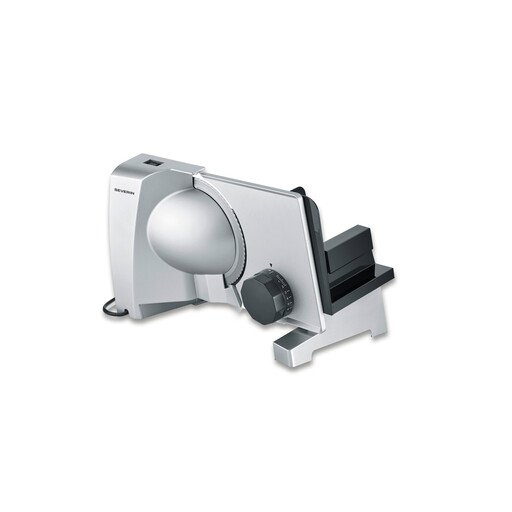
The AS 3912 is worth considering if you’re looking for a folding base plate and cord storage.
- SEVERIN specifies a slice thickness of 0–15 mm and a folding base plate for this model.
- The manufacturer’s specifications don’t show how it will slice your particular crusty loaf. Check that the features suit your loaf and preferred slice thickness.
UNOLD
The Curve model is a folding option if suitability for bread and a food holder are important to your choice.
- For the Curve White 78860, UNOLD specifies a removable serrated blade measuring around 17 cm, a slice-thickness setting from 0 to around 15 mm, and a food holder with finger guard.
- These specifications apply to the Curve model described and not necessarily to every UNOLD appliance.
Joybuy products for bread and storage
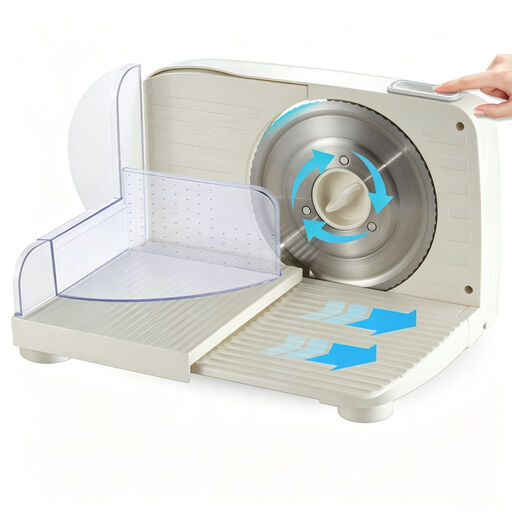
The following Joybuy products are folding food slicers or appliances for bread with adjustable slice thickness. Compare the blade type, operation and cleaning information with your bread and how you plan to use the appliance.
 No image available
Electric food slicer, 0–15 mm, folding
The folding design may suit you if you want to put the appliance away after slicing; remember to check how much space it needs when in use, too.
Adjustable slice thickness: 0–15 mm. The product information lists a stainless steel blade, a food holder and a safety cover.
View at Joybuy
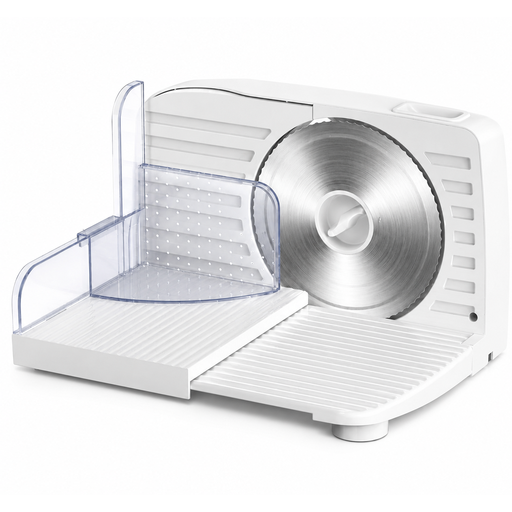
 No image available
Electric food slicer, 250 W, 2 blades
If you want to slice bread and remove the blades and cutting surface for cleaning, check that these features suit the way you plan to use it.
Adjustable slice thickness: 0–15 mm. The product information lists two 17 cm-diameter blades, including a serrated blade, as well as a folding design.
Other listed features include a safety switch, finger guard and non-slip feet.
View at Joybuy
 No image available
Electric bread slicer, 250 W, 0–15 mm
The serrated blade listed is relevant for homemade bread; check that the adjustment range suits the thickness of slice you want.
Adjustable slice thickness: 0–15 mm. The product information lists a 17 cm serrated blade and an additional blade.
The appliance is described as foldable; according to the product information, the blade and cutting surface can be removed. Other listed features include a safety switch, finger guard and non-slip feet.
View at Joybuy
 No image available
SEVERIN AS 3917, 130 W, 0–23 mm
The product information says this model is suitable for bread and cold meats. Check that its adjustment range suits the slices you want from your loaf.
Adjustable slice thickness: 0–23 mm. The product information lists a removable blade and removable food tray.
The product is described as having a metal housing and a 130 W motor.
View at Joybuy
 No image available
YASHE SL-5801D23B3, 180 W, folding
If you want to put your slicer away after use, its folding design is worth considering. Also check that you have enough room to use it.
Adjustable slice thickness: 0–15 mm. The product information lists a 17 cm serrated blade and an output of 180 W.
Other listed features include a safety switch, food holder and integrated cord storage. The product information also says the blade and cutting surface can be removed.
View at Joybuy
Frequently asked questions
Which type of blade should I look at first for bread with a firm crust?
A serrated blade is a sensible place to start: GRAEF specifically recommends its compatible serrated blade for bread with a hard crust. Check which blade comes with the exact model you’re considering; the manufacturer’s recommendation doesn’t guarantee a particular result with your loaf.
Can I remove the blade for cleaning straight after slicing?
Follow the instructions for your specific appliance and unplug it before cleaning. ritter requires this for the E 16 before dismantling or cleaning it; the manufacturer says the blade and carriage can be removed from the icaro 7. Handle the sharp blade with care.
What should I bear in mind when slicing lots of slices one after another?
Check the operating instructions for the specific model rather than assuming it can run continuously without a limit. For the ritter E 16, the manufacturer specifies ‘KB 5 min.’; this doesn’t establish a limit for other appliances.
Are a guarantee and statutory rights the same thing?
No. The Verbraucherzentrale distinguishes statutory rights against the seller when goods are faulty from a guarantee, which is an additional voluntary service with its own terms. If a guarantee is advertised, check which parts and situations it covers.
What does the CE marking mean on an electric food slicer?
The CE marking relates to the relevant EU requirements that apply to the product. Your Europe notes that the manufacturer is responsible for compliance; the marking isn’t an independent test result for slicing performance.


