What should you look for when buying?
First, check that the blade and support suit your bread. Then consider the space it takes up, how it operates and how easy it is to clean for everyday shared use.
| What matters |
What to check before buying |
Who is this important to? |
| Slicing crusty bread |
Check the blade type and usable support or carriage travel against the bread you plan to slice. |
I want to guide firm loaves evenly and set the slice thickness to suit. This is the main consideration for around 31% of consumers. |
| Shared use |
Check the safety features and switch on the specific model, and keep the instruction manual somewhere easy to find. |
When several people use the slicer, I want everyone to understand the switches and safety features. Around 25% of consumers prioritise safe operation. |
| Space and storage |
Measure the space needed in use, the folded dimensions and the room needed for the carriage separately. |
I need to clear the shared worktop after slicing and have somewhere suitable to store the slicer. This is the main consideration for around 25% of consumers. |
| Cleaning between uses |
Check which parts can be removed and what cleaning steps are specified in the instruction manual. |
After shared use, I want to be able to reach crumbs and residue easily. Around 19% of consumers put easy cleaning first. |
Food slicers on Joybuy
The product options below include folding slicers and models whose product details mention a carriage. Before buying, check that the blade, support and operation suit your bread and shared kitchen.
 No image available
Electric food slicer, folding, 0–15 mm
The folding design could suit a kitchen where you need to clear the worktop after slicing; check that the support suits your loaf.
Listed in the product name: slice thickness of 0–15 mm and a stainless steel blade.
View on Joybuy
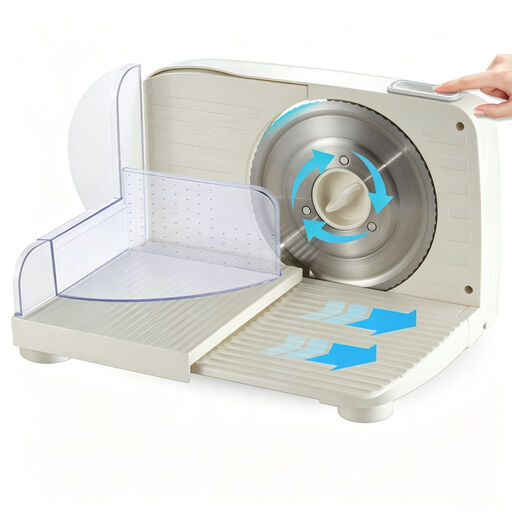 No image available
Electric bread slicer, 250 W, 2 blades
According to the product details, the slicer is designed for bread and folds away; check that the support and blade suit your crusty loaf.
Listed in the product name: 250 W, two blades and a slice thickness of 0 to 15 mm. The product details say the model is intended for home use.
View on Joybuy
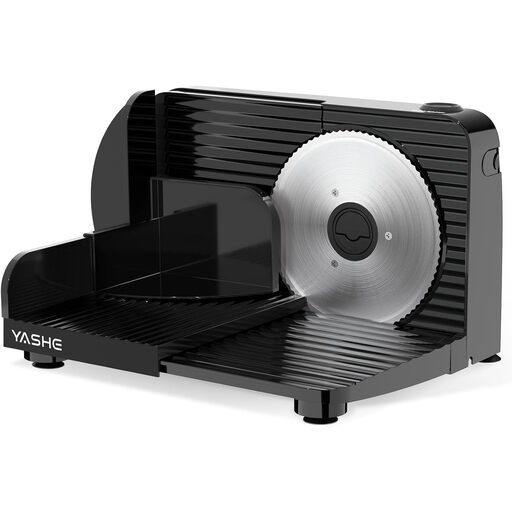 No image available
YASHE SL-5801D23B3, folding food slicer
The folding design may suit you if you want to put the slicer away after use; compare its dimensions both set up and folded with the space you have available.
Listed in the product name: 180 W, 17 cm stainless steel blade and slice thickness of 0 to 15 mm; black.
View on Joybuy
 No image available
Ritter Serano⁷ Professional
If you slice bread frequently, check that the guide and support suit your bread and the space where you plan to use the slicer.
View on Joybuy
 No image available
Ritter Sono¹ food slicer
The removable carriage can make the slicer easier to access when cleaning; follow the instructions for the specific model.
View on Joybuy
Frequently asked questions
How can I check whether a large loaf will fit on a food slicer?
Compare the width and shape of your bread with the support and usable carriage travel of the specific model. For example, Graef says the G50 can accommodate loaves up to 22 cm wide when the carriage is fitted; this is not a general limit for food slicers.
What should everyone remember when cleaning the slicer after use?
Agree on a shared cleaning routine based on the instructions for the specific model. For the Ritter Sono 2, Ritter recommends switching off the slicer, unplugging it and setting the slice thickness to 0 before cleaning. Ritter also warns that the circular blade may continue running after the slicer is switched off. The Verbraucherzentrale recommends cleaning kitchen utensils between tasks.
Are a guarantee and statutory warranty the same thing?
No. Statutory warranty rights relate to faults and are claims against the seller; a guarantee is an additional voluntary service with its own terms. The Verbraucherzentrale recommends keeping the two separate. Also check whether spare parts or a repair service are available for your specific model.
Is the GS mark compulsory when buying in Germany?
No, the GS mark is not a general requirement when buying. Electrical equipment covered by the Low Voltage Directive – 50 to 1,000 V AC or 75 to 1,500 V DC – must meet the relevant EU requirements, including CE marking, as explained by EUR-Lex. The Federal Institute for Occupational Safety and Health makes clear that the GS mark says nothing about performance or service life; no mark proves that a particular slicer is suitable for your bread.
What should you do with an old electric food slicer?
Check whether you can return it as waste electrical equipment. Stiftung ear explains that retailers with a take-back obligation must offer free one-for-one take-back when you buy a device of the same type. The take-back obligation depends, among other things, on the type and size of the retailer.


